Four-character rhythm makes phrases such as “favor passage into Wealth territory” or “most fear punishment and clash” easy to remember. But in our selections, premises are already printed in the preceding group. The first risk is the reader cutting them away in memory, rather than assuming that the four-word form has removed every condition. Brevity and unconditionality are different properties.
In the Qin Shen'an/Wenming witness, NLC42998, juan 12, Siyan dubu begins independently on scan 338, printed 41, and continues through scan 341, printed 44. Wuyan dubu begins separately on scan 342, printed 45. The upper-right prose on 338 still belongs to the preceding Sousui ge and cannot be borrowed as a Four-word gloss.[1–3] The object's 1926 date is catalogue dating, without an independently inspected imprint; the unresolved 1578 mirror is not substituted.[6]
Four groups, sixteen characters, two premises
One continuous passage on scan 339, printed 42, reads “印殺比肩,喜行財鄉。印殺無比,忌見財傷.”[2] The selection contains four groups of four characters, sixteen characters total. Punctuation and regrouping are ours. This location prints 殺, retained even though other passages use 煞.
A reading translation keeps the sequence: Seal, Killing and Peer precede favoring passage into Wealth territory; Seal and Killing with wu-bi precede avoiding Wealth's injury. The first and third groups introduce differing configurations before their respective favorable and unfavorable expressions. Quoting only the second and fourth creates apparently contradictory judgments about Wealth while hiding their entrances.
Wu-bi, “無比,” must also remain visible. This source does not print the familiar alternative “印無比肩,畏行財鄉.” In light of the preceding Peer term, we can explore absence of the corresponding peer-type support as a contextual reading direction. That is a bounded interpretation, not permission to expand the ancient quotation into “without Peer” and call it a verbatim transcription. Its application still needs questions about object and qualification.
Favoring passage and avoiding injury are different expressions
The first pair says “行財鄉,” an expression of passage into a Wealth territory or cycle setting. The second says “見財傷,” explicitly including Wealth's injurious operation. A two-column “Wealth good/Wealth bad” table drops both the premises and the operations. Even an accessible modern summary should retain what Wealth acts upon and the entrance in which it appears.
These verbs alone do not establish a precise whole-book algorithm dividing natal configuration from cycle effects. We can verify the difference in wording and the explicit injury in the second half. Both merit recording; one universal label should not erase them. A short phrase cannot generate every application boundary by itself.
| Four-character group | Task within this passage | How to retain it |
|---|---|---|
| Seal–Killing–Peer | First configuration entrance | Keep with favorable Wealth passage |
| Favor Wealth territory | First tendency, expressed through passage | Retain its premise; no unconditional benefit |
| Seal–Killing–wu-bi | Different entrance; compressed term needs checking | Preserve wording rather than substitute a familiar alternative |
| Avoid Wealth injury | Second tendency and damaging operation | Retain the object question; no inevitable harm whenever Wealth appears |
Return to Seal prose: what is Wealth damaging?
In juan 5, Lun yinshou, scan 91, printed 32, discusses the phase that generates the self and protection of Officer. It says “忌財星,以財能破印”: avoid Wealth because Wealth can break Seal. The same page also retains a different qualification involving original Wealth damage, a Peer/Rob Wealth cycle and personal strength. It is not an exceptionless prohibition.[4]
Placing that prose beside the four-word passage raises questions: which kind of Seal is Wealth acting upon; why is Seal useful here; and what peer support, strength or cycle qualifications apply? These are our return-reading questions. We have not found this prose printed as an independent annotation below the Four-word title, and we do not declare every condition in juan 5 the mnemonic's sole necessary explanation.
The connection preserves kinds of questions rather than making two passages exactly equivalent. A card that treats every Wealth as breaking Seal merely because it sees the word Seal overlooks direct/indirect distinction, the operation chain and the prose's reverse qualifications. The Four-word passage's Killing and Peer terms must not quietly disappear during the return reading.
Return to Inverted Food: Wealth enters another chain
Lun daoshi, scan 97, printed 38, first explains a Food–Wealth–Officer generating chain, then considers Indirect Seal hindering Food and exceptions through control or combination. It also retains the entrance in which no Food is present and the factor is considered only as Indirect Seal. The ending explicitly says “古詩云,” an ancient poem says, followed by four continuous lines: “印星偏者是梟神,柱內最喜見財星。身旺遇此方為福,身衰梟旺更無情.”[5]
The poem calls Indirect Seal the Owl and favors encountering Wealth, then qualifies benefit through personal strength; weakness with a flourishing Owl receives a different judgment. Quoting only its second line creates unconditional approval of Wealth. Its third and fourth preserve the contrast. Fortune and “without feeling” are historical evaluative language here, not our judgments about an actual person's happiness or family affection.
Wealth in the Seal and Inverted Food discussions cannot therefore be compared through one good/bad word. One entrance concerns Wealth breaking useful Seal; the other concerns Indirect Seal's obstruction of Food, control or combination, and strength qualifications. These objects and conditions guide our return to the four-word passage. They do not prove that every Seal–Killing configuration automatically takes the same explanation.
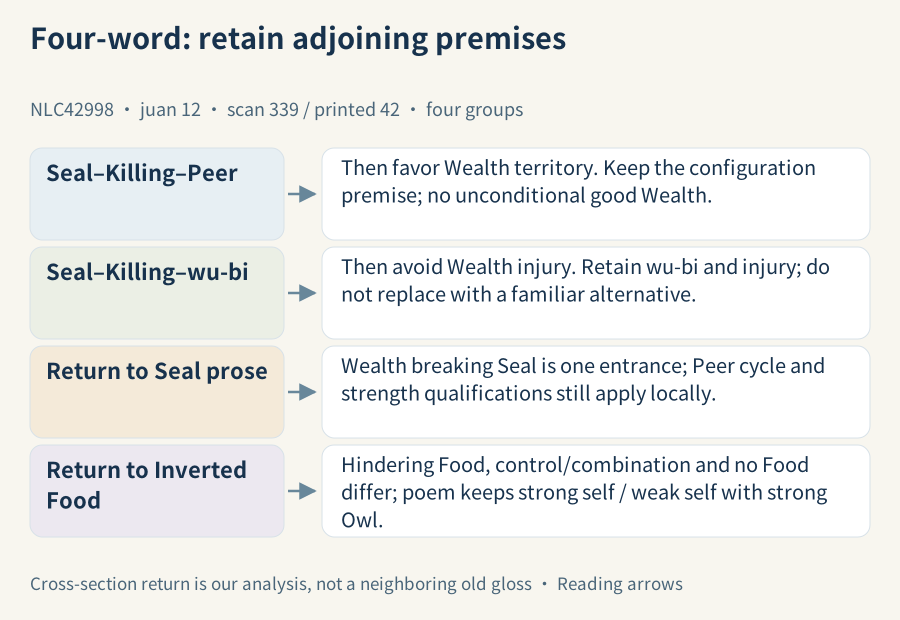
The complete figure is shown below. Select it to enlarge the labels. Open full-size figure · PNG
Even “most fear” has an object
Another continuous selection after the title on scan 338 reads “提綱有用,最怕刑衝。衝運則緩,衝用則凶”: when the organizing guide has a use, punishment and clash are most feared; clash of the cycle is milder, clash of what is used is unfavorable.[1] It does not simply say “most fear clash.” A useful organizing guide precedes the fear, and different objects precede different degrees.
We do not derive a mechanical list of all punishments and clashes or fill in fixed branch positions from modern habit. This is another checkable example: regular rhythm can still preserve object, qualification and turn, provided the reader retains adjoining groups.
Expand without inventing an old gloss
An expansion card can use three lines: the complete printed passage; objects and qualifications worth checking in related prose; and the questions still open in our analysis. The application of wu-bi, the target of Wealth's injury and the range of the cycle expression can occupy the third line. A question mark is more accurate than an unsupported universal rule.
Record section boundaries as well. The preceding Sousui prose is not a Four-word annotation, and material after the Five-word title does not belong retrospectively to Four-word. This phase's Yuanli genuinely has composition and explanation bylines; mere proximity in juan 12 does not make this mnemonic a formula explicitly glossed by Wan.
Four-word form preserves compact relationships; memory becomes risky when only tendency words survive. Our analysis restores premise, operation and object, identifying cross-section return reading as original analysis. The diagram is not a facsimile or complete collation. Seal, Killing, Wealth and fortune belong to historical textual argument here, without assertions about actual birth charts, wealth, health or life outcomes.
Sources and further reading
NLC42998, juan 12, scan 338, printed 41: Four-word title and the organizing-guide/clash passage; preceding prose belongs to Sousui ge. View the opening
Scan 339, printed 42: the four actual Seal–Killing–Peer/wu-bi groups. 殺, 無比 and 忌見財傷 are retained; punctuation and regrouping are ours. View the selection
Four-word continues through scan 341, printed 44; scan 342, printed 45 separately starts Five-word.
Juan 5, Lun yinshou, scan 91, printed 32: Wealth breaking Seal and reverse qualifications. View the prose
Lun daoshi, scan 97, printed 38: operation chain, control/combination and absent-Food entrances, and the attributed poem. This return reading is not a neighboring Four-word gloss. View prose and poem
The 1926 date is catalogue dating, not an independently inspected imprint. View the record
For fuller chains, see Seal and Inverted Food. Return to this phase, or continue to Comparing differences and keeping a source index.
Evidence and source roles
These roles distinguish ancient text, older commentary, historical scholarship and tool reproduction. The numbered notes in the article retain the precise scan pages and explanations. Library and academic sources do not endorse predictive claims.
- SM4-P10 · Ancient text evidence: 四言獨步:起题及提纲组
Text layer in the witness: Independent 四言 title after previous 搜髓歌 prose ending; four-character groups - SM4-P11 · Ancient text evidence: 四言獨步:印殺条件组
Text layer in the witness: Four actual groups of four characters, sixteen characters total; punctuation/regrouping ours - SM4-P12 · Ancient text evidence: 四言/五言篇界
Text layer in the witness: Independent next title; preceding four-word section ends on prior scan - SM4-P13 · Ancient text evidence: 論印綬:财破印与反向资格
Text layer in the witness: Main prose; chapter title begins at scan90/31 end - SM4-P14 · Ancient text evidence: 論倒食:作用链及古诗
Text layer in the witness: Main prose and explicitly introduced 古詩云 voice, distinct - SM4-B01 · Library catalogue fields imported by Commons: Qin Shen’an corrected / Wenming Sanming tonghui, NLC42998, catalogued 1926; independent 1926 imprint not inspected