A compilation can preserve different lookup methods while also calling the same factor favorable or unfavorable in different relationships. Neither difference should be dismissed automatically as contradiction, and neither can always be reconciled by adding a condition. Closing our Sanming tonghui reading means first identifying whether we compare method, object, qualification or an attributed assessment. The conclusion should retain the kind of evidence actually obtained.
We return to two previously read locations: minor cycles in Qin/Wenming NLC94145, juan 2, and Seal/Inverted Food in NLC42998, juan 5. We also read the Siku assessors' comments. Both Qin objects are catalogued as 1926 without independently inspected imprints. Siku scan numbers and printed leaves are recorded separately, not transferred from Qin.[1–9] The proposed 1578 mirror's identity remains unresolved.
First kind: one section actually lists different starts
In Lun xiaoyun, NLC94145 scan 119, printed 41, “小運一年一換。古人以男起丙寅,女起壬申” describes annual change and an ancient method with male Bing–Yin and female Ren–Shen starts. The excerpt ends at Ren–Shen, without supplying the following unsettled question wording. Scan 120, printed 42, continues with “醉醒子以為男女小運皆由時生而行之,逆順亦以年定陰陽”: Zuixingzi considers minor cycles to proceed from the birth hour for both sexes, with direction determined through the year's Yin–Yang.[1–2]
The first account uses fixed starting pairs; the second starts from the hour and explicitly attributes its account to Zuixingzi. The passage does not combine those starts into one procedure. A comparison can retain the ancient-method label and Zuixingzi attribution, recording start and directional reference separately. Taking the fixed pair as a default and the hour as a supplementary input does not establish that the methods have been unified.
Adding personal strength does not remove this difference. It concerns calculation input and attribution. A modern tool selecting one method should separately state its choice and implementation conventions. We build no new algorithm here, calculate no real birth under both methods, and use no unavailable outcome evidence to decide which is correct. Historical sex categories are described as part of the text's method rather than evaluated as values.
Second kind: Wealth acts upon different objects
In Lun yinshou, NLC42998 scan 91, printed 32, “忌財星,以財能破印” avoids Wealth because it can break Seal. The same page retains reverse qualifications involving original Wealth damage, Peer/Rob Wealth cycles and strength.[3] Lun daoshi, scan 97, printed 38, discusses Indirect Seal hindering Food, control/combination exceptions, and the entrance with no Food where the factor is treated only as Indirect Seal. Its ending introduces an ancient poem: “印星偏者是梟神,柱內最喜見財星。身旺遇此方為福,身衰梟旺更無情.”[4]
The poem identifies Indirect Seal with Owl, favors Wealth, then distinguishes strength from weakness with a flourishing Owl. Quoting only Wealth avoidance and Wealth approval makes two passages seem to answer an identical question in opposite ways. Returning to the prose shows different relationships: useful Seal being damaged versus Indirect Seal hindering Food, with control, combination and strength qualifications. An identical factor name does not establish an identical object or task.
This distinction explains why objects and qualifications must be checked first. It does not prove perfect harmony under every possible configuration. The application of the four-word wu-bi and some example connections still need local interpretation; unresolved points remain. But this is a different problem from two minor-cycle starts. Wealth–Seal relationships should not become two interchangeable parameter settings, and two starting methods should not become mere favorable/unfavorable conditions of one method.
| Comparison | Difference actually obtained | What the conclusion retains |
|---|---|---|
| Minor cycles, scans 119/120 | Fixed pairs versus hour start; ancient-method/Zuixingzi labels | Distinct starts and references, without one fabricated procedure |
| Seal 91 / Inverted Food 97 | Object, chain, strength and poem qualifications | Each entrance and voice, without universally good/bad Wealth |
| Siku assessment | Different judgments of collection and partiality | Assessor and inspected-copy scope, not scientific validation |
Read both praise and reservation in the Siku assessment
The Siku Sanming tonghui assessment, scans 3–6, begins “臣等謹案,” marking the court assessors' voice. Scan 3 is printed assessment leaf 1, scan 4 its continuation verso; scan 5 is printed leaf 2 and scan 6 its continuation and submission signatures.[5–7] The assessment praises collecting diverse statements and obtaining their essential points, “皆能採撮羣言,得其精要,” but subsequently criticizes a partial viewpoint as incompletely comprehensive, “其偏執之見,未能圓徹.”[6] These are neither unconditional official approval nor complete rejection.
They supply evidence of reception: how the assessors regarded gathering multiple accounts and certain partial preferences, and how they expected readers to grasp the broader sense and adapt. They do not give a formula scientific authority or establish independent verification of every example's birth inputs and outcomes. We retain assessor identity and statement scope rather than deriving predictive validity from official sponsorship.
Scan 4 says later commercial printings introduced material and were no longer the original text, “後來坊刻所攙入,亦已非原本之舊.”[5] This is the assessors' judgment about the material before them. It raises a transmission question but cannot by itself date the Qin witness's Li Gang example, a particular double-line explanation or every mnemonic. Dating a specific addition requires that passage's own witness evidence. The Qianlong forty-fourth-year, ninth-month submission on scan 6 is also not Qin's printing date.[7]
Keep four phases available for return reading
The book's four phases address 25 reading questions, each with Chinese and English articles, source locators and original diagrams. We close these developed reading routes without claiming that the entire classical book has been collated character by character or that the separate full-text project is complete. The accompanying reading-scope index retains each plan ID, title, entrance and article's evidence scope, so comparisons can return to its source cards.
| Reading route | What to check again | What the route does not directly establish |
|---|---|---|
| Phase 1: attribution, cosmology, phases, characters, Nayin, solar terms | Distinguish collected narrative, traditional numbers and modern calculation conventions | Modern scientific proof of ancient narratives or a complete calendar implementation |
| Phase 2: Seal–Food–Officer–Wealth and configuration entrances | Distinguish relationship, object, strength, month and cycle qualifications | An unconditional favorable/unfavorable Ten Gods table |
| Phase 3: Sha, cycles, shared pattern names, day/hour entries | Distinguish reference, attributed voice, local qualifications and sampling | One algorithm for every entry or complete outcome testing |
| Phase 3: named example and external biography | Distinguish printed fields, identity candidate and directly recorded history | Independently verified complete birth or accuracy statistic |
| Phase 4: Yujing, Yuanli, recollection, Four-word | Distinguish bylines, verse, gloss, poem/postscript and boundaries | Personal authorship of every note inferred from type size or proximity |
| This conclusion: two differences and assessment | Distinguish actual methods, object/condition differences and reception | One authoritative predictive method |
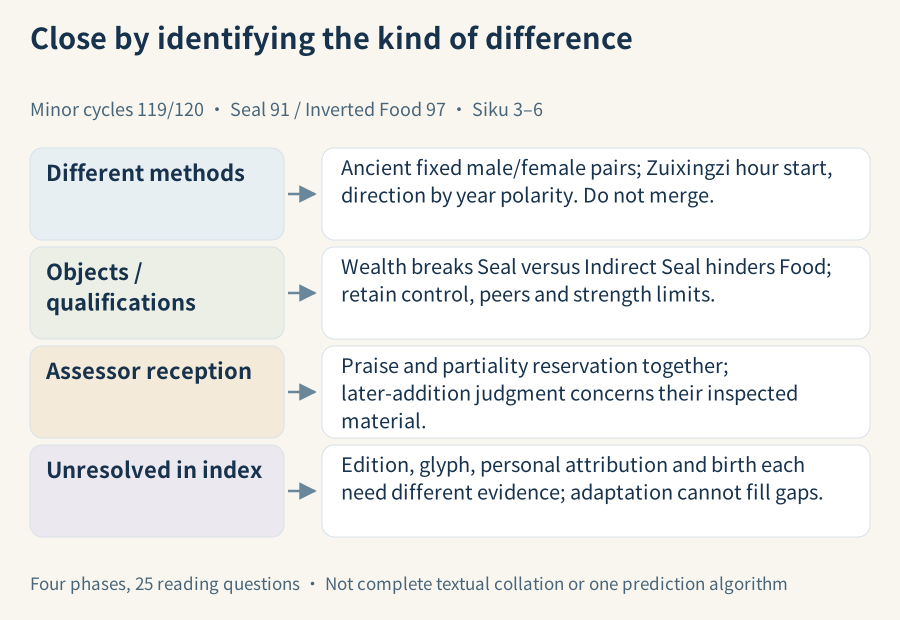
The complete figure is shown below. Select it to enlarge the labels. Open full-size figure · PNG
What may remain unresolved at the close
Edition identity can remain unresolved: a catalogue's 1578 description does not prove that a downloaded mirror is that printing. A glyph can remain unresolved: two secure Yujing excerpts on season and combination do not establish every character of the gloss. Attribution can remain unresolved: an unsigned internal Xiji summary is not automatically Wan's note. Historical input can remain unresolved: a printed name and a biographical candidate do not yield an independently verified complete birth.
Each uncertainty calls for a different next kind of evidence, rather than being filled by “adaptation.” Edition identity needs object and layout evidence; a glyph needs its image; responsibility needs attribution or transmission evidence; birth needs independent historical records. Recording them separately identifies which link is missing, instead of turning caution into uncheckable vagueness.
If two read methods remain unreconciled, the index can retain both with their attributed voices. Closing a compilation means making sources, objects and comparison scope traceable. It does not require a winner for every difference. For actual health, wealth or career decisions, this historical reading cannot replace reliable current evidence and appropriate professional judgment.
The tables, diagram and source-and-scope index are original. Ancient words are quoted only as necessary; source scans, research crops and modern commercial commentary are excluded from the public package. The four-phase Sanming analytical reading concludes here, while full classical-text preparation retains its separate progress and scope.
Sources and further reading
NLC94145, juan 2, Lun xiaoyun, scan 119, printed 41: the fixed-start ancient account. View the first account
Scan 120, printed 42: Zuixingzi's hour start and year-polarity direction. View the other account
NLC42998, juan 5, Lun yinshou, scan 91, printed 32: Wealth breaking Seal and reverse qualifications. View Seal
Lun daoshi, scan 97, printed 38: the operation chain and attributed poem. View Inverted Food
Siku CADAL06056477, scan 4, printed assessment leaf 1 verso: later-printing additions are the assessors' judgment about their source. View the comment
Scan 5, printed 2: praise for collecting diverse accounts and the reservation about partiality. View both judgments
Assessment opening, scan 3, and submission, scan 6: scans and printed leaves remain distinct.
NLC94145 record and NLC42998 record: catalogue dates do not become independently inspected imprints.
Siku object record: an assessment witness distinct from both Qin objects. Punctuation, translation and comparison categories are ours.
For detail, return to minor-cycle references, Seal and Inverted Food, and case evidence boundaries. The four phase entrances are Compilation and Foundations, Officer Wealth Seal and Food, Timing Auxiliary Stars and Examples, and Verses Editorial Voices and Comparison.
Evidence and source roles
These roles distinguish ancient text, older commentary, historical scholarship and tool reproduction. The numbered notes in the article retain the precise scan pages and explanations. Library and academic sources do not endorse predictive claims.
- SM4-P15 · Ancient text evidence: 論小運:所称古人法
Text layer in the witness: Main prose, 古人 account - SM4-P16 · Ancient text evidence: 論小運:醉醒子说
Text layer in the witness: Attributed alternative within same continuing section - SM4-P13 · Ancient text evidence: 論印綬:财破印与反向资格
Text layer in the witness: Main prose; chapter title begins at scan90/31 end - SM4-P14 · Ancient text evidence: 論倒食:作用链及古诗
Text layer in the witness: Main prose and explicitly introduced 古詩云 voice, distinct - SM4-P17 · Qing imperial catalogue assessment: 四库馆臣:坊刻攙入评论
Text layer in the witness: Qing assessors’ commentary, not Qin Sanming main text - SM4-P18 · Qing imperial catalogue assessment: 四库馆臣:褒评与保留意见
Text layer in the witness: Qing assessment; praise and later reservation retained as separate excerpts - SM4-P19 · Qing imperial catalogue assessment: 四库题首与提交署记
Text layer in the witness: Assessment opening and submission/signatures, not Qin imprint - SM4-B01 · Library catalogue fields imported by Commons: Qin Shen’an corrected / Wenming Sanming tonghui, NLC42998, catalogued 1926; independent 1926 imprint not inspected
- SM4-B04 · Library catalogue record: Qin Shen’an corrected / Wenming Sanming tonghui, NLC94145, catalogued 1926; independent 1926 imprint not inspected
- SM4-B05 · Scan-object identity check: Siku quanshu Sanming tonghui assessment, CADAL06056477 juan 1; Qing assessors’ text, separate from Qin/Wenming objects