The two sections criticizing rigid configurations and repeated error can be read as discussions of method, provided their voices remain distinct. What the author criticizes is not what he endorses. His claim to a theory and his judgments about other books are also not findings we have independently established. Rejected abstract, proposed requirement and available evidence need separate fields.
In NLC46443 the rigidity section runs from the middle of scan 46, printed 33, to the first half of 47, printed 34. Repeated Error begins midway through 47 and ends midway through 48, printed 35. We use five secure passages and exclude an uncertain month-character example. Contemporary sayings means the author's discussion of his period, not a direct accusation against a present-day writer.
The reversed-priority criticism retains this book's entrance
The first section makes monthly selection primary and states an alternative when the month has no yongshen, calling the month fundamental and external configurations secondary.[1] This connects to the preceding phase's distinction between originally absent selection and existing selection that is damaged. It does not prohibit every configuration name; it criticizes losing the stated entrance and its exception.
No monthly yongshen remains in the sentence and cannot be deleted merely to emphasize monthly primacy. Textual checking can show how principle and exception coexist. Whether the theory predicts real outcomes requires another kind of evidence, rather than being established because an old book asserts its correctness.
Settled principles is the author's theory claim
The next opening says the eight characters have settled principles and that failing to understand them leads to entrenched false speech and listening.[2] 定理 is the author's description of his theoretical foundation here. It is not already a modern mathematical theorem or an experimentally established natural law. Translating it as a proven law would turn self-description into our certification.
The strong language does not authorize us to direct charges of heresy or foolishness at actual readers. We can examine what method the author defends and which specific problems he identifies next, without transferring his polemical voice into our own treatment of people.
Three criticized readings lose different premises
The continuous list criticizes treating rigidity about external configurations as adaptation, treating damaging the flourishing and supporting the weak as a fixed method without examining preferences, and treating similar stems/branches as one case without examining differences within sameness.[3] The statements after treating as describe rejected readings. They must not become the author's three recommendations.
Each has a checkable premise: whether the selection entrance is bypassed, whether an operation is judged by strength labels alone, and whether positional or relational differences disappear inside a shared category. The last connects directly with this phase's Bing/Ding versus Si/Wu and Shen/You versus Geng/Xin examples.
| Criticized abstract | Requirement stated by the author | Textual question for reading an article |
|---|---|---|
| External rigidity called adaptation | Seek monthly selection and its qualified alternative | Were priority or no-selection qualifications deleted? |
| Damage strong/support weak made fixed rule | Examine preferences | Was an operation's object replaced by a strength label? |
| Similar stems/branches made one case | Examine difference within sameness | Were positions and relationships reduced to a phase name? |
Misinterpreting words differs from proving printing errors
Our next continuous excerpt takes the first three listed reasons: misunderstanding the weight of words, misunderstanding commonplace books, and fixing one's opinion after an accidental fit.[4] Further discussion follows; these are not presented as an exhaustive three-cause list. The first points out that recognizing a character correctly does not ensure understanding its sentence.
For example, disclosed Officer is not strong Officer; shallow Wealth should not be changed to light for table symmetry. 下闕 is this witness's explicit missing-continuation notice, not permission to fill it with a familiar sentence. The Wealth cycle contents/body heading difference should also be recorded separately, rather than one being declared a printing error without evidence.
Repeated error therefore need not mean a damaged printing character alone. Detached quotations, reversed objects, omitted conditions and mistaken methods are distinct transmission problems. The author's judgment that another book is wrong remains his judgment; proving a particular printing error requires particular witness and glyph evidence.
Accidental fit does not settle an explanation permanently
One listed reason concerns matching a case accidentally and then treating one's view as unchangeable.[4] A useful reading check asks whether an explanation first had explicit conditions or whether a fitting result was encountered before the view became fixed.
The passage does not supply modern sample data, comparison rules or experimental results. We do not credit the old criticism with already establishing a modern testing protocol. It raises a question without supplying proof: one matching story does not automatically establish every unlisted condition, and one criticism of a transmission does not authenticate all the critic's own theories.
Known status followed by a fitted explanation is another reversal
Scan 48 criticizes an interpreter who fails to examine the foundation and adjusts the explanation to follow someone's already known wealth/status.[5] Its object is the interpreter's procedure. It does not authenticate that person's identity or supply an independently verified birth time and life record. We invent no biography and calculate no accuracy rate from it.
For present reading, originally recorded facts and explanations added after the outcome can occupy separate fields. If conditions continually change with the result, an account needs to identify which conditions were given beforehand and which were added later. This examines argumentative sequence rather than accusing a particular online article we have not read.
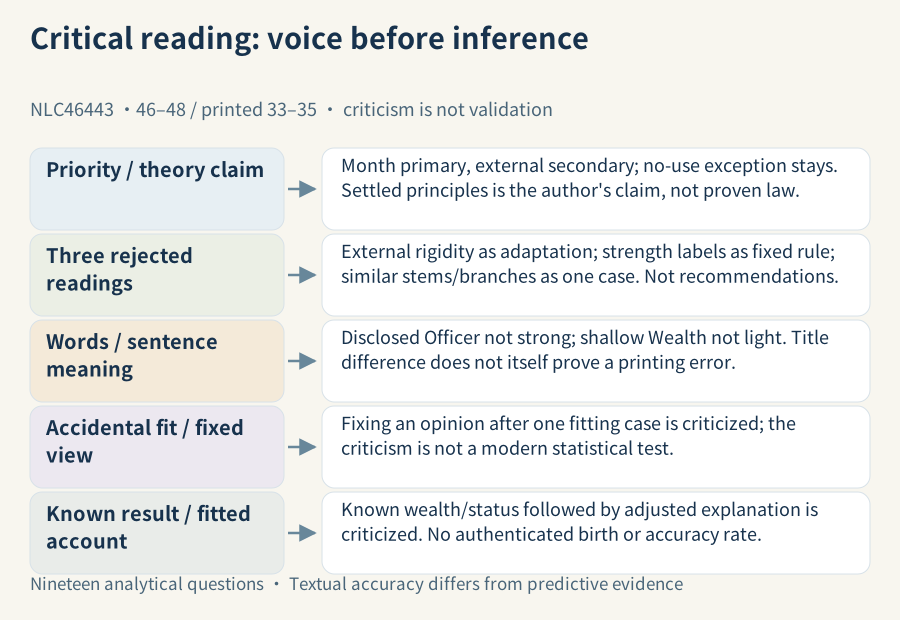
The complete figure is shown below. Select it to enlarge the labels. Open full-size figure · PNG
Textual accuracy and predictive evidence are separate checks
A textual check asks which witness was read, where the heading is, whether the quotation is continuous, who speaks, and which negations and conditions remain. An efficacy check asks what supports a real-world conclusion and whether the explanation can be separated from a known outcome. Doing the first well does not automatically complete the second.
The series can preserve the merged cycle-section location, the Wealth title difference, the lacuna and uncertain glyph boundaries, while explaining why six selection discussions cannot be flattened into one table. Those are reading findings. They do not make disagreement between divination books evidence of scientific validity or justify judging actual people's character, property or danger.
Nineteen questions delimit an analytical reading
The three planned collections provide nineteen original analytical questions: editions and entrances, conditioned formation and change, then cycle comparison and textual criticism. The selected witness has title differences and a local gap, and its classical text has not been fully transcribed or collated here. The accompanying index identifies each question's scope and sources rather than using article count to imply a complete critical edition.
A final card can record quotation and location, speaker or rejected voice, complete stated conditions, our interpretation, and conclusions not established. Fill the inspectable fields first and leave unsupported fields empty. That gives readers a usable checking habit before accepting a favorable or unfavorable conclusion and searching afterward for a quotation to support it.
Sources and further reading
NLC46443, 論時說拘泥格局, printed 三三, scan 46. Identified source page
NLC46443, 論時說以訛傳訛, printed 三四, scan 47. Identified source page
NLC46443, 論時說以訛傳訛, printed 三四, scan 47. Identified source page
NLC46443, 論時說以訛傳訛, printed 三四, scan 47. Identified source page
NLC46443, 論時說以訛傳訛, printed 三五, scan 48. Identified source page
NLC46443, 实际刊记:出版与发行, no numbered printed leaf, scan 74. Identified source page
Punctuation, translation, analysis and diagrams are original; modern Xu Lewu commentary and research facsimiles are excluded. Return to Cycles Comparison and Textual Critique, or consult the Ten Gods guide for basic symbols.
Evidence and source roles
These roles distinguish ancient text, older commentary, historical scholarship and tool reproduction. The numbered notes in the article retain the precise scan pages and explanations. Library and academic sources do not endorse predictive claims.
- ZP3-05-A · Ancient text evidence: 論時說拘泥格局
Text layer in the witness: Secure selected ancient main-text words; author or criticized voice identified. Article punctuation, translation and interpretation original; not modern Xu commentary. - ZP3-05-B · Ancient text evidence: 論時說以訛傳訛
Text layer in the witness: Secure selected ancient main-text words; author or criticized voice identified. Article punctuation, translation and interpretation original; not modern Xu commentary. - ZP3-05-C · Ancient text evidence: 論時說以訛傳訛
Text layer in the witness: Secure selected ancient main-text words; author or criticized voice identified. Article punctuation, translation and interpretation original; not modern Xu commentary. - ZP3-05-D · Ancient text evidence: 論時說以訛傳訛
Text layer in the witness: Secure selected ancient main-text words; author or criticized voice identified. Article punctuation, translation and interpretation original; not modern Xu commentary. - ZP3-05-E · Ancient text evidence: 論時說以訛傳訛
Text layer in the witness: Secure selected ancient main-text words; author or criticized voice identified. Article punctuation, translation and interpretation original; not modern Xu commentary. - ZP3-IMPRINT · Ancient text evidence: 实际刊记:出版与发行
Text layer in the witness: Actual separately arranged end-colophon publication/distribution fields, not main text or modern commentary