This text explicitly discusses Lu and Monthly Rob together, but that does not give them and Blade using Officer one unconditional cycle table. The comparison concerns the relationship used, the object restrained and the protection qualification. Blade using Officer asks how Officer restrains Blade and whether Officer has a deep root; one Lu/Rob Officer branch expressly requires Seal protection.
We use NLC46443's actual Blade Configuration, Blade Cycle Selection, Lu/Monthly Rob Configuration and Lu/Monthly Rob Cycle Selection sections on scans 62–66, printed 49–53. Blade cycle selection starts at the end of 63 and continues on 64. Lu/Rob cycle selection is on 66, before Miscellaneous Configurations. The witness prints 刃; another book's knife-shaped title is not imported here.
The definition identifies its reference object
The Blade section says it robs the self's Direct Wealth and is Direct Wealth's Seven Sha: “乃正財之七煞也.”[1] Direct Wealth is the stated reference. Translating this as the day master's Seven Sha changes the relationship, while extracting Seven Sha alone hides the reference through which Blade is described.
This is a terminology analogy within the work. It is not a claim that an actual person will steal a reader's property or a reason to label people dangerous. An uncertain numerical glyph in the opening is excluded from our quotation, and no universal Blade lookup table is built from it. The selected definition retains only the secure words.
Other configurations and Blade using Officer restrain different objects
The comparison says that in other configurations one Sha can damage the self, hence restraint is favored and Wealth/Seal opposed; Blade using Officer relies on it to restrain Blade, so its stated preference reverses.[2] Other configurations is indispensable. The first half is the author's comparative premise, followed by the specific Blade-using-Officer task.
Omitting other configurations turns the first half into a Sha rule without a specified comparison. Omitting Blade using Officer turns the second into all Blade favors Wealth/Seal. Both deletions lose entrances. A sound abstract retains who acts on what before explaining the author's reversed preference.
Damage to the self and not fearing damage are the historical model's phrases, not our conclusions about actual bodily injury or safety. The graphic records objects and the attributed preference, rather than a health forecast.
Lu and Monthly Rob are explicitly combined here
The other section rejects the idea that Lu's disclosed qi can simply be relied on as the use, then says: “建祿與月劫可同一格,不必另分,” with Wealth, Officer, Sha and Food separately selected through disclosure or branch gathering.[3] The rejected idea cannot be excerpted alone and attributed to the author as an endorsed rule.
The paragraph permits Lu/Monthly Rob to share a selection entrance. It does not say every combination is already complete or include Blade in that same grouping. A comparison can therefore have one Blade group and one combined Lu/Monthly Rob group, retaining the author's grouping rather than contradicting it.
Its wording that Lu is Rob belongs to this classification discussion. It need not be erased to fit a generic label chart, but it also does not rewrite every hidden-stem relationship label. The task is to explain selection in the current passage through its specific objects and operations.
Blade using Officer has a deep-root qualification
The cycle paragraph first favors assisting Officer under Blade using Officer. It then adds that when Officer has a deep root in the original configuration, Seal/Peers/Rob directions instead become favorable, while retaining the “傷食合官” restriction.[4] The initial direction and the qualified reversal need to be read together.
Keeping only assist Officer omits the additional branch. Keeping only Seal/Peers/Rob favorable omits deep Officer root. The conditions cannot be silently exchanged for whichever rule seems more familiar.
The original ending prints Injury/Food and combining Officer continuously. We read these as listed restriction categories, with editorial punctuation making that reading explicit; we do not translate the string as a fact that Injury and Food all actively combine Officer. Nor is the combined object changed to Blade. Original wording and interpretive responsibility stay identifiable.
Lu/Rob using Officer first requires Seal protection
The other cycle sentence says that Lu/Rob using Officer with Seal protection favors Wealth, fears Officer combination and multiplying Seven Sha, and does not let Food/Injury harm; Rob/Peers are not immediately inauspicious.[5] With Seal protection is a condition, not a removable aside.
Not immediately inauspicious is also a limited negation rather than Rob/Peers are always favorable. It differs from Blade's deep-root qualification before Seal/Peers/Rob is favored. Shared Officer and peer-category names cannot turn the two entrances into one procedure.
| Entrance compared | Added qualification | Direction and restriction in the selected statement |
|---|---|---|
| Blade uses Officer | Initial stated entrance | Assist Officer |
| Blade uses Officer | Officer deeply rooted | Seal/Peers/Rob favorable instead; retain Food/Injury and Officer-combination restrictions |
| Lu/Monthly Rob original selection | Disclosure/gathering selects elsewhere | Wealth, Officer, Sha and Food used; not Lu disclosure alone |
| Lu/Rob uses Officer | Seal protection | Wealth favored; Officer combination and Sha multiplication feared; Food/Injury not harming, Rob/Peers not immediately adverse |
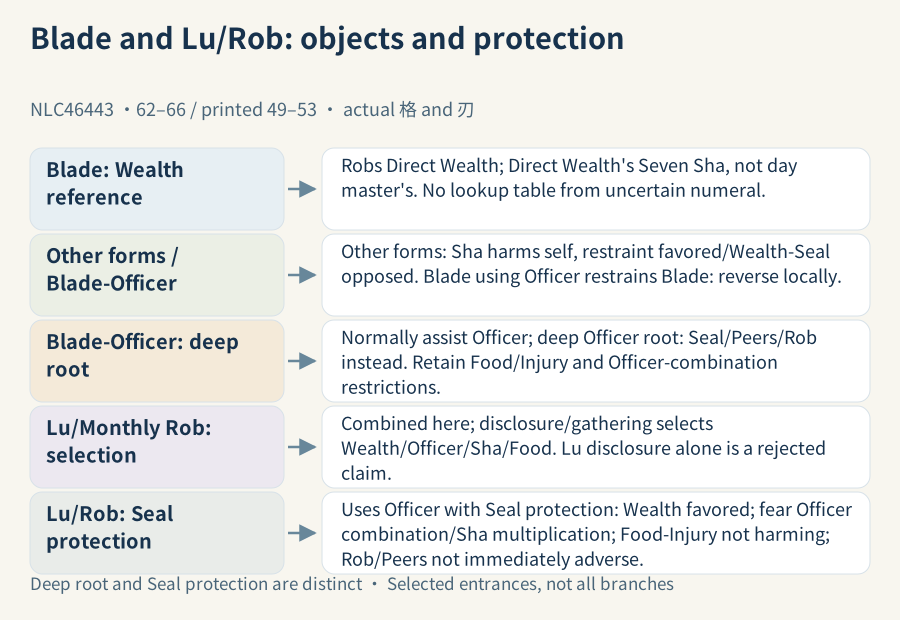
The complete figure is shown below. Select it to enlarge the labels. Open full-size figure · PNG
Two kinds of support information are not interchangeable
Deep Officer root describes the Officer's root condition; Seal protection describes a protecting relationship. Both may alter an assessment, but they are not the same field. Replacing protection with root depth, or root depth with simply having Seal, removes the difference between the paragraphs.
This is why the graphic compares selected statements rather than all configurations in either chapter. The Blade section has other entrances, and Lu/Rob separately selects other relationships. One Officer sentence cannot stand for every combination. Each row's name, object, condition and negation jointly bound its conclusion.
Check heading, direction and qualification
First verify the actual combined Lu/Monthly Rob headings. Then check the reference in Direct Wealth's Seven Sha and the Blade that Officer restrains. Finally retain other configurations, deep Officer root, Seal protection and not immediately. Dropping any of these can broaden an abstract beyond the source.
The resulting comparison respects the author's explicit Lu/Monthly Rob grouping while retaining its difference from Blade using Officer. It is a reading of configuration arguments, not an assessment of real property, employment or physical condition. The final question examines how the author himself criticizes reversed priorities and treating different conditions as one example.
Sources and further reading
NLC46443, 論陽刃格, printed 四九, scan 62. Identified source page
NLC46443, 論陽刃格, printed 四九, scan 62. Identified source page
NLC46443, 論建祿月劫格, printed 五一, scan 64. Identified source page
NLC46443, 論陽刃取運, printed 五一, scan 64. Identified source page
NLC46443, 論建祿月劫取運, printed 五三, scan 66. Identified source page
NLC46443, 实际刊记:出版与发行, no numbered printed leaf, scan 74. Identified source page
Punctuation, translation, analysis and diagrams are original; modern Xu Lewu commentary and research facsimiles are excluded. Return to Cycles Comparison and Textual Critique, or consult the Ten Gods guide for basic symbols.
Evidence and source roles
These roles distinguish ancient text, older commentary, historical scholarship and tool reproduction. The numbered notes in the article retain the precise scan pages and explanations. Library and academic sources do not endorse predictive claims.
- ZP3-04-A · Ancient text evidence: 論陽刃格
Text layer in the witness: Secure selected ancient main-text words; author or criticized voice identified. Article punctuation, translation and interpretation original; not modern Xu commentary. - ZP3-04-B · Ancient text evidence: 論陽刃格
Text layer in the witness: Secure selected ancient main-text words; author or criticized voice identified. Article punctuation, translation and interpretation original; not modern Xu commentary. - ZP3-04-C · Ancient text evidence: 論建祿月劫格
Text layer in the witness: Secure selected ancient main-text words; author or criticized voice identified. Article punctuation, translation and interpretation original; not modern Xu commentary. - ZP3-04-D · Ancient text evidence: 論陽刃取運
Text layer in the witness: Secure selected ancient main-text words; author or criticized voice identified. Article punctuation, translation and interpretation original; not modern Xu commentary. - ZP3-04-E · Ancient text evidence: 論建祿月劫取運
Text layer in the witness: Secure selected ancient main-text words; author or criticized voice identified. Article punctuation, translation and interpretation original; not modern Xu commentary. - ZP3-IMPRINT · Ancient text evidence: 实际刊记:出版与发行
Text layer in the witness: Actual separately arranged end-colophon publication/distribution fields, not main text or modern commentary