A comparison of six cycle-selection discussions should put six entrances and their reasons side by side. It should not attach one permanently favorable phase to Officer, Wealth, Seal, Food, Sha and Injury. Each section has internal combinations. Even where Food generates Wealth, the Wealth and Food sections cannot simply exchange all their cycle statements.
We use the relevant NLC46443 passages on scans 48–62, printed 35–49. The actual body headings name Direct Officer, Wealth, Seal, Food, Indirect Officer and Injury configurations, each followed by its cycle discussion. Wealth's contents heading says “論財取運,” while the body says “論財格取運.” That difference is retained. We select one local combination in each group rather than claiming to cover every branch in all twelve discussions.
Officer: assisting the self and assisting Officer differ
The original Officer section starts from Officer controlling the self while distinguishing it from Seven Sha.[1] The selected cycle entrance is Direct Officer using Wealth and Seal: if the self is slightly light, assist the self; if Officer is slightly light, assist Officer.[2] The object of insufficiency and the assistance target need separate fields.
This is not Officer configurations always favor Officer assistance. The paragraph also restricts combination, mixed Sha, repeated Officer and branch punishment/clash when Officer is disclosed. Disclosed is a visibility condition, not a statement that Officer is strong. These restrictions remain attached to this discussion rather than becoming one rule for all six entrances.
Wealth: retain its reliance on Food generation
The Wealth section describes what the self controls and uses, calling its ability to generate Officer favorable.[3] Our selected cycle branch is Wealth relying on Food generation. Heavy Wealth/Food with a light self favors self assistance; light Wealth/Food with a heavy self continues through Wealth/Food. It then explicitly says Sha cycles are not taboo and Officer/Seal instead obscure the arrangement.[4]
Heavy and light provide no kilograms, percentages or money amounts. The passage's relational assessment is not a modern investment strategy. Sha not taboo must not be extended to every Wealth configuration, and the stated Officer/Seal qualification cannot be erased merely because those names are conventionally auspicious.
Seal: two Officer-using branches alter the Food/Injury assessment
The Seal section begins with generating the self and gives its own treatment of direct and indirect classifications.[5] That treatment does not abolish differences between specific combinations. In the selected cycle discussion, Seal using Officer with Officer disclosed and Seal heavy favors Wealth and the Food/Injury direction. A subsequent branch, using Officer while already carrying Food/Injury, favors flourishing Officer and Seal regions, calls Food/Injury harmful and does not prohibit Sha.[6]
Officer disclosed plus heavy Seal and already carrying Food/Injury are indispensable branch conditions. Merging them into Seal always favors, or always fears, Food/Injury produces contradictory abstracts. Disclosed Officer cannot be rewritten as strong Officer to fit a familiar strength table.
Food: the same generating direction has another boundary
Food's original discussion describes release of qi and the ability to generate Direct Wealth.[7] The selected cycle entrance is Food generating Wealth: light Wealth/Food takes Wealth/Food routes; heavy Wealth/Food favors helping the self. Its closing statement calls both Officer and Sha directions unfavorable.[8]
Wealth relying on Food and Food generating Wealth share a generating direction, but retain different principal entrances in their sections. The Wealth branch's Sha not taboo cannot be imported here to overwrite both Officer and Sha unfavorable. A same-direction arrow does not decide the entire cycle assessment. Section entrance and full local qualifications still matter.
Indirect Officer: three support targets answer three problems
The Indirect Officer section begins with Sha attacking the self, then qualifies its use through fitting control.[9] The selected cycle combination is Sha controlled by Food. Heavy Sha/light Food calls for Food support; light Sha/heavy Food for Sha support; balanced Sha/Food with a lightly rooted day master for self support. Mixed Direct Officer and Seal taking Food away remain restrictions.[10]
The three routes are not options to choose arbitrarily. Supporting Sha especially must not be extracted as a recommendation for every Indirect Officer configuration: it is qualified by Food control and Sha lighter than Food. Another branch supports Food instead. Light day-master root likewise cannot become a claim about actual bodily weight or health, and the balanced Sha/Food premise must stay.
Injury: keep shallow Wealth rather than replacing it with light
The Injury section retains both not an auspicious factor and the author's expressive-refinement assessment.[11] We select only Injury using Wealth: flourishing Wealth with a light self favors Seal/Peers; strong self with shallow Wealth favors Wealth cycles.[12] The printed shallow, 淺, should not be replaced by light for visual symmetry.
Shallow is a traditional qualitative description here, not account depth or a liquidity metric. Other Injury combinations follow in the chapter, so this row explicitly says Injury using Wealth rather than covering every use of Injury, including unexamined Seal branches.
| Selected entrance | Distinctions retained | Recorded direction and boundary |
|---|---|---|
| Officer uses Wealth/Seal | Self slightly light versus Officer slightly light; also disclosure | Assist self versus Officer; combination, mixed Sha, repetition and branch-damage restrictions |
| Wealth relies on Food generation | Wealth/Food heavy and self light versus the reverse | Self support versus Wealth/Food; Sha not taboo, Officer/Seal obscures locally |
| Seal uses Officer | Officer disclosed and Seal heavy versus existing Food/Injury | First favors Wealth/Food/Injury; second favors Officer/Seal, Food/Injury harms, Sha not taboo |
| Food generates Wealth | Wealth/Food light versus heavy | Wealth/Food versus self support; Officer/Sha both unfavorable |
| Sha uses Food restraint | Sha heavy/Food light, reverse, or balanced with day-master root light | Food, Sha or self support; retain mixed-Officer and Food-taking restrictions |
| Injury uses Wealth | Wealth flourishing/self light versus self strong/Wealth shallow | Seal/Peers versus Wealth; shallow not replaced by light |
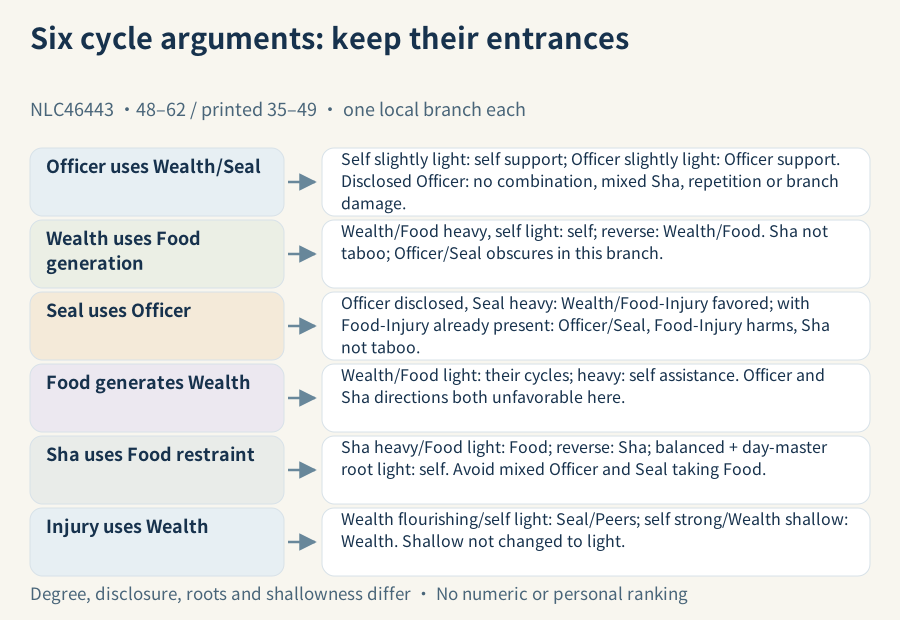
The complete figure is shown below. Select it to enlarge the labels. Open full-size figure · PNG
The table must lead back to the section
The table's value lies in retaining differences rather than making rows identical in length. Disclosure, heavy, slightly light, light root, flourishing and shallow are not measurements with a shared numerical unit. We supply no fixed percentages and use no support-target term to assess a reader's health, personality or future income.
Two deletion tests show why the entrances matter. Remove Wealth relies on Food and Food generates Wealth, and their Sha statements seem contradictory. Remove the two Seal/Officer branch conditions, and the Food/Injury assessments also collide. Restore the entrances and qualifications, and each statement returns to the particular question it addresses. That is a comparison of reasons, rather than an interchangeable list of favorable cycles.
Sources and further reading
NLC46443, 論正官格, printed 三五, scan 48. Identified source page
NLC46443, 論正官取運, printed 三七, scan 50. Identified source page
NLC46443, 論財格, printed 三八, scan 51. Identified source page
NLC46443, 論財格取運, printed 四〇, scan 53. Identified source page
NLC46443, 論印綬格, printed 四〇, scan 53. Identified source page
NLC46443, 論印綬取運, printed 四二, scan 55. Identified source page
NLC46443, 論食神格, printed 四三, scan 56. Identified source page
NLC46443, 論食神取運, printed 四四, scan 57. Identified source page
NLC46443, 論偏官格, printed 四四, scan 57. Identified source page
NLC46443, 論偏官取運, printed 四六, scan 59. Identified source page
NLC46443, 論傷官格, printed 四七, scan 60. Identified source page
NLC46443, 論傷官取運, printed 四九, scan 62. Identified source page
NLC46443, 实际刊记:出版与发行, no numbered printed leaf, scan 74. Identified source page
Punctuation, translation, analysis and diagrams are original; modern Xu Lewu commentary and research facsimiles are excluded. Return to Cycles Comparison and Textual Critique, or consult the Ten Gods guide for basic symbols.
Evidence and source roles
These roles distinguish ancient text, older commentary, historical scholarship and tool reproduction. The numbered notes in the article retain the precise scan pages and explanations. Library and academic sources do not endorse predictive claims.
- ZP3-03-GUAN-ENTRY · Ancient text evidence: 論正官格
Text layer in the witness: Secure selected ancient main-text words; author or criticized voice identified. Article punctuation, translation and interpretation original; not modern Xu commentary. - ZP3-03-GUAN-CYCLE · Ancient text evidence: 論正官取運
Text layer in the witness: Secure selected ancient main-text words; author or criticized voice identified. Article punctuation, translation and interpretation original; not modern Xu commentary. - ZP3-03-CAI-ENTRY · Ancient text evidence: 論財格
Text layer in the witness: Secure selected ancient main-text words; author or criticized voice identified. Article punctuation, translation and interpretation original; not modern Xu commentary. - ZP3-03-CAI-CYCLE · Ancient text evidence: 論財格取運
Text layer in the witness: Secure selected ancient main-text words; author or criticized voice identified. Article punctuation, translation and interpretation original; not modern Xu commentary. - ZP3-03-YIN-ENTRY · Ancient text evidence: 論印綬格
Text layer in the witness: Secure selected ancient main-text words; author or criticized voice identified. Article punctuation, translation and interpretation original; not modern Xu commentary. - ZP3-03-YIN-CYCLE · Ancient text evidence: 論印綬取運
Text layer in the witness: Secure selected ancient main-text words; author or criticized voice identified. Article punctuation, translation and interpretation original; not modern Xu commentary. - ZP3-03-SHI-ENTRY · Ancient text evidence: 論食神格
Text layer in the witness: Secure selected ancient main-text words; author or criticized voice identified. Article punctuation, translation and interpretation original; not modern Xu commentary. - ZP3-03-SHI-CYCLE · Ancient text evidence: 論食神取運
Text layer in the witness: Secure selected ancient main-text words; author or criticized voice identified. Article punctuation, translation and interpretation original; not modern Xu commentary. - ZP3-03-SHA-ENTRY · Ancient text evidence: 論偏官格
Text layer in the witness: Secure selected ancient main-text words; author or criticized voice identified. Article punctuation, translation and interpretation original; not modern Xu commentary. - ZP3-03-SHA-CYCLE · Ancient text evidence: 論偏官取運
Text layer in the witness: Secure selected ancient main-text words; author or criticized voice identified. Article punctuation, translation and interpretation original; not modern Xu commentary. - ZP3-03-SHANG-ENTRY · Ancient text evidence: 論傷官格
Text layer in the witness: Secure selected ancient main-text words; author or criticized voice identified. Article punctuation, translation and interpretation original; not modern Xu commentary. - ZP3-03-SHANG-CYCLE · Ancient text evidence: 論傷官取運
Text layer in the witness: Secure selected ancient main-text words; author or criticized voice identified. Article punctuation, translation and interpretation original; not modern Xu commentary. - ZP3-IMPRINT · Ancient text evidence: 实际刊记:出版与发行
Text layer in the witness: Actual separately arranged end-colophon publication/distribution fields, not main text or modern commentary