Stems and branches can share a conventional phase category without receiving the same preference in this text. The Bing/Ding versus Si/Wu and Shen/You versus Geng/Xin comparisons retain position and the relationships entered. The subsequent disclosure section asks how something waiting for use in a branch takes another operational state through a listed incoming stem.
The actual location needs clarification. The plan used a separate stem/branch-preference heading as a locator, but neither the forty-five-entry contents nor the corresponding body of NLC46443 supplies that independent title. The contrast is inside the cycle section on scan 44, printed 31. The separate branch-disclosure section begins on 45, printed 32, and ends midway through 46, printed 33. The reading question remains; the witness's sections are not artificially split.
Bing/Ding support and Si/Wu clash share a stated entrance
The passage gives Bing born in Zi month and Hai year: encountering Bing/Ding supports the self, while encountering Si/Wu clashes.[1] The day stem, month branch and year branch together define the entrance. Names commonly assigned to Fire enter different relationships here.
Treating Si/Wu as merely another notation for Bing/Ding removes the connection to the original branches and the specified clashes. A graphic must keep support and clash on separate routes. Nor does the example mean that every Bing/Ding supports or every Si/Wu clashes; its entrance limits the comparison.
The phrase favoring a stem route but not a branch route does not describe a calculator function for choosing only the cycle stem and deleting its branch. We perform no complete cycle-pillar, starting-age or five-year-boundary calculation. The analysis concerns the author's distinction between the listed relationships.
Disclosed Xin can still leave Officer weak
The other example gives Jia in You month, Xin Metal disclosed but Officer still weak: Shen/You establishes its roots, while Geng/Xin produces mixture or repeated Officer.[2] Disclosure and weakness coexist. Disclosure records a state; weak records the author's assessment of degree. One cannot substitute for the other.
A single Metal-cycle label cannot explain why the listed sides differ. Mixture and repeated Officer also should not become an arithmetic claim of too much Metal. They name particular relationships rather than merely counting elements.
Together the examples run in different directions. The Bing/Zi/Hai entrance distinguishes stem support from branch clash. The Jia/You entrance distinguishes branch rooting from stem mixture/repetition. Their evidence supports checking position and operation, not an assertion that stems are always preferable to branches or the reverse.
Becoming clear does not erase the prior distinction
The separate section first says branch preferences differ from stem preferences, then adds that becoming clear in a cycle gives something previously quiet and awaiting use its use.[3] Both parts remain. A summary that branches and stems were always equivalent deletes the opening distinction; a claim that waiting and disclosed states are identical does the same.
The waiting-to-used account and the word verification belong to the historical author's model. The passage supplies no modern experiment, biography dataset or reproducible accuracy rate. Our translation keeps the causal claim attributed to the work while examining how the text connects state and operation.
Wei does not receive one fixed assessment in advance
The example uses Jia with You Officer. It lists Chen/Wei as a Wealth-related situation with Wu disclosed in the cycle, then Wu/Wei as an Injury-related situation with Ding disclosed.[4] The Wealth/Wu and Injury/Ding routes remain separate under the shared entrance. Wei appearing in both is reason to avoid preassigning every Wei appearance one permanent preference.
We do not add that Wei itself hides Wu. The source lists a Wealth-category situation and incoming Wu disclosure; category relation does not mean that each listed branch hides exactly the same stem. The paragraph also does not assign every character to a pillar position. Completing those positions merely to make the graphic resemble a chart would introduce data.
| Original entrance and position | Listed conditions | Operation or state recorded |
|---|---|---|
| Bing day stem, Zi month, Hai year | Bing/Ding versus Si/Wu | Self support versus clash |
| Jia day stem, You month, Xin disclosed but Officer weak | Shen/You versus Geng/Xin | Root establishment versus mixture/repeated Officer |
| Jia using You Officer, Wealth-category situation | Chen/Wei with incoming disclosed Wu | Branch relation becomes explicit through the listed disclosure |
| Jia using You Officer, Injury-category situation | Wu/Wei with incoming disclosed Ding | Separate disclosure path, not all Wei appearances identical |
In the table, Wu/Wei refers to the noon branch Wu 午 paired with Wei; disclosed Wu 戊 is the Earth stem in the other row. The characters and roles differ despite the shared romanization. Keeping them identified prevents an English label from merging the routes.
If it is a monthly factor limits the comparison
Scan 46 says that if a factor of the Month Command becomes clear in a cycle, it is not very far removed from having been present in the pillars, linking it with the preceding formation/change discussion.[5] If it is a monthly factor cannot be removed and the statement applied to every incoming disclosure. Not very far removed also retains degree rather than asserting absolute identity.
This connects the previous question's gathering and disclosure with the present comparison of states. It does not make all hidden information automatically operational in the same way. Nor does the cross-reference fill the preceding section's missing continuation.
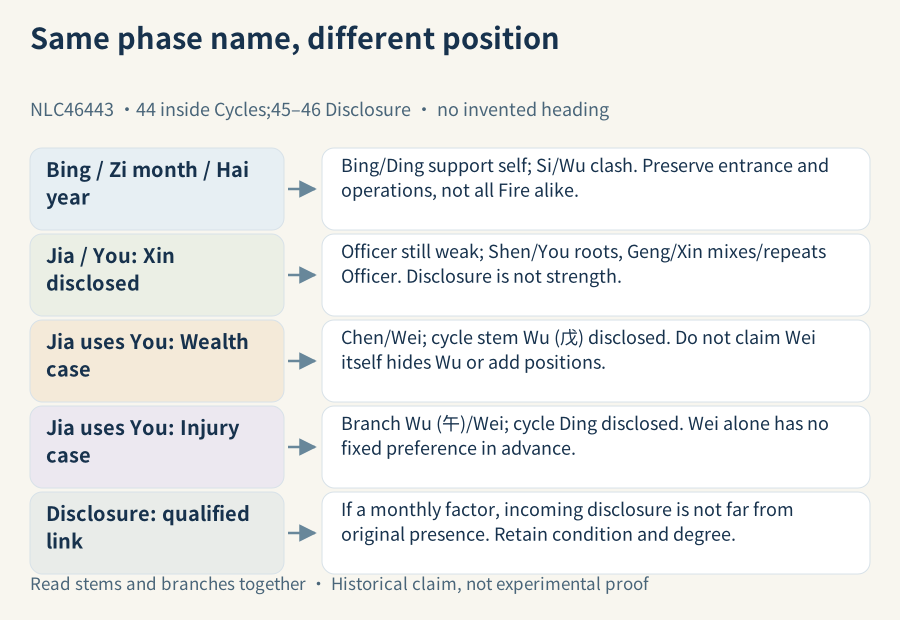
The complete figure is shown below. Select it to enlarge the labels. Open full-size figure · PNG
Reading vertically requires both separation and connection
The paragraph concludes that each stem and branch must be considered together, describing branch as the stem's footing and stem as the branch's expression of use.[5] These roles explain why separate fields still need to be read together. A branch is not another font for a stem, and a stem's phase name does not replace its position and relationship.
A four-field card can record the original entrance, position or waiting state, added disclosure and the relationship reached. It retains more of the passage than a single phase column. Diagram arrows mark these reading connections, not empirical weights or dates of real events.
Finally, removing Zi month/Hai year loses the first example's entrance; removing disclosed Xin but weak Officer loses the second example's problem; removing the monthly-factor condition overextends the disclosure comparison. Restoring them preserves both differentiation and connection without inventing an independent chapter heading absent from the witness.
Sources and further reading
NLC46443, 論行運, printed 三一, scan 44. Identified source page
NLC46443, 論行運, printed 三一, scan 44. Identified source page
NLC46443, 論支中喜忌逢運透清, printed 三二, scan 45. Identified source page
NLC46443, 論支中喜忌逢運透清, printed 三二, scan 45. Identified source page
NLC46443, 論支中喜忌逢運透清, printed 三三, scan 46. Identified source page
NLC46443, 实际刊记:出版与发行, no numbered printed leaf, scan 74. Identified source page
Punctuation, translation, analysis and diagrams are original; modern Xu Lewu commentary and research facsimiles are excluded. Return to Cycles Comparison and Textual Critique, or consult the Ten Gods guide for basic symbols.
Evidence and source roles
These roles distinguish ancient text, older commentary, historical scholarship and tool reproduction. The numbered notes in the article retain the precise scan pages and explanations. Library and academic sources do not endorse predictive claims.
- ZP3-02-A · Ancient text evidence: 論行運
Text layer in the witness: Secure selected ancient main-text words; author or criticized voice identified. Article punctuation, translation and interpretation original; not modern Xu commentary. - ZP3-02-B · Ancient text evidence: 論行運
Text layer in the witness: Secure selected ancient main-text words; author or criticized voice identified. Article punctuation, translation and interpretation original; not modern Xu commentary. - ZP3-02-C · Ancient text evidence: 論支中喜忌逢運透清
Text layer in the witness: Secure selected ancient main-text words; author or criticized voice identified. Article punctuation, translation and interpretation original; not modern Xu commentary. - ZP3-02-D · Ancient text evidence: 論支中喜忌逢運透清
Text layer in the witness: Secure selected ancient main-text words; author or criticized voice identified. Article punctuation, translation and interpretation original; not modern Xu commentary. - ZP3-02-E · Ancient text evidence: 論支中喜忌逢運透清
Text layer in the witness: Secure selected ancient main-text words; author or criticized voice identified. Article punctuation, translation and interpretation original; not modern Xu commentary. - ZP3-IMPRINT · Ancient text evidence: 实际刊记:出版与发行
Text layer in the witness: Actual separately arranged end-colophon publication/distribution fields, not main text or modern commentary