The cycle discussion in Ziping zhenquan requires incoming stems and branches to be read against the existing configuration. A character may complete a structure or change its selection path, and its auspicious name alone cannot decide which. The clearest contrast uses the same stated entrance, Ding in Chen month with Ren disclosed as Officer: the listed Shen/Zi gathering and disclosed Wu as Injury lead into different relationships.
Our witness is NLC46443, combined volume 2, with its actual January 1926 colophon on scan 74. The cycle section extends from scan 43, printed 30, to the opening of 45, printed 32. The formation/change section starts separately on 45 and visibly ends with 下闕, a notice that the continuation is missing. The final character of the residual start remains uncertain. We use intact selected passages without supplying a modern completion or calling nineteen reading questions a complete collation.
Existing relationships remain the reference
Scan 43 says that examining cycles and examining the configuration use the same method: the four pillars are matched with monthly preferences, and incoming cycle stems and branches are then matched with the configuration's preferences.[1] The two matching operations have different references. The statement does not declare one character favorable for every configuration.
A card reduced to Water cycle good or Fire cycle bad deletes what the factor is matched with and under which initial conditions. A better card records the entrance and existing relationships before recording the incoming character, its operation and the author's assessment.
The same page requires every incoming character to be considered with the whole configuration.[2] Its later assertion that auspicious and inauspicious results become clear is the author's confidence in his method, not our modern outcome validation. What can be checked is the stated relational requirement and the examples supporting it.
Formation or change asks an additional question
The next section says that a configuration forms through the eight characters, but matching it with cycles also has the power of completing or changing it. The author calls these changes more consequential than ordinary preference or aversion.[3] The distinction should not collapse into a single points-added or points-subtracted button.
A reading can ask whether an incoming relationship supports or damages an existing one, and then whether a structure not fully completed is supplied with something further or its selection path changes. These questions organize the paragraph; they do not guarantee corresponding real events. The old language of fortune and misfortune remains attributed to the work.
Formed but incomplete does not mean no prior selection
Its definition reads: “本命用神成而未全,運從而就之者是也.” Selection is formed but not fully completed, and the incoming cycle completes it.[4] This does not describe an originally empty monthly entrance or authorize abandoning a damaged selection for an arbitrary external name. Existing structure and what remains incomplete both matter.
Fullness here concerns structural completion rather than completeness of birth data. An example called formed can still leave year, month, day or hour fields unstated in our selected passage. Conversely, incomplete does not establish which biographical data are absent. Separating these meanings permits close reading without implying birth-record authentication.
Gathering and disclosure supply two different completion examples
The continuous paragraph gives Ding in Chen month, with Ren disclosed as Officer, encountering the listed Shen/Zi to gather the relationship. It then gives Yi in Chen month, with Shen or Zi gathering a Seal configuration, encountering Ren/Gui disclosed.[4] Gathering completes one path; disclosure continues the other. Their day stems, selected relationships and operations differ.
Ren is not assigned a permanent role across both entrances. The Ding example calls Ren Officer; the Yi example connects Ren/Gui to Seal disclosure. The day stem and original entrance determine the recorded relationship. We retain Officer and Seal without imposing unlisted direct/indirect subcategories on the fragment.
Shen/Zi and Ren/Gui are the source's listed characters, not complete cycle pillars we have calculated. The passage does not pair every listed stem with a branch or supply ages and civil-calendar dates. The components can remain precise while their unlisted fields stay empty; joining two characters into an invented single cycle pillar would add information.
| Original entrance | Incoming characters listed | Recorded operation | Scope of assessment |
|---|---|---|---|
| Ding in Chen month, Ren disclosed as Officer | Shen/Zi | Gathering the original relationship | Author's completion example |
| Yi in Chen month, Shen or Zi gathers Seal | Ren/Gui | Disclosure on the Seal path | Separate completion entrance, not merged with Ding |
| Ding in Chen month, Ren disclosed as Officer | Wu additionally disclosed | Bringing out Chen's Injury relationship | Author's changing example |
The same Ding/Chen entrance can take another direction
The changing example reads: “如丁生辰月,透壬為官,而運又逢戊,透出辰中傷官.”[5] Ding, Chen and Ren Officer remain, but the incoming condition is Wu disclosure bringing out Injury. The comparison concerns which relationship the added factor enters, not merely how many characters were added.
Calling every disclosure completion would delete this contrast. Calling every gathered group favorable would likewise omit the work's demand for whole-configuration reading. The two recorded paths can be explained accurately without deriving a universal conclusion for every disclosed Wu or any actual person's future.
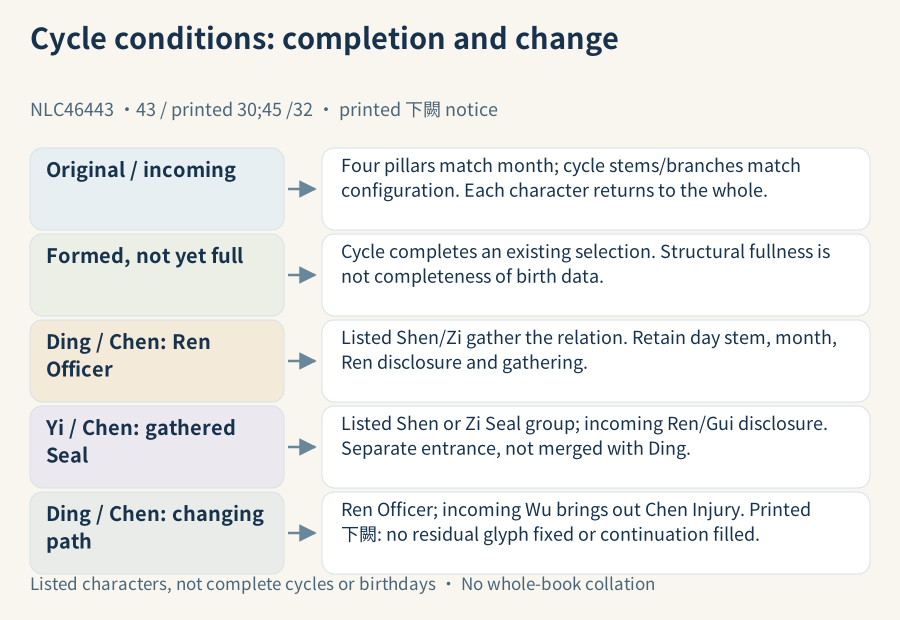
The complete figure is shown below. Select it to enlarge the labels. Open full-size figure · PNG
The missing continuation limits the account
After the intact changing example, the witness prints a residual start and the small notice 下闕. We report the clear notice without fixing the uncertain last character or explaining an unseen following example. It limits what this witness supplies here; it does not show that every modern edition, earlier manuscript or other witness has the same gap.
We therefore cannot claim that a complete following account in this copy proves every changing result. Nor can a familiar sentence from another text be inserted and described as personally read in this witness. Marking the gap preserves the value of the intact passages while separating their evidence from an unavailable continuation.
Keep a relationship card rather than a cycle slogan
A card can record the original entrance, completion state, listed incoming characters, gathering or disclosure, the object reached and the author's judgment. It can also mark a missing continuation or unlisted pillar position. This is textual analysis; no starting-age or calendar calculation has been performed and no real-life forecast is offered.
The next question adds position: why does this work treat incoming stems and branches differently even within the same phase category? Keeping what is matched, where it appears and how it becomes explicit turns cycles into conditioned changes with a reference, rather than a detached good/bad year list.
Sources and further reading
NLC46443, 論行運, printed 三〇, scan 43. Identified source page
NLC46443, 論行運, printed 三〇, scan 43. Identified source page
NLC46443, 論行運成格變格, printed 三二, scan 45. Identified source page
NLC46443, 論行運成格變格, printed 三二, scan 45. Identified source page
NLC46443, 論行運成格變格, printed 三二, scan 45. Identified source page
NLC46443, 实际刊记:出版与发行, no numbered printed leaf, scan 74. Identified source page
Punctuation, translation, analysis and diagrams are original; modern Xu Lewu commentary and research facsimiles are excluded. Return to Cycles Comparison and Textual Critique, or consult the Ten Gods guide for basic symbols.
Evidence and source roles
These roles distinguish ancient text, older commentary, historical scholarship and tool reproduction. The numbered notes in the article retain the precise scan pages and explanations. Library and academic sources do not endorse predictive claims.
- ZP3-01-A · Ancient text evidence: 論行運
Text layer in the witness: Secure selected ancient main-text words; author or criticized voice identified. Article punctuation, translation and interpretation original; not modern Xu commentary. - ZP3-01-B · Ancient text evidence: 論行運
Text layer in the witness: Secure selected ancient main-text words; author or criticized voice identified. Article punctuation, translation and interpretation original; not modern Xu commentary. - ZP3-01-C · Ancient text evidence: 論行運成格變格
Text layer in the witness: Secure selected ancient main-text words; author or criticized voice identified. Article punctuation, translation and interpretation original; not modern Xu commentary. - ZP3-01-D · Ancient text evidence: 論行運成格變格
Text layer in the witness: Secure selected ancient main-text words; author or criticized voice identified. Article punctuation, translation and interpretation original; not modern Xu commentary. - ZP3-01-E · Ancient text evidence: 論行運成格變格
Text layer in the witness: Secure selected ancient main-text words; author or criticized voice identified. Article punctuation, translation and interpretation original; not modern Xu commentary. - ZP3-IMPRINT · Ancient text evidence: 实际刊记:出版与发行
Text layer in the witness: Actual separately arranged end-colophon publication/distribution fields, not main text or modern commentary