The sections on stars having no bearing on configuration and on using or setting aside external configurations each ask what a kind of material is authorized to decide. The first refuses to let an auspicious star name replace configuration assessment. The second refuses to let a damaged existing selection become an arbitrary excuse for selecting an external configuration. Their shared question is authority; their entrances differ.
We use NLC46443. The stars section begins at the end of scan 38, printed 25, and ends in the upper part of 40, printed 27. External Configurations begins separately on 40 and ends before the Palace Positions and Family Relations heading. The actual title prints 用舍, not an editorially substituted 用捨. The analysis concerns old arguments, not real danger prediction or arranging life decisions through configuration names.
What does stars mean in this section?
Scan 38 says that configurations match the Month Command with the four pillars, then asks how good or bad stars can control formation and failure when they cannot perform the work of generation or control.[1] The following text names Lonely Star, Eight Sha, Heavenly Virtue and Noble Person. Stars should be understood through these named divinatory factors, not as a proposition about modern astronomy.
The key question is authority over formation and failure. The author prioritizes the monthly entrance and generating/controlling relationships for this configuration task. We can identify that allocation of authority without claiming to have proved every historical auxiliary-star theory false in every domain.
The distinction also matters across books. The previous Sanming readings examined different auxiliary-star references and qualifications in that work. Its treatment must remain attached to its own source. This article first explains the present book's task rather than using one text to adjudicate every other text. A comparison gains value by preserving differences.
Already formed and already broken are conditions
Scan 39 contrasts an already formed configuration full of Lonely Star and Eight Sha, which do not diminish its nobility, with an already broken configuration full of Heavenly Virtue and Noble Person, which do not make up its efficacy.[2] Both sentences give the configuration state before the star labels.
Removing already broken from the second deletes its premise. Removing already formed from the first does the same. The contrast does not say that every star name has no meaning whatsoever. It says that, for this task, adverse names do not undo the existing forming assessment and favorable names do not fill the operational gap of the broken structure.
Nobility and efficacy remain the old author's terms. They are not modern guarantees of appointment, achievement or safety. A table can show the stated conditional relationship, but should not turn the star list into a danger index or a count through which human worth is assessed.
The Two Virtues concession retains possibility
Scan 40 adds: “若云命逢險格,柱有二德,逢凶有救,可免於危,則亦有之。然終無關於格局之貴賤也.”[3] If a hazardous configuration has the Two Virtues and rescue under adversity, the author allows that avoiding danger may occur, while still separating this from configuration status. The printed 可 matters: possible avoidance is not guaranteed immunity.
Nearby discussion also contains historical comments about women's configurations and virtues. These do not authorize judging modern women's character. The selected continuous sentence is enough to show the restricted concession and the author's subsequent boundary. We make no danger forecast and give no advice that symbolic virtues replace real safety measures.
This qualification gives the title's no bearing a particular scope. Keeping the concession does not restore the Two Virtues as the authority over configuration formation or failure. Keeping the closing boundary does not allow deletion of the concession. Both deserve their own fields.
External configurations have a qualified alternative entrance
The following section asks why external configurations exist if yongshen is principally monthly. It answers that they are provisionally used because the month has no use: “蓋因月令無用,權而用之.”[4] The monthly entrance remains primary, and the alternative receives a condition rather than being available whenever a reader prefers another label.
The page then asks: “若月令自有用神,豈可別尋外格?” If the month itself has yongshen, how can one separately seek an external configuration?[5] Before selecting the alternative, a study card must ask whether the original entrance genuinely lacks a selection or whether an existing selection has been damaged.
This connects with the explicit exception retained in the first phase's yongshen reading. A primary principle and a stated exception can coexist. Neither means that every configuration name from every book is universally invalid, nor that any desired favorable name can replace an inconvenient entrance.
Damaged is different from originally absent
The continuation explains that no monthly use means the month originally has no yongshen. It criticizes treating Wealth robbed or Officer injured, where an existing yongshen has been broken, as no monthly selection and abandoning it for an external configuration.[6] Originally absent and already damaged describe different states.
Wealth robbed and Officer injured presuppose something that had been selected and then encountered a problem. They do not establish that no selection ever existed. This keeps formation, failure and rescue relevant: an existing damaged relationship should first be identified and its particular damage examined, rather than erased by switching to an attractive name.
The restriction does not guarantee rescue for every damaged configuration. It rejects the specific misclassification of damaged as absent. That is the author's stated criticism, and it is more precise than treating external configuration as either always allowed or never allowed.
| Entrance in this text | Stated condition | Boundary retained |
|---|---|---|
| Stars contrast A | Configuration already formed; Lonely Star/Eight Sha | Adverse names do not diminish the existing assessment |
| Stars contrast B | Configuration already broken; Heavenly Virtue/Noble Person | Favorable names do not repair its efficacy |
| Two Virtues concession | Hazardous configuration, Two Virtues and rescue | Possible avoidance; not authority over configuration status |
| Qualified external entrance | Month originally has no yongshen | Provisional selection, not arbitrary favorable naming |
| Criticized replacement | Wealth robbed or Officer injured; yongshen damaged | Damage must not be renamed no monthly selection |
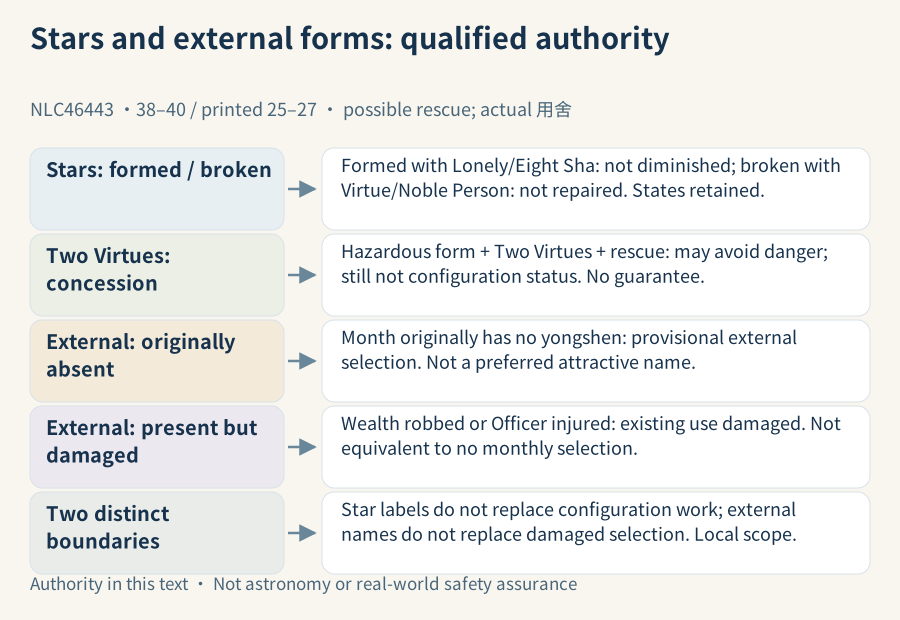
The complete figure is shown below. Select it to enlarge the labels. Open full-size figure · PNG
Name the judgment's object before deciding use or omission
The two sections can share an authority card without becoming one prohibited-factor list. The stars card asks whether additional names replace configuration judgment, retaining the concession. The external-configuration card asks whether its alternative entrance qualifies, distinguishing absence from damage. Each boundary concerns a particular judgment being protected or replaced.
This closes the second phase's reading path: formation and rescue have objects; change is not automatic improvement; purity is not counting; levels remain historical evaluation; reversals track dependencies; climate, mixed qi and storehouse exceptions retain qualifications. Auspicious, inauspicious and attractive external names cannot replace those checks. This is an organization for reading arguments, not an automatic procedure for judging actual lives.
Sources and further reading
NLC46443, 論星辰無關格局, printed 二五, scan 38. Identified source page
NLC46443, 論星辰無關格局, printed 二六, scan 39. Identified source page
NLC46443, 論星辰無關格局, printed 二七, scan 40. Identified source page
NLC46443, 論外格用舍, printed 二七, scan 40. Identified source page
NLC46443, 論外格用舍, printed 二七, scan 40. Identified source page
NLC46443, 論外格用舍, printed 二七, scan 40. Identified source page
NLC46443, 实际刊记:出版与发行, no numbered printed leaf, scan 74. Identified source page
Punctuation, translation, analysis and diagrams are original. Research facsimiles and modern commentary are excluded. Return to Formation Rescue and Change; basic relationships are introduced in Ten Gods.
Evidence and source roles
These roles distinguish ancient text, older commentary, historical scholarship and tool reproduction. The numbered notes in the article retain the precise scan pages and explanations. Library and academic sources do not endorse predictive claims.
- ZP2-P25 · Ancient text evidence: 論星辰無關格局
Text layer in the witness: Identified 1926 witness main text, single-line print; original punctuation, translation and analysis; not modern Xu commentary - ZP2-P26 · Ancient text evidence: 論星辰無關格局
Text layer in the witness: Identified 1926 witness main text, single-line print; original punctuation, translation and analysis; not modern Xu commentary - ZP2-P27 · Ancient text evidence: 論星辰無關格局
Text layer in the witness: Identified 1926 witness main text, single-line print; original punctuation, translation and analysis; not modern Xu commentary - ZP2-P28 · Ancient text evidence: 論外格用舍
Text layer in the witness: Identified 1926 witness main text, single-line print; original punctuation, translation and analysis; not modern Xu commentary - ZP2-P29 · Ancient text evidence: 論外格用舍
Text layer in the witness: Identified 1926 witness main text, single-line print; original punctuation, translation and analysis; not modern Xu commentary - ZP2-P30 · Ancient text evidence: 論外格用舍
Text layer in the witness: Identified 1926 witness main text, single-line print; original punctuation, translation and analysis; not modern Xu commentary - ZP2-P31 · Ancient text evidence: 实际刊记:出版与发行
Text layer in the witness: Actual end colophon, separately arranged publication/distribution fields; inspected for the preceding first phase