Why can Wealth, Officer, Seal and Food, called four auspicious factors, break a configuration, while Sha, Injury, Owl and Blade, called four inauspicious factors, form one? The two sections do not invert every label. They add improper use and appropriate application alongside the classifications. The category name records a traditional classification; formation or failure still concerns what the factor does in the specified structure.
The actual contents and body titles in NLC46443 are “論四吉神能破格” and “論四凶神能成格.” The first begins midway through scan 36, printed 23, and ends after its initial continuation on 37, printed 24. The second is on 37, ending before the separate generation/control sequence heading. We take one continuous example from each without importing adjacent sections or modern commentary into the quotation.
Can preserves a qualified possibility
The headings say can break and can form, not that every auspicious factor must break or every inauspicious one must form. Each body paragraph adds a qualification of application. A reversed good/bad list would still substitute a name for a relationship, repeating the problem the passages address.
These categories do not classify real people as morally good, dangerous or undesirable. Wealth, Officer, Seal and Food are also not a literal list of modern professionals or family members. Transferring inauspicious from a historical symbolic factor to a population label would change the object of judgment.
A study note therefore needs three fields: category name, surrounding structure and assessed operation. The first retains historical language, the second the entrance, and the third the forming or breaking judgment. This keeps the original classification visible without letting it decide the outcome alone.
Wealth breaks under the Food-with-Sha and disclosure entrance
The continuous sentence on scan 36 reads: “財官印食,四吉神也。然用之不當,亦能破格。如食神帶煞,透財為害,財能破格也.”[1] The class statement is followed by a qualified adverse possibility and then a specific example. It is not every Wealth factor or every Food factor: Food carries Sha, and Wealth is disclosed.
An abstract reduced to Wealth breaks configurations can suggest that actual wealth is inevitably harmful. Four auspicious factors are not auspicious hides which factor changes its operation under which conditions. A precise abstract keeps the whole entrance and attributes the harmful-role judgment to the author's stated Food, Sha and disclosed-Wealth relationship.
The previous reading of Sha receiving Food restraint, with Sha used and Food assisting, helps identify the relational task. Food and Sha can participate in a structured operation; newly added Wealth cannot be assessed by its auspicious name alone. This connection does not mean that the present short example supplies every condition of a complete Food-restraining-Sha configuration.
A category name does not replace relationship direction
Traditional relations among Food, Wealth and Sha have directions, and a factor can participate in more than one connection. Jumping directly from auspicious to favorable skips those connections. The selected sentence gives the judgment that disclosed Wealth harms, but does not unfold a complete network in this quotation. Our analysis preserves its objects and entrance without claiming that an expanded full network is already printed word for word.
The graphic consequently marks only the explicit entrance, Food carrying Sha, the disclosed-Wealth addition, and the author's harm assessment. It invents no pillar positions, hidden/disclosed degrees or complete case. Expanding the fragment into a full calculation would require further identified evidence; compact wording does not license unlimited completion.
Sha forms only after lightly rooted Seal is specified
The other sentence says: “煞傷梟刃,四凶神也。然施之得宜,亦能成格。如印綬根輕,透煞為助,煞能成格也.”[2] It does not merely name Seal: its root is light. It does not merely name Sha: Sha is disclosed. Those qualifications explain the entrance under which the author calls the disclosed Sha assisting.
The list also retains Owl, printed 梟. It is not silently replaced by Rob Wealth to match the earlier monthly-selection list of Sha, Injury, Blade and Rob Wealth. Different paragraphs supply different classifications for their own discussions. Producing a uniform poster is not a reason to harmonize them without disclosure.
Light root and disclosure cannot be reduced to Seal and Sha both present. The first identifies the support problem; the second gives the stated factor's condition. Keeping only Sha assists would generalize assistance to every Sha appearance. Keeping only lightly rooted Seal leaves the assisting relationship unidentified.
| Field | Example from auspicious-factor section | Example from inauspicious-factor section |
|---|---|---|
| Printed category | Wealth among Wealth/Officer/Seal/Food | Sha among Sha/Injury/Owl/Blade |
| Listed entrance | Food carries Sha | Seal has a light root |
| Listed state | Wealth disclosed | Sha disclosed |
| Author's operation assessment | Disclosed Wealth harms and can break | Disclosed Sha assists and can form |
| Unsupported expansion | All Wealth harms | All Sha assists |
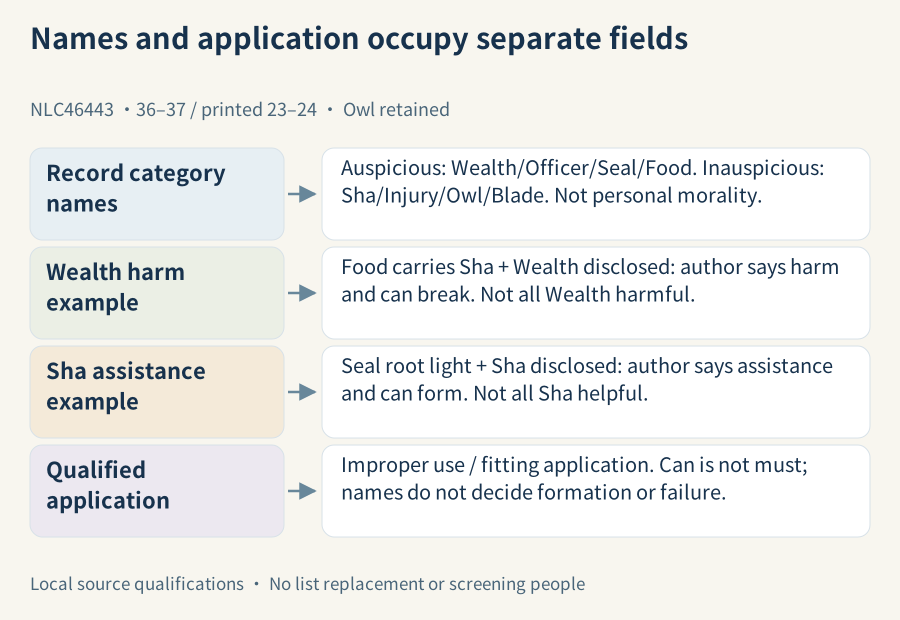
The complete figure is shown below. Select it to enlarge the labels. Open full-size figure · PNG
The labels are retained rather than abolished
The examples preserve their category names while showing that application can produce another structural assessment. Classification and application are distinct tasks in the author's account. A historical inquiry can ask how a class influences a default reading, then identify which explicit qualifications alter that reading.
The book still uses traditional formation, failure and status evaluation. It supplies no real-world evidence that people carrying one character deserve more trust or that people carrying another should be excluded. Our comparison concerns factors in a textual argument, not selecting people by symbolic categories.
This distinction is also a translation discipline. Auspicious and inauspicious indicate the work's names, while harms and assists describe its assessment in a specified example. If the translation uses good and bad for both fields without explanation, readers may lose the difference the two paragraphs are making.
Symmetrical deletions reveal the same error
Delete Food carrying Sha from the Wealth example and the range of the harm claim expands. Delete lightly rooted Seal from the Sha example and the assistance claim likewise expands. Delete disclosure from both and a specified state becomes mere presence. The errors are symmetrical, regardless of whether an interpreter favors auspicious or inauspicious vocabulary.
A stronger abstract follows this sentence form: a factor in a named category, under a named structure and state, performs the operation assessed by the author. Historical labels and relational judgments then occupy separate fields. This prepares the next question: when an auxiliary star name cannot enter the generating/controlling selection relations prioritized by this work, does it nevertheless have authority to replace the formation/failure assessment?
Sources and further reading
NLC46443, 論四吉神能破格, printed 二三, scan 36. Identified source page
NLC46443, 論四凶神能成格, printed 二四, scan 37. Identified source page
NLC46443, 实际刊记:出版与发行, no numbered printed leaf, scan 74. Identified source page
Punctuation, translation, analysis and diagrams are original. Research facsimiles and modern commentary are excluded. Return to Formation Rescue and Change; basic relationships are introduced in Ten Gods.
Evidence and source roles
These roles distinguish ancient text, older commentary, historical scholarship and tool reproduction. The numbered notes in the article retain the precise scan pages and explanations. Library and academic sources do not endorse predictive claims.
- ZP2-P23 · Ancient text evidence: 論四吉神能破格
Text layer in the witness: Identified 1926 witness main text, single-line print; original punctuation, translation and analysis; not modern Xu commentary - ZP2-P24 · Ancient text evidence: 論四凶神能成格
Text layer in the witness: Identified 1926 witness main text, single-line print; original punctuation, translation and analysis; not modern Xu commentary - ZP2-P31 · Ancient text evidence: 实际刊记:出版与发行
Text layer in the witness: Actual end colophon, separately arranged publication/distribution fields; inspected for the preceding first phase