Mixed-qi selection and storehouse clashes are related questions, but they do not combine into a rule that every storehouse must be clashed. The first section asks how mixed hidden relationships are selected through disclosure or branch gathering. The next examines whether punishment or clash can replace those qualifications. It criticizes the no-clash-no-development slogan while retaining an example of a particular storehouse clash that does not break the configuration. Both directions matter.
We use NLC46443. Mixed-Qi Selection begins midway through scan 33, printed 20, and ends on 35, printed 22. The storehouse section then starts separately and continues to 36, printed 23, before the four auspicious factors heading. Adjacent pages do not erase distinct questions, and sharing Chen month does not make different day stems, disclosures and objects interchangeable.
Hidden candidates do not automatically have equal selected roles
Scan 33 states that disclosed stems and gathered branches select what is clear, making mixture not mixed. Its common entrance is Jia in Chen month: disclosed Wu is used as Indirect Wealth, disclosed Gui as Direct Seal, and disclosed Yi as Monthly Rob Wealth.[1] The passage does not say that every hidden candidate automatically has the same selected function.
The printed Gui must not become Ren in the Seal example. Monthly Rob Wealth likewise remains in the list rather than being omitted because its name sounds less auspicious. Hidden and disclosed states have different fields: the mixed background provides candidates, while disclosure participates in the stated selection. A shortened table must keep the entrance and actual disclosed characters, not only configuration labels.
Mixture not mixed does not mean that Chen physically loses every other hidden stem. It describes relational selection of what is clear. Physical removal of elements, reduced phase counts or numerical purification are not facts supplied by this paragraph.
Gathering and disclosure are distinct entrances
The continuation asks what branch gathering means and gives Jia in Chen month meeting Shen and Zi to form a group, using Water Seal. It then distinguishes one disclosure, multiple disclosures and disclosure together with gathering.[2] Shen and Zi, with the already stated Chen month, are the actual components. Any arbitrary combination character cannot stand in for them.
The Water-Seal path and the disclosed-Gui path are related but expressed differently. The text says that joint disclosure or disclosure plus gathering entails joint use, while subsequent discussion still examines fitting or unfitting relationships. Joint use should not be translated as formation already guaranteed. This connects to the previous purity question without replacing relationship analysis with a count.
| Listed condition for Jia in Chen month | Selection described here | Difference retained |
|---|---|---|
| Wu disclosed | Indirect Wealth | Disclosure, not merely Earth hidden in Chen |
| Gui disclosed | Direct Seal | Actual Gui and its disclosed state |
| Yi disclosed | Monthly Rob Wealth | Preserve the listed factor despite its label |
| Shen and Zi gather a group | Water Seal | Actual components with Chen-month entrance |
| Joint disclosure, or disclosure plus gathering | Multiple or joint use | Relationships still require checking |
The no-clash-no-development slogan is a criticized voice
The next section records that Chen, Xu, Chou and Wei most favor punishment/clash and that Wealth or Officer entering a storehouse cannot develop without clash. It immediately says that, although commonplace books celebrate this view, the method attributed to Master Ziping has no such doctrine.[3] The opening slogan is what the author criticizes, not the rule this section endorses.
Extracting those first clauses alone reverses the stance of the passage. This shows why voice matters alongside chapter boundaries: who is speaking, and does the following text accept or reject the statement? We have not independently inspected every book included in the author's generalization about commonplace books, nor authenticated a biography of Master Ziping. What is clear is this section's rejection of the slogan as a universal principle.
Clash does not automatically substitute for undisclosed Wu
Scan 35 asks why punishment or clash is needed when mixed qi already has disclosure or gathering. It separately identifies disclosed Wu as Indirect Wealth and Shen/Zi gathering as Seal. It then says that if Wu Earth is not disclosed, Chen-Xu clash still leaves the Wealth configuration not especially clear.[4]
Still not especially clear is a qualified conclusion. It should not become absolute nonformation, and the condition if Wu is not disclosed cannot be omitted. The argument is that clash under this entrance does not automatically replace disclosure and yield equivalent clarity. This example does not support the opposite blanket rule that every clash is useless.
Wealth here is a traditional relational category, not an actual bank account or material storage room. A Chen-Xu symbolic clash cannot be turned into an instruction to open a real financial storehouse or a promise of income. The question is whether one selection qualification can be replaced by another relationship.
The exception says no breaking, not the reverse
Scan 36 explicitly acknowledges cases that develop with clash and gives: “癸生辰月,透戊為官,與戌相衝,不見破格.” Gui in Chen month, with Wu disclosed as Officer and a clash with Xu, does not show the configuration being broken.[5] The negation is decisive. It must not be rewritten as the author declaring this example broken.
The earlier day stem is Jia; the later one is Gui. The earlier example concerns Wu not disclosed; the later expressly has disclosed Wu as Officer. Grouping both solely under Chen-Xu clash misses these differences in entrance and object. The section also distinguishes storehouse Earth movement from clashes involving Zi, Wu, Mao and You; acknowledging this exception does not make every clash favorable.
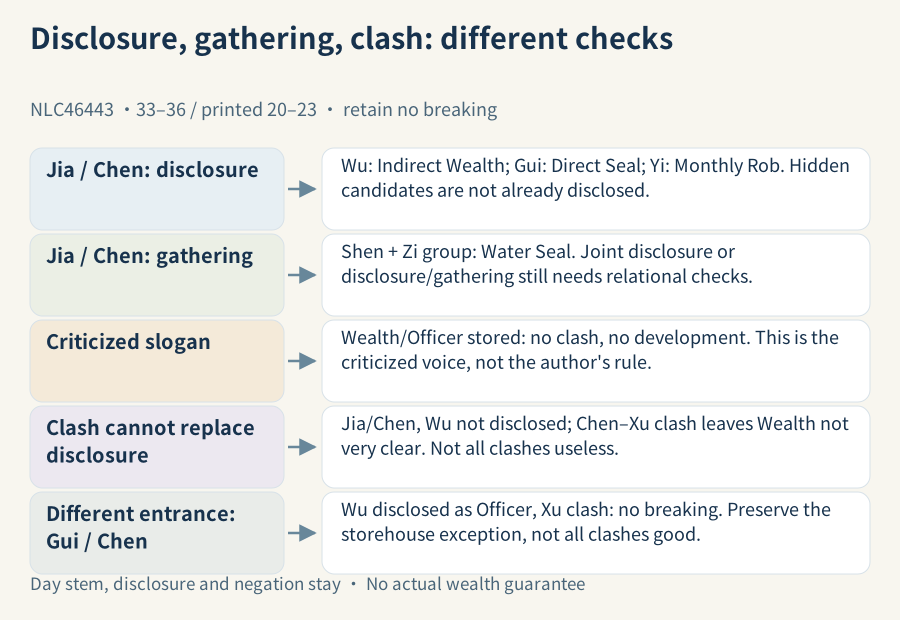
The complete figure is shown below. Select it to enlarge the labels. Open full-size figure · PNG
Two checks are clearer than an opening-storehouse slogan
One card asks how hidden candidates enter selection through disclosure or gathering, whether multiple use occurs, and what relations connect the selected factors. Another asks what structure punishment or clash confronts, and whether it has been incorrectly treated as an automatic replacement for disclosure or gathering. The cards can be read together without merging their questions.
The conclusion is neither all storehouse clashes good nor all bad. The author rejects compulsory clash, uses Jia/Chen with undisclosed Wu to show that clash does not automatically produce clear Wealth selection, and preserves the Gui/Chen disclosed-Wu Officer example in which clash does not break the configuration. Objects, disclosure and negation occupy different fields. Omitting one can turn a bounded argument into its opposite.
Sources and further reading
NLC46443, 論雜氣如何取用, printed 二〇, scan 33. Identified source page
NLC46443, 論雜氣如何取用, printed 二〇, scan 33. Identified source page
NLC46443, 論墓庫刑衝之說, printed 二二, scan 35. Identified source page
NLC46443, 論墓庫刑衝之說, printed 二二, scan 35. Identified source page
NLC46443, 論墓庫刑衝之說, printed 二三, scan 36. Identified source page
NLC46443, 实际刊记:出版与发行, no numbered printed leaf, scan 74. Identified source page
Punctuation, translation, analysis and diagrams are original. Research facsimiles and modern commentary are excluded. Return to Formation Rescue and Change; basic relationships are introduced in Ten Gods.
Evidence and source roles
These roles distinguish ancient text, older commentary, historical scholarship and tool reproduction. The numbered notes in the article retain the precise scan pages and explanations. Library and academic sources do not endorse predictive claims.
- ZP2-P18 · Ancient text evidence: 論雜氣如何取用
Text layer in the witness: Identified 1926 witness main text, single-line print; original punctuation, translation and analysis; not modern Xu commentary - ZP2-P19 · Ancient text evidence: 論雜氣如何取用
Text layer in the witness: Identified 1926 witness main text, single-line print; original punctuation, translation and analysis; not modern Xu commentary - ZP2-P20 · Ancient text evidence: 論墓庫刑衝之說
Text layer in the witness: Identified 1926 witness main text, single-line print; original punctuation, translation and analysis; not modern Xu commentary - ZP2-P21 · Ancient text evidence: 論墓庫刑衝之說
Text layer in the witness: Identified 1926 witness main text, single-line print; original punctuation, translation and analysis; not modern Xu commentary - ZP2-P22 · Ancient text evidence: 論墓庫刑衝之說
Text layer in the witness: Identified 1926 witness main text, single-line print; original punctuation, translation and analysis; not modern Xu commentary - ZP2-P31 · Ancient text evidence: 实际刊记:出版与发行
Text layer in the witness: Actual end colophon, separately arranged publication/distribution fields; inspected for the preceding first phase