Translating Sun and Yi as decrease and increase easily invites a plus-or-minus reading. The selected texts give a different task. Sun's judgement includes a named form of offering; its lines contain benefit and a warning about proceeding. Yi's upper line contains no benefit, possible attack and an adverse qualification. The title alone cannot supply a direction for prices, income or assets.
Our comparison asks what is adjusted, how an action is qualified and whether the recipient is actually specified. These are reading questions about finite classical words. They are not a model for forecasting financial change.
Sun's judgement asks about a use and a measure
The judgement reads 損有孚元吉无咎可貞利有攸往曷之用二簋可用享.[1] The favorable words do not exhaust it. 曷之用 introduces a question, followed by 二簋可用享. The number two, the gui-vessels and their use belong to the selected sentence.
For this close reading, we render 二簋 as two gui-vessels and 用享 as use in offering. That rendering is an interpretive choice, not a copied modern translation. It keeps the culturally specific object rather than turning two into an investment percentage or a quantity of cash. The passage's concern with an adequate form of use is different from a statement about the market value of everything called a decrease.
The precise ritual interpretation can be developed through a separately identified old annotation. The classical clause itself already supplies a modest but important check: any paraphrase that says only “loss is unfavorable” has ignored 元吉, 无咎 and 可用享 in this actual Sun judgement.
A line can restrain proceeding while naming benefit
Sun's second nine reads 九二利貞征凶弗損益之.[3] 利貞 and 征凶 are attached to different qualifications, and 弗損益之 keeps benefit in the decrease hexagram. A close rendering of the last phrase can say do not diminish; benefit the referent of 之. The selected phrase does not by itself name that referent as a modern account, client or asset.
This is why the syntax matters more than the title's arithmetic association. Treating every occurrence of 損 as a negative number would miss 弗損; treating every benefit as permission to proceed would miss 征凶. The line contains both a restrained activity and a differently qualified outcome or orientation.
We also avoid silently supplying a fixed beneficiary. A later interpretation might explain whose decrease or benefit is at issue. That explanation needs its own location and responsibility. Until then, keeping the pronoun visible is more informative than giving it a confident modern identity.
A cultural number is not a ready-made money conversion
Sun's fifth six reads 六五或益之十朋之龜弗克違元吉.[4] The line includes 或, benefit, 十朋之龜, 弗克違 and 元吉. Translating only increase would leave the culturally named tortoise expression and the qualification unexplained.
We retain ten peng in discussing that expression rather than assigning a modern currency amount. Nor do we infer that it means exactly ten individual tortoises merely from the numeral. Determining the historical measure and its use would require further sources beyond the selected sentence. The words here are enough to show why a spreadsheet column labeled profit cannot stand in for the line.
The manuscript's same-scan continuation from 弗克違 to 元吉 also matters. Reading the first part alone could detach the outcome from the very line being cited. Keeping the text together does not turn it into a record of a verifiable economic transaction.
Yi's favorable judgement remains its own unit
Yi's judgement reads 益利有攸往利涉大川.[2] It permits the named going and river-crossing activities in its own judgement. That is not the same textual unit as Sun's second-line warning about 征. Pairing them does not make one statement cancel the other.
Yi's initial nine reads 初九利用爲大作元吉无咎.[5] The line supplies an action, 大作, and favorable words at a named initial position. We leave the scale and historical application of 大作 open rather than translating it into a guaranteed business expansion. A modern large project would have its own costs, evidence and decisions.
Yi's upper line tests the optimistic title
The upper nine reads 上九莫益之或擊之立心勿恒凶.[6] No one benefiting the referent, possible attack, 立心勿恒 and 凶 are all present in the same line. The exact interpretation of the heart or intention phrase can be discussed, but the unfavorable term cannot be removed to preserve a uniformly positive increase label.
Likewise, 或 must not be turned into a certain event for a real person. A finite old divinatory scene is not an empirical dataset. The useful test is textual: an account of Yi that promises gain at every position contradicts the selected upper line before any modern application is attempted.
Four questions replace an automatic plus or minus
| Reading question | Sun selections | Yi selections | What remains unestablished |
|---|---|---|---|
| What is used or done? | Two gui-vessels; proceeding qualification | Going, crossing; 大作 | Modern project or asset identity |
| What is restricted? | 征凶; 弗損 at second nine | 莫益, 或擊, 勿恒 at upper nine | A universal rule for all positions |
| Who or what receives? | The pronoun 之; tortoise expression | The pronoun 之 in upper line | A particular modern beneficiary |
| What kind of number? | Two; ten peng in named cultural contexts | No financial measure in these selections | Currency conversion or price change |
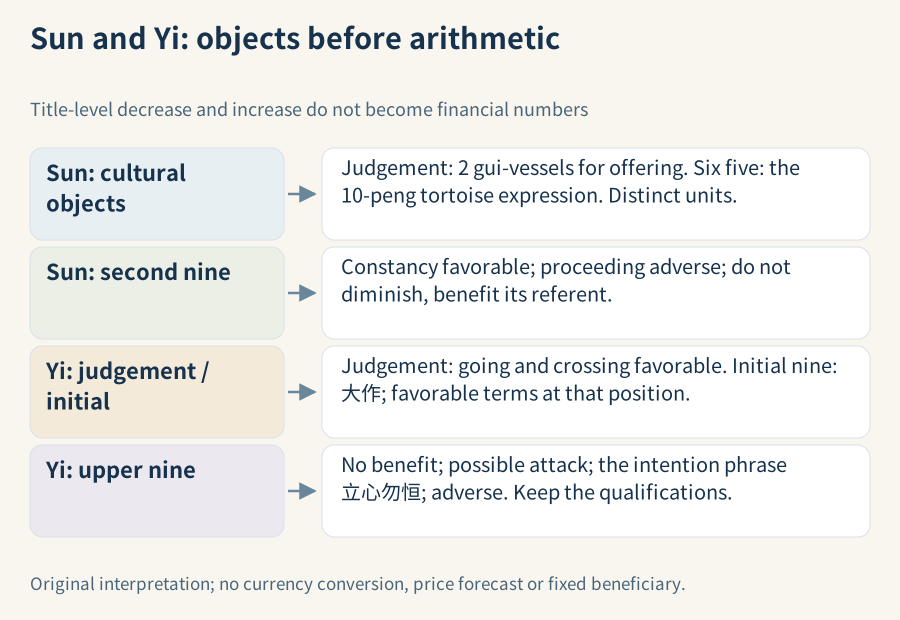
The complete figure is shown below. Select it to enlarge the labels. Open full-size figure · PNG
Calling this an adjustment-and-benefit reading is useful only if we still inspect the object, measure and qualification. It does not mean that every act of giving or cutting back is endorsed. The title offers an entrance to the text; the sentence determines what our finite interpretation can actually support.
The next pair, Jiji and Weiji, closes the collection with another challenge to a simple title: a completed situation still contains qualifications, while an unfinished one need not supply a permanent verdict of failure.
Sources and further reading
損卦辞(经);卷7, scan2; manuscript folio unverified。Selected witness/source page
益卦辞(经);卷7, scan7; manuscript folio unverified。Selected witness/source page
損所选爻辞(经);卷7, scan5; manuscript folio unverified。Selected witness/source page
損所选爻辞(经);卷7, scan6; manuscript folio unverified。Selected witness/source page
益所选爻辞(经);卷7, scan9; manuscript folio unverified。Selected witness/source page
益所选爻辞(经);卷7, scan11; manuscript folio unverified。Selected witness/source page
別046-0003写本目录字段(Commons承接);Catalogue fields; ancient page number inapplicable。Selected witness/source page
Short quotations retain the selected manuscript’s classical forms. Punctuation, translations, comparisons and diagrams are original. Manuscript era is a catalogue field and unverified folios stay blank. Source scans are not republished; finite paired reading is not a complete 64-hexagram critical edition or validated life prediction.
Evidence and source roles
These roles distinguish ancient text, older commentary, historical scholarship and tool reproduction. The numbered notes in the article retain the precise scan pages and explanations. Library and academic sources do not endorse predictive claims.
- YC2-E05-SUN-JUDGMENT · Ancient text evidence: 損卦辞(经)
Text layer in the witness: Classical hexagram statement in the identified manuscript. Interposed Wings, old annotation and subcommentary are excluded from the selected words. - YC2-E05-YI-JUDGMENT · Ancient text evidence: 益卦辞(经)
Text layer in the witness: Classical hexagram statement in the identified manuscript. Interposed Wings, old annotation and subcommentary are excluded from the selected words. - YC2-E05-SUN-NINE-TWO · Ancient text evidence: 損所选爻辞(经)
Text layer in the witness: Classical line statement in the identified manuscript. Interposed Wings, old annotation and subcommentary are excluded from the selected words. - YC2-E05-SUN-SIX-FIVE · Ancient text evidence: 損所选爻辞(经)
Text layer in the witness: Classical line statement in the identified manuscript. Interposed Wings, old annotation and subcommentary are excluded from the selected words. - YC2-E05-YI-INITIAL-NINE · Ancient text evidence: 益所选爻辞(经)
Text layer in the witness: Classical line statement in the identified manuscript. Interposed Wings, old annotation and subcommentary are excluded from the selected words. - YC2-E05-YI-UPPER-NINE · Ancient text evidence: 益所选爻辞(经)
Text layer in the witness: Classical line statement in the identified manuscript. Interposed Wings, old annotation and subcommentary are excluded from the selected words. - YC2-E00-CATALOGUE · Historical-manuscript library catalogue: 別046-0003写本目录字段(Commons承接)
Text layer in the catalogue: Historical-witness catalogue fields imported by the institutional-linked Commons mirror. The Muromachi label and catalogued responsibilities are metadata, not a dated copying inscription or authenticated autograph.