Tai and Pi are often organized through the contrast of openness and blockage. The selected classical words make that contrast useful, but also make a permanent favorable-or-unfavorable label inadequate. Tai contains warnings about return and a fallen wall. Pi has an upper line that moves from blockage to joy. Each statement still belongs to its own unit and position.
The point is not to replace one absolute label with its opposite. It is to compare what the whole judgement says with what a selected line adds, and to keep the change described by the text separate from a prediction of a modern social cycle.
Read the movement before assigning identities
Tai's judgement reads 泰小往大來吉亨. Pi's reads 否之匪人不利君子貞大往小來.[1,2] The going and coming of small and great are reversed. Those are actual differences in the words. Determining everything that small and great represent in an interpreter's account requires further evidence from that account.
We therefore retain the movement terms before translating them into a complete theory of persons, classes or cosmic forces. The labels can guide comparison, but the finite classical excerpts do not authorize us to rank modern people as inherently great or small.
Pi also names 君子 and includes the phrase 否之匪人. A smooth translation such as “bad people are in charge” would settle an interpretive question and supply a political scene not explicitly established by this selected passage. Keeping the phrase visible helps readers distinguish classical wording from a later explanation. The unfavorable term is attached to the judgement's actual qualification; it is not a moral diagnosis of an identifiable person today.
Tai's third line does not permit flat certainty
Tai's third nine reads 九三无平不陂无往不復艱貞无咎勿恤其孚于食有福.[3] The first paired clauses may be closely rendered as no level without a slope, no going without returning. They are followed by qualifications involving hardship and constancy, no calamity, assurance and food. The witness's 无 forms and the written 于 remain in our quotation.
The whole line matters because a reader can make two opposite mistakes. Extracting only no going without return and predicting a dated reversal discards the rest of the scene. Extracting only the Tai judgement's 吉亨 and assuming permanent stability discards the line's explicit return language.
We can state a smaller conclusion: this Tai position has a qualified description of instability alongside its outcome terms. We have not established an empirical law that every favorable institution or relationship reverses on a schedule. The absence of a modern date or unit of measurement is not something an editor should fill with a confident forecast.
The upper line changes the scale of the warning
Tai's upper six reads 上六城復于隍勿用師自邑告命貞吝.[4] The wall returning to the moat or ditch is a concrete image. 勿用師 supplies a prohibition, while 自邑告命 and 貞吝 remain part of the line. It cannot be compressed into “the wall falls, therefore any forceful response is appropriate.”
A historical image is not a documented event merely because it is vivid. This finite reading has not identified a city, a commander or an actual campaign. Nor does it turn the line into modern military or emergency instructions. The textual contribution is more direct: a title associated with openness still contains a sharply qualified upper-line scene, and its negative must stay with its object.
This also guards against treating the six positions as a guaranteed chronological narrative. The upper designation locates a line in the hexagram; assigning it an age, a regime's final year or an investment horizon requires evidence beyond the selected words.
Pi's upper line does not preserve blockage forever
Pi's upper nine reads 上九傾否先否後喜.[5] It connects overturning blockage with first blockage, afterward joy. 先 and 後 are meaningful parts of the sentence. A permanently adverse Pi label would fail to account for the latter term.
Yet the line's contrast does not promise that every difficult modern situation ends happily. Its scope is the named upper line. It also does not erase the earlier judgement. The two textual units can be read together precisely because their scale and qualification remain visible.
Comparing this Pi line with Tai's upper line gives a disciplined reversal test. Tai's title-level favorable words cannot make its upper warning disappear; Pi's title-level adverse words cannot make its upper joy disappear. We need not force the lines into one identical mechanism to see why both permanent labels are too broad.
A comparison should retain the unit of each claim
| Reading unit | Tai | Pi | Limit on generalization |
|---|---|---|---|
| Judgement movement | Small goes, great comes | Great goes, small comes | Do not silently assign modern identities |
| Selected third line | Going and return; further qualifications | Not selected here | A finite selection is not all six lines |
| Selected upper line | Wall, 勿用師, 貞吝 | Overturning blockage, first blockage and later joy | The title does not erase line wording |
| Present comparison | Favorable label contains a warning | Adverse label contains a contrasting outcome | No universal timetable inferred |
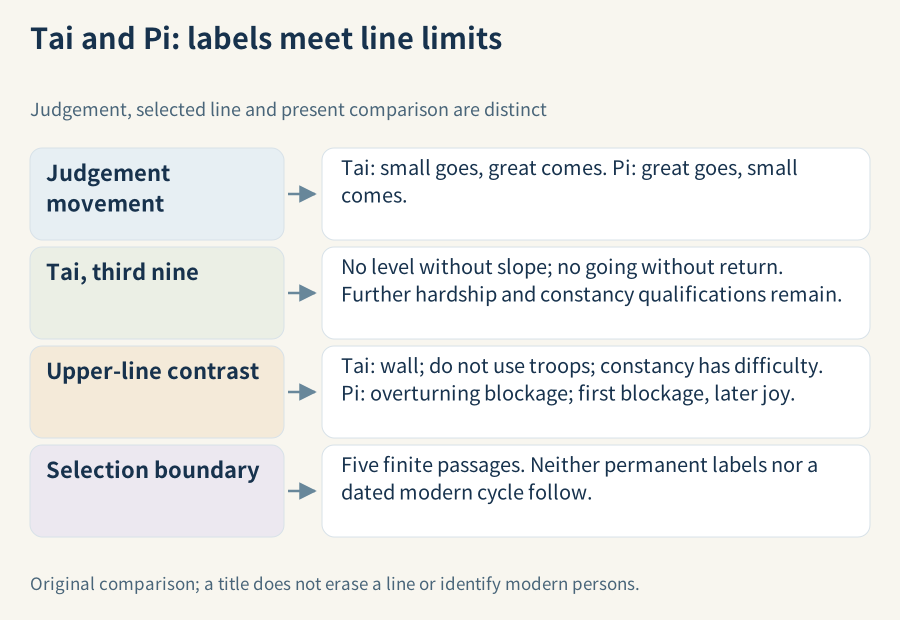
The complete figure is shown below. Select it to enlarge the labels. Open full-size figure · PNG
One cell deliberately says not selected. That is more honest than borrowing an unexamined familiar Pi line to make the table perfectly symmetrical. Our source selection supplies enough evidence for the permanent-label question without pretending to exhaust either hexagram.
Openness and blockage are qualified reading terms
Test the statements “Tai has no danger” and “Pi has no exit” against the selected upper lines. Each fails a concrete textual check. A better description retains a unit, an image and its result or restraint: Tai upper six, wall and prohibition; Pi upper nine, overturning and afterward joy.
This reading method permits comparison while resisting a total verdict on modern lives. The next pair, Sun and Yi, adds a related problem: titles translated as decrease and increase invite numerical associations, but their actual objects and ritual setting require closer attention.
Sources and further reading
泰卦辞(经);卷3, scan21; manuscript folio unverified。Selected witness/source page
否卦辞(经);卷3, scan25; manuscript folio unverified。Selected witness/source page
泰所选爻辞(经);卷3, scan23; manuscript folio unverified。Selected witness/source page
泰所选爻辞(经);卷3, scan25; manuscript folio unverified。Selected witness/source page
否所选爻辞(经);卷3, scan28; manuscript folio unverified。Selected witness/source page
別046-0003写本目录字段(Commons承接);Catalogue fields; ancient page number inapplicable。Selected witness/source page
Short quotations retain the selected manuscript’s classical forms. Punctuation, translations, comparisons and diagrams are original. Manuscript era is a catalogue field and unverified folios stay blank. Source scans are not republished; finite paired reading is not a complete 64-hexagram critical edition or validated life prediction.
Evidence and source roles
These roles distinguish ancient text, older commentary, historical scholarship and tool reproduction. The numbered notes in the article retain the precise scan pages and explanations. Library and academic sources do not endorse predictive claims.
- YC2-E04-TAI-JUDGMENT · Ancient text evidence: 泰卦辞(经)
Text layer in the witness: Classical hexagram statement in the identified manuscript. Interposed Wings, old annotation and subcommentary are excluded from the selected words. - YC2-E04-PI-JUDGMENT · Ancient text evidence: 否卦辞(经)
Text layer in the witness: Classical hexagram statement in the identified manuscript. Interposed Wings, old annotation and subcommentary are excluded from the selected words. - YC2-E04-TAI-NINE-THREE · Ancient text evidence: 泰所选爻辞(经)
Text layer in the witness: Classical line statement in the identified manuscript. Interposed Wings, old annotation and subcommentary are excluded from the selected words. - YC2-E04-TAI-UPPER-SIX · Ancient text evidence: 泰所选爻辞(经)
Text layer in the witness: Classical line statement in the identified manuscript. Interposed Wings, old annotation and subcommentary are excluded from the selected words. - YC2-E04-PI-UPPER-NINE · Ancient text evidence: 否所选爻辞(经)
Text layer in the witness: Classical line statement in the identified manuscript. Interposed Wings, old annotation and subcommentary are excluded from the selected words. - YC2-E00-CATALOGUE · Historical-manuscript library catalogue: 別046-0003写本目录字段(Commons承接)
Text layer in the catalogue: Historical-witness catalogue fields imported by the institutional-linked Commons mirror. The Muromachi label and catalogued responsibilities are metadata, not a dated copying inscription or authenticated autograph.