Jiji and Weiji can close this collection because they make completion itself a question. Their titles do not let a reader stop checking conditions. Jiji's judgement includes a favorable beginning and disorder at the end; Weiji includes a little fox, a nearly completed crossing and a wet tail. Their selected initial and upper lines make an especially useful comparison of similar images with different surrounding words.
This is a close reading of two hexagrams, not an account of every stage in a person's life. It also closes a collection of six editorial pairs, not a complete study of all sixty-four hexagrams. A later collection will turn to the Wings and interpretation with their separate textual responsibilities.
Completion has an internal qualification
Jiji's judgement reads 既濟亨小利貞初吉終亂.[1] We retain 亨小利貞 without treating one modern punctuation of 小 as authenticated ancient punctuation. More than one division can influence a fluent rendering. The present contrast does not require us to suppress that choice, because 初吉 and 終亂 are secure words in the selected sequence.
Those beginning-and-ending terms prevent completion from meaning permanent immunity to difficulty. A rendering that says only “already completed, therefore favorable” loses the end's disorder. Conversely, retaining 終亂 does not identify a modern date or prove that all completed projects must eventually collapse.
The proper scale is the judgement being read. It contains a contrast that needs interpretation; it does not contain a dataset establishing a universal law of endings. The title opens the question rather than settling all later units.
Weiji names a crossing with an animal and a limit
Weiji's judgement reads 未濟亨小狐汔濟濡其尾无攸利.[2] 小狐 specifies the little fox. We provisionally render 汔 as nearly, preserving the manuscript's actual water-radical-plus-乞 character rather than silently replacing it with a familiar alternative. The tail becomes wet, and 无攸利 remains attached to this represented situation.
Neither the animal nor the incomplete crossing is an ornament to be dropped before making a modern success slogan. A statement such as “unfinished means progress is always favorable” would omit the wet tail and its adverse qualification. “Unfinished means failure forever” would turn a selected scene into an unlimited time claim.
The two judgements therefore resist opposite shortcuts. Jiji is not simply a permanent good ending; Weiji is not simply permanent inability. Their classical words qualify the scenes differently, and those differences should be explained before any analogy is proposed.
The same wet tail does not produce the same line result
Jiji's initial nine reads 初九曳其輪濡其尾无咎.[3] Weiji's initial six reads 初六濡其尾吝.[4] Both contain 濡其尾, but Jiji also includes dragging the wheel and gives 无咎; Weiji gives 吝 at its own initial six.
This is a strong test of keyword interpretation. Wet tail alone does not carry one fixed verdict across the two lines. It would be just as misleading to delete 曳其輪 from the first line to make the comparison visually neat. The initial designation, nine or six, preceding action and result all remain part of what is compared.
We do not infer that a specific physical technique caused the different judgements, or that repeating an action from one line guarantees its result in another. Those would be additional causal claims. The finite evidence supports a reading claim: an image must stay with its surrounding action and the named textual unit.
Upper-line water does not erase its surroundings either
Jiji's upper six reads 上六濡其首厲.[5] The head rather than the tail is wet, and 厲 supplies its own warning. This actual upper-line scene is another reason to keep a qualification beside the completed title.
Weiji's upper nine is longer: 上九有孚于飲酒无咎濡其首有孚失是.[6] It names assurance in drinking wine and no calamity, then wetting the head and a further 有孚 with 失是. Our close rendering treats 失是 as losing the proper orientation, an interpretive choice that does not replace the original words.
The two occurrences of 有孚 must both survive transcription. Quoting only the first portion would keep reassurance and omit the later loss; joining the head image to an unrelated modern drinking recommendation would lose the text's own scene. The upper line demonstrates how even a shared assurance term can be differently qualified within one unit.
A matched image is the beginning of a comparison
| Unit | Jiji selection | Weiji selection | What the match cannot decide alone |
|---|---|---|---|
| Judgement | 初吉 / 終亂 | Little fox, 汔濟, wet tail, 无攸利 | A final verdict from the title |
| Initial line | Dragging wheel + wet tail + 无咎 | Wet tail + 吝 | A fixed result for 濡其尾 |
| Upper line | Wet head + 厲 | Wine scene; two 有孚; wet head and 失是 | A result from one detached reassurance |
| Editorial pairing | Completion still has qualifications | Incompletion has a specified scene | A universal sequence of modern lives |
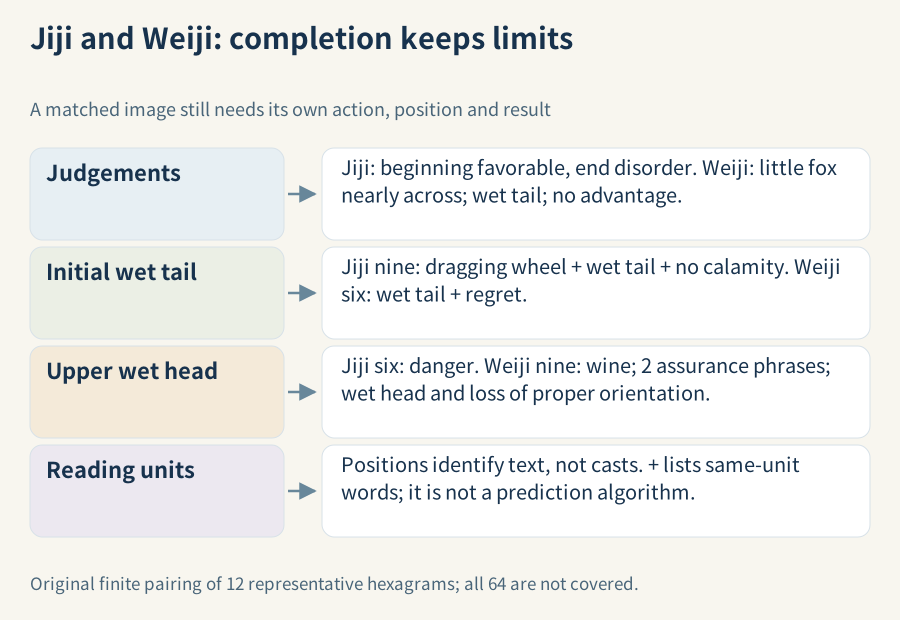
The complete figure is shown below. Select it to enlarge the labels. Open full-size figure · PNG
The table's plus signs only enumerate components that occur in the selected unit. They do not encode an algorithm for changing lines or calculating outcomes. The first collection's symbol-and-position distinction remains necessary: these are identified textual positions, not recorded casts.
Finish the collection by retaining its limits
Across the six pairs, we have compared different roles, kinds of beginning, waiting and dispute, openness and blockage, adjustment and benefit, completion and incompletion. They are representative selections organized for reading. The argument does not claim that the twelve selected hexagrams exhaust the classical text or establish a new historical classification.
A reusable habit emerges: name the unit, preserve the actor and action, retain negatives and qualifiers, compare the outcome at the same scale, and identify any addition made by translation or analogy. Finishing this exercise should make those questions easier to ask. It should not make a reader think that a final label has removed the need to ask them.
Sources and further reading
既濟卦辞(经);卷9, scan27; manuscript folio unverified。Selected witness/source page
未濟卦辞(经);卷9, scan31; manuscript folio unverified。Selected witness/source page
既濟所选爻辞(经);卷9, scan28; manuscript folio unverified。Selected witness/source page
未濟所选爻辞(经);卷9, scan32; manuscript folio unverified。Selected witness/source page
既濟所选爻辞(经);卷9, scan30; manuscript folio unverified。Selected witness/source page
未濟所选爻辞(经);卷9, scan34; manuscript folio unverified。Selected witness/source page
別046-0003写本目录字段(Commons承接);Catalogue fields; ancient page number inapplicable。Selected witness/source page
Short quotations retain the selected manuscript’s classical forms. Punctuation, translations, comparisons and diagrams are original. Manuscript era is a catalogue field and unverified folios stay blank. Source scans are not republished; finite paired reading is not a complete 64-hexagram critical edition or validated life prediction.
Evidence and source roles
These roles distinguish ancient text, older commentary, historical scholarship and tool reproduction. The numbered notes in the article retain the precise scan pages and explanations. Library and academic sources do not endorse predictive claims.
- YC2-E06-JI-JUDGMENT · Ancient text evidence: 既濟卦辞(经)
Text layer in the witness: Classical hexagram statement in the identified manuscript. Interposed Wings, old annotation and subcommentary are excluded from the selected words. - YC2-E06-WEI-JUDGMENT · Ancient text evidence: 未濟卦辞(经)
Text layer in the witness: Classical hexagram statement in the identified manuscript. Interposed Wings, old annotation and subcommentary are excluded from the selected words. - YC2-E06-JI-INITIAL-NINE · Ancient text evidence: 既濟所选爻辞(经)
Text layer in the witness: Classical line statement in the identified manuscript. Interposed Wings, old annotation and subcommentary are excluded from the selected words. - YC2-E06-WEI-INITIAL-SIX · Ancient text evidence: 未濟所选爻辞(经)
Text layer in the witness: Classical line statement in the identified manuscript. Interposed Wings, old annotation and subcommentary are excluded from the selected words. - YC2-E06-JI-UPPER-SIX · Ancient text evidence: 既濟所选爻辞(经)
Text layer in the witness: Classical line statement in the identified manuscript. Interposed Wings, old annotation and subcommentary are excluded from the selected words. - YC2-E06-WEI-UPPER-NINE · Ancient text evidence: 未濟所选爻辞(经)
Text layer in the witness: Classical line statement in the identified manuscript. Interposed Wings, old annotation and subcommentary are excluded from the selected words. - YC2-E00-CATALOGUE · Historical-manuscript library catalogue: 別046-0003写本目录字段(Commons承接)
Text layer in the catalogue: Historical-witness catalogue fields imported by the institutional-linked Commons mirror. The Muromachi label and catalogued responsibilities are metadata, not a dated copying inscription or authenticated autograph.