Establish the shared words before comparing translations
Our selected manuscript's classical Qian statement is “乾元亨利貞.”[1] It is a compact sentence with several decisions still open to a translator. Is a term best rendered as an action, a quality, or a judgement? Should one Chinese word receive one target-language word, or several? Should an explanatory interpretation be left in a note or carried into the translation itself? Comparing actual editions makes these decisions visible.
The comparison uses James Legge's 1882 English The Yî King and P.-L.-F. Philastre's 1885 French Le Yi: King.[3][4] They are two different original-language translations. The English and Chinese explanations of Philastre's French below are our own work; they are not quotations from a later English translation. Nor do we claim that either translator used our Japanese manuscript. The shared classical wording is the object of comparison, while each witness keeps its separate identity.
An old explanation also makes choices
The selected subcommentary says “元亨利貞者是乾之四德也” and separately introduces “子夏傳云元始也亨通也利和也貞正也.”[2] Our explanatory rendering of the second quotation is: “The Zixia tradition says: yuan is beginning; heng is passage; li is harmony; zhen is correctness.” The name belongs to an attribution made within the subcommentary. This reading does not authenticate a surviving autograph by Zixia or independently establish that attribution.
The point is that interpretation was already occurring before the modern translators. Calling the terms four virtues and giving them explanatory equivalents are acts of explanation. The old gloss may help a translator, but does not eliminate the need to choose target-language words. It also cannot be merged into the shorter classical statement and presented as if every added definition belonged to the same layer.
Legge expands the terms into an English judgement
Legge's actual opening is: “Khien (represents) what is great and originating, penetrating, advantageous, correct and firm.”[3] The parenthetical “represents” openly mediates between the hexagram's name and the description. The translation gives more than four English adjectives: “great and originating” forms one linked expression, and “correct and firm” another. In our reading, these linked expressions make aspects of yuan and zhen explicit, rather than forcing a one-word correspondence.
“Penetrating” emphasizes movement or passage, whereas “advantageous” gives li a practical evaluative emphasis. Those are observations about the words on the page, not a proof of Legge's complete theory drawn from one sentence. To investigate his whole method, more of his introduction and commentary would need independent reading. The finite comparison already shows an important responsibility: an expanded translation should remain attributable to the translator, instead of being mistaken for extra words present in the classical sentence.
Philastre chooses four French headings
Philastre prints: “Khièn ; Cause initiale, Liberté, bien, perfection.”[4] For this comparison, our literal English guide is “initial cause, freedom, good, perfection”; our Chinese guide is “初始原因、自由、善/好、完善.” These guides deliberately expose the lexical choices. They do not settle how each expression functions throughout Philastre's commentary.
In particular, Liberté should not automatically be turned into a claim about modern political freedom. That would require contextual evidence beyond the selected line. It is enough here to see that this French noun leads a reader toward a different immediate association from Legge's “penetrating.” Similarly, perfection is a single noun where Legge has “correct and firm.” Translating those expressions into our own English or Chinese creates an additional explanatory layer, which we name rather than concealing it.
Compare differences without awarding a winner
| Classical term | Legge's selected English | Philastre's selected French | Present reading question |
|---|---|---|---|
| 元 | great and originating | Cause initiale | Are quality and beginning joined, or is a cause foregrounded? |
| 亨 | penetrating | Liberté | What immediate sense of passage or openness does the choice encourage? |
| 利 | advantageous | bien | Is advantage, goodness or another evaluation being emphasized? |
| 貞 | correct and firm | perfection | Does the wording join correctness with firmness, or select one abstract noun? |
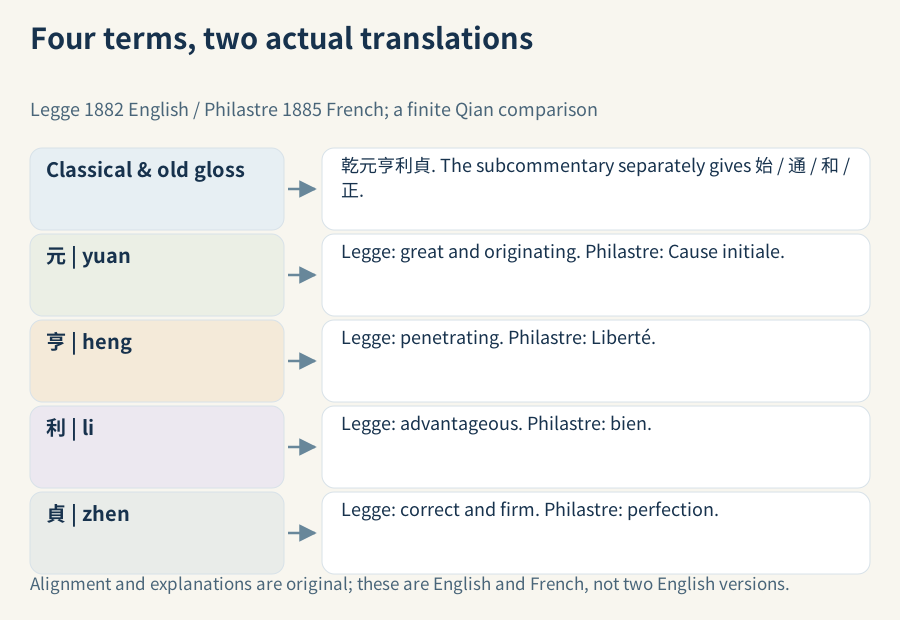
The complete figure is shown below. Select it to enlarge the labels. Open full-size figure · PNG
The term-to-expression alignment is our finite analytical arrangement. It is not a translator's numerical score, a complete dictionary entry, or a claim that the four terms always have these meanings elsewhere. The old gloss supplies a third interpretive reference, with its own responsibility kept separate.
Page labels and edition dates are part of the argument
Legge's title page actually gives his name, Oxford's Clarendon Press and 1882. His Qian page is scan86; no printed page number is visible there. The contents reference to57 and the next page's visible58 support an inferred page57, which we distinguish from a number printed on that page.[3] Philastre's title page gives Paris, Ernest Leroux and 1885; his selected sentence appears on scan23, visibly numbered13.[4] A scan index and a printed number should not be reported as the same observation.
These are finite quotations from the actual nineteenth-century works, followed by original analysis. We do not reproduce source images, substitute a copyrighted later translation, or claim to have compared the complete commentaries. A useful translation comparison ends with a clearer account of each choice and its source. It preserves what the classical words leave open, what the old explanation adds, and what each translator makes explicit. The reader can then assess a rendering through its stated decisions instead of mistaking smooth English for an interpretation without an author.
Sources and further reading
經/乾卦辭;卷1, scan2; manuscript folio unverified。Selected source page
疏/乾卦辭解說;卷1, scan3; manuscript folio unverified。Selected source page
乾卦首句译文/Qian opening translation;scan86; page57 inferred from contents and next page, no numeral visible here。Selected source page Additional location: Original title page: Legge / Clarendon Press /1882 / scan10 Additional location: Contents supports opening page57 / scan13 Additional location: Following page visibly numbered58 / scan87
乾卦首句译文/Qian opening translation;scan23, visible printed page13。Selected source page Additional location: Original title page: Philastre / Ernest Leroux /1885 / scan9
別046-0003写本馆目字段/manuscript catalogue fields;Source webpage; ancient printed page inapplicable。Selected source page
Classical text, Wings, subcommentary, translations and modern scholarship are separately attributed. Repetition signs expand only as noted. Punctuation, translations, diagrams and comparisons are original. Source scans are not republished and unverified folios stay blank; these finite readings are not whole-book collation, autograph authentication or validated life prediction.
Evidence and source roles
These roles distinguish ancient text, older commentary, historical scholarship and tool reproduction. The numbered notes in the article retain the precise scan pages and explanations. Library and academic sources do not endorse predictive claims.
- YC3-E01-QIAN-JING · Ancient text evidence: 經/乾卦辭
Text layer in the witness: Classical Qian judgement; finite selected wording in the identified manuscript. Classical text, explanatory Wings and subcommentary are separately attributed.National Archives of Japan 別046-0003 Zhou yi zhu shu manuscript; copying era catalogued as Muromachi, actual copying date unverified
卷1 · scan 2 · no page numeral verified here
The selected classical four-term statement is distinct from the neighbouring explanation. Punctuation and translations are editorial.
Not a full-volume collation, composition dating, original autograph authentication, variant census, predictive efficacy, or complete Ten Wings study.
- YC3-E12-QIAN-JING-GUSHU · Older subcommentary evidence: 疏/乾卦辭解說
Text layer in the witness: Old subcommentary on the Qian judgement; finite selected wording in the identified manuscript. Classical text, explanatory Wings and subcommentary are separately attributed.National Archives of Japan 別046-0003 Zhou yi zhu shu manuscript; copying era catalogued as Muromachi, actual copying date unverified
卷1 · scan 3 · no page numeral verified here
The same subcommentary separately quotes 子夏傳云元始也亨通也利和也貞正也 across adjacent columns. This is an attribution within the subcommentary, not authentication of a Zixia autograph.
Not a full-volume collation, composition dating, original autograph authentication, variant census, predictive efficacy, or complete Ten Wings study.
- YC3-E14-LEGGE1882-QIAN · Nineteenth-century translation: 乾卦首句译文/Qian opening translation
Text layer in the translation: Translation of canonical Qian hexagram opening; its own commentary follows separately; a nineteenth-century translator’s wording, not the classical Chinese or a modern later translation.James Legge, The Yî King, Oxford: Clarendon Press,1882; original title-page fields actually read
Sacred Books of the East, volume16, The Sacred Books of China, PartII · scan 86 · no page numeral verified here · inferred page number (not visible here) 57
Khien (represents) what is great and originating, penetrating, advantageous, correct and firm.
Additional located evidence: Original title page: Legge / Clarendon Press /1882 · scan 10 (page numeral unverified); Contents supports opening page57 · scan 13 (printed page viii); Following page visibly numbered58 · scan 87 (printed page 58)
The actual title page at scan10 credits James Legge, Oxford Clarendon Press and1882. Scan86 has no visible page numeral. Contents scan13 points to57 and scan87 visibly shows58;57 is therefore inferred. The selected wording is English, and its correspondence to the four Chinese terms is the present author’s analysis.
No claim that this translator used the selected Japanese manuscript; no whole-commentary comparison, current copyrighted translation or source-scan republication.
- YC3-E15-PHILASTRE1885-QIAN · Nineteenth-century translation: 乾卦首句译文/Qian opening translation
Text layer in the translation: Translation of canonical Qian hexagram opening; its own commentary follows separately; a nineteenth-century translator’s wording, not the classical Chinese or a modern later translation.P.-L.-F. Philastre, Le Yi: King, Première partie, Paris: Ernest Leroux,1885; original title-page fields actually read
Première partie · scan 23 · printed page 13
Khièn ; Cause initiale, Liberté, bien, perfection
Additional located evidence: Original title page: Philastre / Ernest Leroux /1885 · scan 9 (page numeral unverified)
Original title page scan9 credits P.-L.-F. Philastre, Première partie, Paris Ernest Leroux and1885. The quoted French occurs at scan23, visibly numbered13, alongside 乾。元亨利貞。; the following Cheng commentary heading is a separate layer. English and Chinese guides to the French are original explanations by the present author.
No claim that this translator used the selected Japanese manuscript; no whole-commentary comparison, current copyrighted translation or source-scan republication.
- YC3-E00-CATALOGUE · Historical-manuscript library catalogue: 別046-0003写本馆目字段/manuscript catalogue fields
Text layer in the catalogue: Institutional-linked catalogue identification through the mirror. Muromachi is a catalogue era label, not a physical copying inscription.National Archives of Japan 別046-0003 Zhou yi zhu shu manuscript; copying era catalogued as Muromachi, actual copying date unverified
This collection uses finite classical, Wing and subcommentary passages. The thirteen-volume corpus is not wholly collated; original authorship of the Wings is not authenticated here.
No fresh official/mirror byte-equivalence verification, original autograph or complete critical edition claimed.