A background of thought begins with a named passage
“一陰一陽之謂道” is a selected sentence of the Xici's upper portion in our identified manuscript.[1] Our own deliberately close rendering is: “A yin and a yang: this is called dao.” Retaining dao makes the unresolved breadth of the term visible. Translating it as “way,” “order,” or another expression can be useful, but each choice supplies an English emphasis. The sentence should first be read as a claim made by a named explanatory text, with its location and responsibility retained.
This matters on a Four Pillars reading site. Familiar vocabulary can encourage readers to treat the sentence as the direct source of any later yin–yang practice. Shared words are evidence of a connection worth investigating; they do not by themselves document when a specific calculation developed, who transmitted it, or how it was validated. This article examines a philosophical background through three finite passages. It does not construct an otherwise undocumented genealogy of birth-chart calculation.
Naming a relationship differs from assigning fixed labels
The sentence places yin and yang together in what it calls dao. It is therefore more than an isolated list of two things. Yet the selected words contain neither a complete classification of people nor an instruction to turn one term into a moral virtue and the other into a defect. A reader who adds such a scheme needs another argument and another source.
Even the English decision to write “a yin and a yang” deserves attention. It keeps the compact repeated 一 visible without claiming that a single numerical pair exhausts the passage's meaning. An exposition might emphasize alternation or complementary processes; those are explanations to be defended through context, not quantities mechanically delivered by the short sentence. The advantage of a close initial rendering is that it keeps the next interpretive step open to scrutiny.
Shengsheng describes continuity through generation
A separately located upper-portion sentence reads “生生之謂易,” with 生生 expanded from the manuscript's repetition sign.[2] Our translation is: “Generation continuing through generation: this is called yi.” The repetition of 生 encourages an account of ongoing production rather than a single completed event. This is our explanation of the selected wording. It is not a claim that the passage has supplied a measured reproduction rate or a universal scientific mechanism.
Comparing the two sentences is productive. The first names yin and yang in relation to dao; the second names continuing generation in relation to yi. They are separately sourced statements, not adjacent halves that we can concatenate into one new quotation. Their relation is the present article's comparison. Keeping that distinction visible allows us to discuss a common concern with process without inventing a continuous ancient paragraph.
The lower portion places change in a narrative
The selected lower-portion words are “易窮則變變則通通則久,” with the repeated 變 and 通 expanded from repetition signs.[3] Our rendering is: “In yi, reaching an impasse brings change; change brings passage, and passage brings duration.” The initial 易 belongs to the observed text and is retained. A familiar modern slogan that starts at 窮 would be a narrower excerpt, not the complete wording selected here.
The wider source window contains the narrative “神農氏沒黃帝堯舜氏作.”[3] That setting matters: the change-language participates in an account of succession and practices within the transmitted text. Quoting the narrative does not independently certify the named ancient events as historical facts. It does, however, stop us from treating the compact sentence as an instruction printed outside all context. Duration here is part of the passage's argument, not a promised number of successful years for a present reader.
What a philosophical theme supplies, and what a procedure needs
| Selected wording | Interpretive work it can support | What it does not specify |
|---|---|---|
| 一陰一陽之謂道 | Discussing a relation between yin, yang and dao | A complete list of categories or a measurable unit |
| 生生之謂易 | Discussing continuity through generation | A production rate, dataset or physical law |
| 易窮則變… | Examining change, passage and duration in a narrative | Inputs, thresholds or an algorithm for life outcomes |
| A present calculation | Applying explicitly stated conventions | Its historical derivation merely from shared vocabulary |
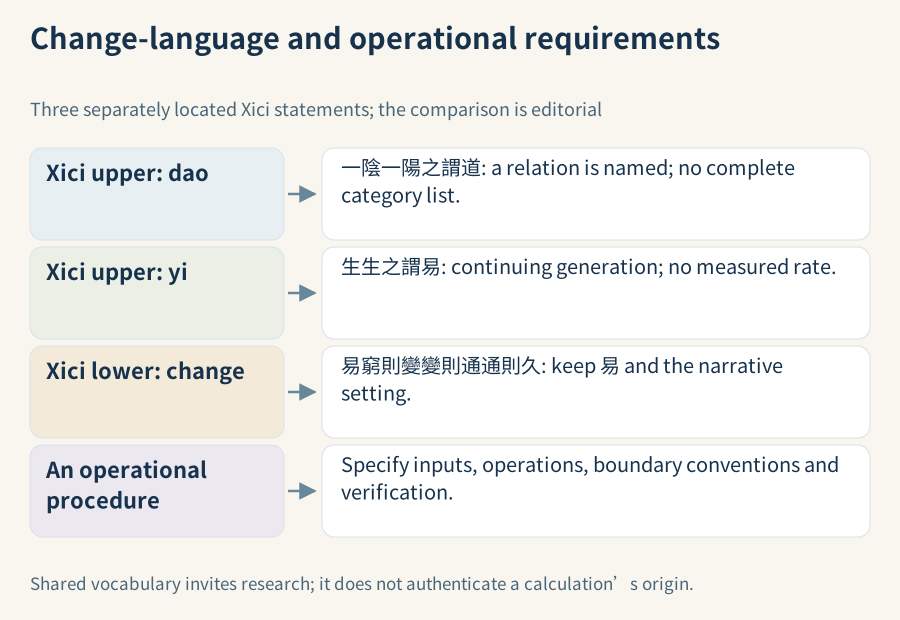
The complete figure is shown below. Select it to enlarge the labels. Open full-size figure · PNG
The diagram compares kinds of explanation. It does not measure yin and yang, and its arrows are not a validated model of causation. A procedure needs a specified input, an operation, conventions for disputed boundaries, and a way to check its result. A philosophical sentence can orient the questions we ask without furnishing all those elements.
Keep an attractive interpretation answerable to its source
Suppose a reader takes “change brings passage” as encouragement to revise an unsuccessful plan. That is a contemporary application. Its practical merits should be examined through the plan's actual conditions. It is not evidence that this ancient passage predicts which revision will work, or that every impasse guarantees a beneficial outcome. The word “change” alone does not choose between possible actions.
Likewise, a later technical text may give yin and yang a particular operational role. To explain that role historically, we would need its own definitions, dating and evidence of transmission. To test its claims empirically, we would need observations and a suitable method. Neither task is completed by recognizing the Xici's vocabulary. The background is valuable as an inherited language for discussing relations and processes; the present reading remains strongest when it states what those finite words actually contribute and leaves additional claims with their own burden of evidence.
Sources and further reading
傳/繫辭上;卷10, scan16; manuscript folio unverified。Selected source page
傳/繫辭上;卷10, scan20; manuscript folio unverified。Selected source page
傳/繫辭下;卷12, scan9; manuscript folio unverified。Selected source page
別046-0003写本馆目字段/manuscript catalogue fields;Source webpage; ancient printed page inapplicable。Selected source page
Classical text, Wings, subcommentary, translations and modern scholarship are separately attributed. Repetition signs expand only as noted. Punctuation, translations, diagrams and comparisons are original. Source scans are not republished and unverified folios stay blank; these finite readings are not whole-book collation, autograph authentication or validated life prediction.
Evidence and source roles
These roles distinguish ancient text, older commentary, historical scholarship and tool reproduction. The numbered notes in the article retain the precise scan pages and explanations. Library and academic sources do not endorse predictive claims.
- YC3-E09-XICI-YINYANG-FINAL · Ancient text evidence: 傳/繫辭上
Text layer in the witness: Xici upper portion; finite selected wording in the identified manuscript. Classical text, explanatory Wings and subcommentary are separately attributed.National Archives of Japan 別046-0003 Zhou yi zhu shu manuscript; copying era catalogued as Muromachi, actual copying date unverified
卷10 · scan 16 · no page numeral verified here
A finite Xici statement about yin, yang and dao. The statement alone neither supplies a calculation nor authenticates a later technique’s genealogy.
Not a full-volume collation, composition dating, original autograph authentication, variant census, predictive efficacy, or complete Ten Wings study.
- YC3-E10-XICI-SHENGSHENG-FINAL · Ancient text evidence: 傳/繫辭上
Text layer in the witness: Xici upper portion; finite selected wording in the identified manuscript. Classical text, explanatory Wings and subcommentary are separately attributed.National Archives of Japan 別046-0003 Zhou yi zhu shu manuscript; copying era catalogued as Muromachi, actual copying date unverified
卷10 · scan 20 · no page numeral verified here
生生 expands a visible repetition sign. The present explanation of continuing generation is editorial, without a measured rate or scientific validation claim.
Not a full-volume collation, composition dating, original autograph authentication, variant census, predictive efficacy, or complete Ten Wings study.
- YC3-E11-XICI-QIONGBIAN-FINAL · Ancient text evidence: 傳/繫辭下
Text layer in the witness: Xici lower portion; finite selected wording in the identified manuscript. Classical text, explanatory Wings and subcommentary are separately attributed.National Archives of Japan 別046-0003 Zhou yi zhu shu manuscript; copying era catalogued as Muromachi, actual copying date unverified
卷12 · scan 9 · no page numeral verified here
The initial 易 remains. Repeated 變 and 通 expand visible repetition signs. The wider passage separately narrates 神農氏沒黃帝堯舜氏作; that is a claim within the transmitted text, not independently verified ancient history.
Not a full-volume collation, composition dating, original autograph authentication, variant census, predictive efficacy, or complete Ten Wings study.
- YC3-E00-CATALOGUE · Historical-manuscript library catalogue: 別046-0003写本馆目字段/manuscript catalogue fields
Text layer in the catalogue: Institutional-linked catalogue identification through the mirror. Muromachi is a catalogue era label, not a physical copying inscription.National Archives of Japan 別046-0003 Zhou yi zhu shu manuscript; copying era catalogued as Muromachi, actual copying date unverified
This collection uses finite classical, Wing and subcommentary passages. The thirteen-volume corpus is not wholly collated; original authorship of the Wings is not authenticated here.
No fresh official/mirror byte-equivalence verification, original autograph or complete critical edition claimed.