Locate an ethical interpretation before applying it
The Wenyan gives the Qian vocabulary a sustained ethical reading. In the selected manuscript, its opening joins yuan, heng, li and zhen to four virtues and to the actions of the junzi.[1] This is a particular explanatory layer responding to Qian, not a free-standing inventory of personality traits. Identifying that relationship is the first step in placing its language in a historical setting.
Historical placement here has a modest, verifiable meaning. We identify the layer, the expressions it uses and the earlier words it explains. We do not infer a precise composition date from the manuscript's catalogue era or authenticate the speech introduced by “子曰” as a contemporary transcript. The expression junzi is retained as a term for the idealized actor in this passage. Calling every modern reader a “gentleman” would import associations about gender and social status that the comparison need not endorse.
Four terms become four ethical relationships
The selected wording begins “文言曰元者善之長也亨者嘉之會也利者義之和也貞者事之幹也.”[1] Our own rendering is: “The Wenyan says: yuan is the foremost of the good; heng is the gathering of the admirable; li is the harmony of what is right; zhen is the sustaining stem of affairs.” Each English expression is a choice intended to show the relation being constructed, not a claim to have found an uncontested equivalent.
The repeated 者…也 structure matters. It turns the four words into objects of definition. The explanation does not merely repeat the judgement; it makes a claim about what each term means in this ethical discussion. “The sustaining stem of affairs” deliberately keeps the functional metaphor of 幹 visible. A smoother rendering might be easier to read, but should not erase the passage's transition from a short classical formula to a set of normative relationships.
The junzi is described through practices
The same continuous passage then says “君子體仁足以長人嘉會足以合禮利物足以和義貞固足以幹事君子行此四德者故曰乾元亨利貞.”[1] In our explanatory rendering, the junzi embodies benevolence, gathers what is admirable in accord with ritual, benefits things in accord with rightness, and remains firm enough to sustain affairs. The passage concludes by connecting these four practices back to Qian's four terms.
The sequence has direction. It defines the terms, gives them actions and relationships, then returns to the judgement. That is why a diagram of the passage should show practices rather than four scores assigned to a person. Benefiting things requires an object; sustaining affairs names a responsibility. Neither is a quantity automatically supplied by a birth date. Nor does the fourfold arrangement establish that every historical community understood benevolence, ritual or rightness identically.
A particular line prompts another account of practice
The classical nine-three sentence is “君子終日乾乾夕惕若厲无咎”: sustained activity, evening caution, danger and no blame.[2] Here 乾乾 expands the manuscript's repetition sign. The source window does not independently print the heading 九三; its position is confirmed through the next page's subcommentary. A later Wenyan discussion explicitly introduces that line and asks what it means.[3] Its selected explanation reads “君子進德脩業忠信所以進德也脩辭立其誠所以居業也.”[4] Our translation is: “The junzi advances virtue and cultivates work: loyalty and trust are how virtue advances; cultivating speech and establishing sincerity are how work is maintained.” The observed character 脩 is retained in the quotation.
This expands the earlier line's language of activity. The explanation names loyalty, trust, speech and sincerity as practices that support virtue and work. They are additions made by the Wenyan's interpretive voice. Reading them beside the classical line allows us to see the addition without pretending that all these nouns were already printed in the line itself. It also prevents a general statement about industriousness from swallowing the line's caution and named position.
A close-reading map
| Passage | Operation in the selected text | Responsible present use |
|---|---|---|
| Qian's four terms | Short classical judgement | Keep later definitions separate |
| Wenyan's four definitions | Connect terms with good, the admirable, rightness and affairs | Explain the normative choices being made |
| Junzi's four practices | Turn definitions into a model of conduct | Name actions and their objects |
| Nine-three discussion | Elaborate activity through trust and sincere speech | Retain the particular line and interpretive voice |
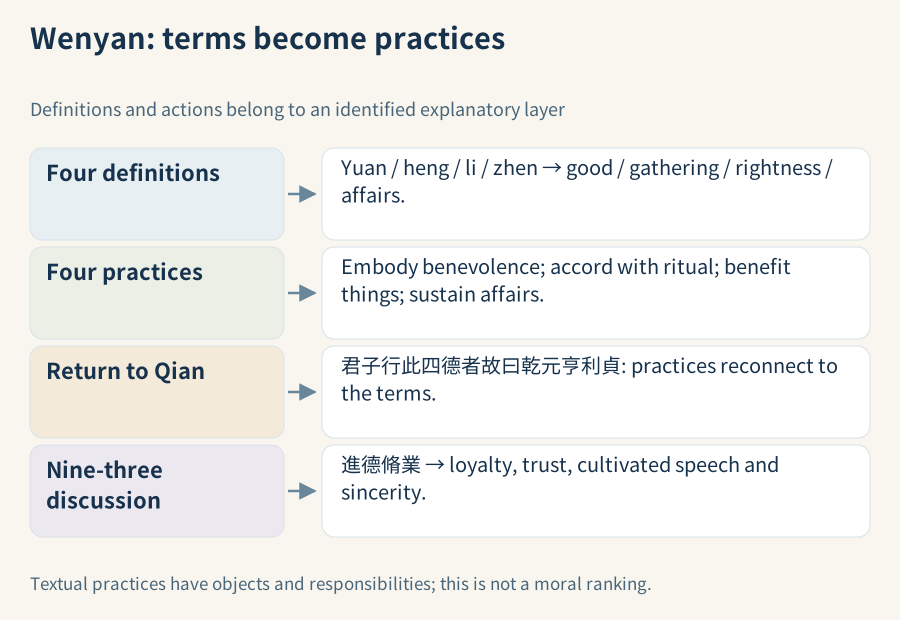
The complete figure is shown below. Select it to enlarge the labels. Open full-size figure · PNG
The diagram marks textual operations. It does not divide readers into superior and inferior types, and its connections are not empirical measurements. An ideal actor is part of the argument the old passage makes; it is not an independently verified description of all who receive a particular hexagram.
Historical reading allows both engagement and distance
A reader can take the emphasis on trustworthy speech seriously while recognizing that the passage belongs to an inherited normative vocabulary. That engagement needs neither an assertion that the ancient ideal solves every contemporary problem nor a dismissal that old terms are meaningless. It begins with the actual relation between conduct and the terms being explained.
For example, a present reader might ask whether a promise was expressed clearly and maintained sincerely. That is a new question prompted by the passage, not a historical claim that its writer addressed today's workplace or family arrangement. Stating the transfer openly preserves the difference between reading an old argument and making a current judgement. The result is an ethical text that can be examined and discussed, without using its junzi language to rank the worth of modern people or to assert a measured moral destiny.
Sources and further reading
傳/文言四德;卷1, scan16; manuscript folio unverified。Selected source page
經/乾九三句體;卷1, scan6; manuscript folio unverified。Selected source page Additional location: 疏/九三定位 / scan7
文言引九三的问义语境;卷1, scan20; manuscript folio unverified。Selected source page
傳/文言九三解說;卷1, scan21; manuscript folio unverified。Selected source page
別046-0003写本馆目字段/manuscript catalogue fields;Source webpage; ancient printed page inapplicable。Selected source page
Classical text, Wings, subcommentary, translations and modern scholarship are separately attributed. Repetition signs expand only as noted. Punctuation, translations, diagrams and comparisons are original. Source scans are not republished and unverified folios stay blank; these finite readings are not whole-book collation, autograph authentication or validated life prediction.
Evidence and source roles
These roles distinguish ancient text, older commentary, historical scholarship and tool reproduction. The numbered notes in the article retain the precise scan pages and explanations. Library and academic sources do not endorse predictive claims.
- YC3-E07-QIAN-WENYAN · Ancient text evidence: 傳/文言四德
Text layer in the witness: Wenyan four-virtue explanation; finite selected wording in the identified manuscript. Classical text, explanatory Wings and subcommentary are separately attributed.National Archives of Japan 別046-0003 Zhou yi zhu shu manuscript; copying era catalogued as Muromachi, actual copying date unverified
卷1 · scan 16 · no page numeral verified here
Four definitions, junzi practices and the return to 乾元亨利貞 form one finite Wenyan passage. Definitions are not present-day personality scores.
Not a full-volume collation, composition dating, original autograph authentication, variant census, predictive efficacy, or complete Ten Wings study.
- YC3-E03-QIAN-NINE3-JING-FINAL · Ancient text evidence: 經/乾九三句體
Text layer in the witness: Classical Qian nine-three sentence; finite selected wording in the identified manuscript. Classical text, explanatory Wings and subcommentary are separately attributed.National Archives of Japan 別046-0003 Zhou yi zhu shu manuscript; copying era catalogued as Muromachi, actual copying date unverified
卷1 · scan 6 · no page numeral verified here
Additional located evidence: 疏/九三定位 · scan 7 (page numeral unverified)
乾乾 expands a visible repetition sign. This classical window does not print an independent 九三 heading; the next page’s subcommentary identifies the position. Observed 无 is retained.
Not a full-volume collation, composition dating, original autograph authentication, variant census, predictive efficacy, or complete Ten Wings study.
- YC3-E13-WENYAN-NINE3-CONTEXT · Ancient text evidence: 文言引九三的问义语境
Text layer in the witness: Wenyan reintroduces nine-three and asks its meaning; this location is contextual, not the first classical occurrence.National Archives of Japan 別046-0003 Zhou yi zhu shu manuscript; copying era catalogued as Muromachi, actual copying date unverified
卷1 · scan 20 · no page numeral verified here
The following selected explanation occurs at scan21. The present article describes the question-setting without copying a further long passage.
Finite context identification only; not an authenticated report of an historical speaker.
- YC3-E08-QIAN-WENYAN-JUNZI-FINAL · Ancient text evidence: 傳/文言九三解說
Text layer in the witness: Wenyan explanation of nine-three; finite selected wording in the identified manuscript. Classical text, explanatory Wings and subcommentary are separately attributed.National Archives of Japan 別046-0003 Zhou yi zhu shu manuscript; copying era catalogued as Muromachi, actual copying date unverified
卷1 · scan 21 · no page numeral verified here
The selected explanation follows the Wenyan’s separate reintroduction of nine-three at scan20. Observed 脩 is retained in quotation; explanatory modern wording may use 修.
Not a full-volume collation, composition dating, original autograph authentication, variant census, predictive efficacy, or complete Ten Wings study.
- YC3-E00-CATALOGUE · Historical-manuscript library catalogue: 別046-0003写本馆目字段/manuscript catalogue fields
Text layer in the catalogue: Institutional-linked catalogue identification through the mirror. Muromachi is a catalogue era label, not a physical copying inscription.National Archives of Japan 別046-0003 Zhou yi zhu shu manuscript; copying era catalogued as Muromachi, actual copying date unverified
This collection uses finite classical, Wing and subcommentary passages. The thirteen-volume corpus is not wholly collated; original authorship of the Wings is not authenticated here.
No fresh official/mirror byte-equivalence verification, original autograph or complete critical edition claimed.