Begin with the words that are being explained
The classical statement of Qian in our selected manuscript reads “乾元亨利貞.”[1] A reader then encounters a Tuan passage, a Great Image, images attached to particular lines, and older annotation and subcommentary. Their proximity on a page can make them look like one continuous statement. A responsible reading first asks which voice is speaking and what its object is. Four words in a judgement, an account of a hexagram, and a response to one line perform different tasks.
This collection uses a National Archives of Japan manuscript identified through its institutional-linked Commons record. Its copying era is a catalogue field; its exact physical copying date remains unverified.[6] We distinguish visible textual layers within this witness. That does not establish when every layer originated, authenticate an original author's handwriting, or settle the authorship of the Wings. Scan numbers are navigation references rather than verified manuscript folios.
The Tuan enlarges the scale of the judgement
The selected opening is “彖曰大哉乾元萬物資始乃統天.”[2] Our own translation is: “The Tuan says: Great indeed is Qian's yuan; the myriad things draw their beginnings from it, and it embraces heaven.” The translation leaves yuan visible because choosing “origin,” “beginning,” or another English expression already interprets the word. Punctuation is also an editorial decision.
The contrast with the judgement is concrete. The Tuan names Qian's yuan and gives it a relation to the beginnings of the myriad things and to heaven. These are additional explanatory commitments. They are not words that can be silently inserted into “乾元亨利貞” and then quoted as the classical judgement. Nor does the selected opening explain all four terms equally. It provides a finite starting point for examining what the Tuan adds, not a complete account of every sentence in the passage.
The Great Image changes both object and action
Another layer reads “象曰天行健君子以自強不息.”[3] Our translation is: “The Image says: Heaven's movement is vigorous; the junzi accordingly strengthens himself without ceasing.” The second clause introduces an idealized human actor and a practice. A cosmic description becomes a reason for conduct through the relation expressed by 以.
That move is visible in the text. The Great Image does more than supply a synonym for yuan or zhen. It relates an image to what the junzi should do. Calling it an ethical interpretation describes this added direction; it does not mean that the classical judgement itself already contained the whole injunction. It also does not make “unremitting self-strengthening” an instruction to ignore exhaustion or contemporary health needs. The present comparison concerns how an old explanatory text constructs a model of action.
A Small Image answers a particular line
The classical initial line is “初九潛龍勿用.”[4] Our rendering is: “Initial nine: a hidden dragon; do not employ it.” The selected Small Image says “潛龍勿用陽在下也.”[5] We render the added explanation as: “Hidden dragon, do not employ it: yang is below.” The overlap is important, but so is the addition. The line supplies the dragon and the negative instruction; the Small Image explains them by a positional account of yang.
This is a narrower object than the whole-hexagram language of the Tuan. Replacing the initial line's source with the Small Image would import the explanation while concealing the change in responsibility. Conversely, removing “陽在下也” from a discussion of the Small Image would hide the very explanatory step under comparison. A negative instruction should remain attached to its named position, not be expanded into “Qian always prohibits action.”
Four layers, four reading questions
| Selected layer | Actual object | What the finite passage contributes | Question to retain |
|---|---|---|---|
| Classical judgement | Qian | “乾元亨利貞” | Which meanings are still being chosen by the reader? |
| Tuan | Qian's yuan | Beginnings of myriad things and heaven | What has the explanation added? |
| Great Image | Heaven's movement and the junzi | A model of sustained action | How does an image become a reason for conduct? |
| Small Image | The initial-nine line | Yang below explains the negative instruction | Which position restricts the explanation? |
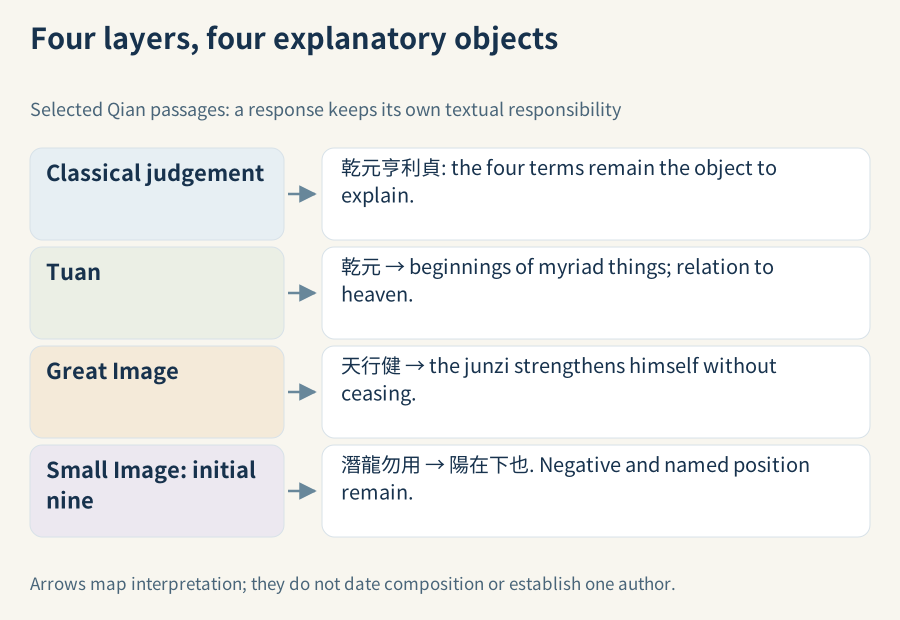
The complete figure is shown below. Select it to enlarge the labels. Open full-size figure · PNG
The diagram is an original map of these selected relationships. Its arrows mean “responds to” or “offers an interpretation of”; they do not establish a chronological sequence of composition. Older notes and subcommentary can interpret these layers in turn, but they must receive their own labels and sources.
A response is evidence of interpretation, not common authorship
Modern scholarship treats the received Changes as a text with a classical core, explanatory Wings, and subsequent interpretive histories.[7] That brief organizing description helps us ask the right questions. The evidence for the present comparison, however, is the finite manuscript wording just examined. A visible response to a line shows an interpretive relationship; it does not by itself prove a common writer or date.
The practical benefit is traceability. If an explanation seems persuasive, we can name the words that support it and the layer that supplied them. If two explanations emphasize different objects, we can compare their additions instead of declaring the ancient judgement internally inconsistent. Reading the layers together remains valuable precisely because their responsibilities remain visible. The result is a more intelligible textual conversation, with no need to turn its imagery into a verified forecast about a present person's life.
Sources and further reading
經/乾卦辭;卷1, scan2; manuscript folio unverified。Selected source page
傳/彖傳;卷1, scan10; manuscript folio unverified。Selected source page
傳/大象;卷1, scan13; manuscript folio unverified。Selected source page
經/乾初九;卷1, scan3; manuscript folio unverified。Selected source page
傳/初九小象;卷1, scan15; manuscript folio unverified。Selected source page
別046-0003写本馆目字段/manuscript catalogue fields;Source webpage; ancient printed page inapplicable。Selected source page
Chinese Philosophy of Change (Yijing);Source webpage; ancient printed page inapplicable。Selected source page
Classical text, Wings, subcommentary, translations and modern scholarship are separately attributed. Repetition signs expand only as noted. Punctuation, translations, diagrams and comparisons are original. Source scans are not republished and unverified folios stay blank; these finite readings are not whole-book collation, autograph authentication or validated life prediction.
Evidence and source roles
These roles distinguish ancient text, older commentary, historical scholarship and tool reproduction. The numbered notes in the article retain the precise scan pages and explanations. Library and academic sources do not endorse predictive claims.
- YC3-E01-QIAN-JING · Ancient text evidence: 經/乾卦辭
Text layer in the witness: Classical Qian judgement; finite selected wording in the identified manuscript. Classical text, explanatory Wings and subcommentary are separately attributed.National Archives of Japan 別046-0003 Zhou yi zhu shu manuscript; copying era catalogued as Muromachi, actual copying date unverified
卷1 · scan 2 · no page numeral verified here
The selected classical four-term statement is distinct from the neighbouring explanation. Punctuation and translations are editorial.
Not a full-volume collation, composition dating, original autograph authentication, variant census, predictive efficacy, or complete Ten Wings study.
- YC3-E04-QIAN-TUAN-FINAL · Ancient text evidence: 傳/彖傳
Text layer in the witness: Tuan explanation; finite selected wording in the identified manuscript. Classical text, explanatory Wings and subcommentary are separately attributed.National Archives of Japan 別046-0003 Zhou yi zhu shu manuscript; copying era catalogued as Muromachi, actual copying date unverified
卷1 · scan 10 · no page numeral verified here
This is the selected Tuan opening, not the classical judgement. Its relationship to the judgement does not establish common authorship.
Not a full-volume collation, composition dating, original autograph authentication, variant census, predictive efficacy, or complete Ten Wings study.
- YC3-E05-QIAN-DAXIANG-FINAL · Ancient text evidence: 傳/大象
Text layer in the witness: Great Image explanation; finite selected wording in the identified manuscript. Classical text, explanatory Wings and subcommentary are separately attributed.National Archives of Japan 別046-0003 Zhou yi zhu shu manuscript; copying era catalogued as Muromachi, actual copying date unverified
卷1 · scan 13 · no page numeral verified here
The selected Great Image crosses two columns: 象曰天 at one column’s end, followed by 行健君子以自強不息. It adds a junzi practice.
Not a full-volume collation, composition dating, original autograph authentication, variant census, predictive efficacy, or complete Ten Wings study.
- YC3-E02-QIAN-INITIAL-JING-FINAL · Ancient text evidence: 經/乾初九
Text layer in the witness: Classical Qian initial-nine line; finite selected wording in the identified manuscript. Classical text, explanatory Wings and subcommentary are separately attributed.National Archives of Japan 別046-0003 Zhou yi zhu shu manuscript; copying era catalogued as Muromachi, actual copying date unverified
卷1 · scan 3 · no page numeral verified here
The initial-nine position and 勿 negative remain in the finite classical quotation; the Small Image is separately located.
Not a full-volume collation, composition dating, original autograph authentication, variant census, predictive efficacy, or complete Ten Wings study.
- YC3-E06-QIAN-XIAOXIANG-FINAL · Ancient text evidence: 傳/初九小象
Text layer in the witness: Initial-nine Small Image explanation; finite selected wording in the identified manuscript. Classical text, explanatory Wings and subcommentary are separately attributed.National Archives of Japan 別046-0003 Zhou yi zhu shu manuscript; copying era catalogued as Muromachi, actual copying date unverified
卷1 · scan 15 · no page numeral verified here
This Small Image responds to initial nine, adding 陽在下也. Its explanatory words are not imported into the classical line.
Not a full-volume collation, composition dating, original autograph authentication, variant census, predictive efficacy, or complete Ten Wings study.
- YC3-E00-CATALOGUE · Historical-manuscript library catalogue: 別046-0003写本馆目字段/manuscript catalogue fields
Text layer in the catalogue: Institutional-linked catalogue identification through the mirror. Muromachi is a catalogue era label, not a physical copying inscription.National Archives of Japan 別046-0003 Zhou yi zhu shu manuscript; copying era catalogued as Muromachi, actual copying date unverified
This collection uses finite classical, Wing and subcommentary passages. The thirteen-volume corpus is not wholly collated; original authorship of the Wings is not authenticated here.
No fresh official/mirror byte-equivalence verification, original autograph or complete critical edition claimed.
- YC3-E17-SEP-HON · Modern scholarly analysis: Chinese Philosophy of Change (Yijing)
Text layer in the modern scholarly analysis: Tze-Ki Hon’s modern scholarly organization of textual layers and interpretive history; not an ancient text witness.Stanford Encyclopedia of Philosophy, Summer 2024 archive
A single brief attributed synopsis supplies an organizing distinction. The manuscript analysis, diagrams and translations in these articles are original.
No saved modern HTML, copyrighted translation passages or complete article reproduced.