Neighbouring hexagrams can invite comparison without describing the same problem. Zhun's selected words concern a difficult beginning, restraint in proceeding and establishing support. Meng names a questioner, a divinatory consultation and conditions on answering. Calling both growth is possible as a broad modern theme, but it does not explain these different objects.
This article reads both judgements and selected lines from the same manuscript volume. The pairing is editorial: it gives us a controlled way to compare what a sentence permits or restricts. It does not establish a universal sequence in which every person's life moves from Zhun into Meng.
Zhun keeps a favorable formula beside restraint
The Zhun judgement reads 屯元亨利貞勿用有攸往利建侯.[1] Its traditional opening formula is followed by 勿用有攸往 and 利建侯. A reader has to account for both a restraint on going forth and the favorable assessment of establishing a lord or leader. The word 利 does not cancel 勿, and 勿 does not erase the named action that remains advantageous.
These different objects are the sentence's most useful feature for close reading. A paraphrase such as “a promising start, so act quickly” would drop the restraint. “Nothing can be done” would drop establishing support. Neither follows the actual distribution of permission and restriction.
建侯 also retains a historical political image. Translating it into “hire a manager” may produce an accessible analogy, but changes the institution and audience. Such an analogy can be discussed as our present comparison; it cannot silently replace the classical phrase or become a forecast about a modern business.
The initial line repeats the support question at a position
Zhun's initial nine reads 初九磐桓利居貞利建侯.[3] The image 磐桓 is followed by advantageous abiding in constancy and advantageous establishing a leader. Both expressions of 利 belong to this initial position. The judgement and line share 建侯, but the line adds its own picture and 居 qualification.
That relationship is more precise than a single title-level slogan. Staying is not merely absence of action here: it is a named orientation linked to the line's own favorable terms. We need not settle every historical gloss of 磐桓 to preserve the clear difference between 居 and 往 in the selected classical clauses.
The upper six gives a different scene: 上六乘馬班如泣血漣如.[4] A horse and streaming bloody tears do not simply repeat the initial line's favorable support language. The image belongs to the upper line, not an inevitable final event predicted for everyone who experiences a beginning. It does, however, challenge a claim that a favorable opening formula guarantees identical results throughout the hexagram.
Meng makes the direction of asking explicit
Meng's judgement reads 蒙亨匪我求童蒙童蒙求我初筮告再三瀆瀆則不告利貞.[2] One close translation of its central contrast is: it is not I who seek the young or untutored learner; the learner seeks me. At the first divinatory inquiry, there is an answer; repeated profaning leads to no answer. The closing 利貞 remains part of the judgement.
The pronouns and direction matter. 匪我求 and 童蒙求我 are not equivalent statements about a teacher freely choosing a pupil. 筮 explicitly names a divinatory inquiry, so recasting the whole sentence as a school policy would lose its textual setting. We retain the ambiguity around how far 童蒙 should be understood as youth or untutoredness rather than deciding that it refers to every modern child.
The repeated 瀆 in 再三瀆瀆則不告 is visible in this witness. The second occurrence links the described conduct to the withholding of an answer; it is not a redundant word an editor should casually remove. Nor does 再三 supply a ready-made app rule that allows exactly a specified number of questions. A modern numerical limit would require an explicit reconstruction, not just an isolated ancient phrase.
A favorable learner line does not remove all limits
Meng's line designation matters here: the selected line is the fifth six, 六五童蒙吉.[5] It attaches 吉 to 童蒙 at that position. The nearby explanation marked 象曰 belongs to the Wing layer, not to the selected line statement. This article does not merge the two voices.
Meng's upper nine instead reads 上九擊蒙不利爲寇利禦寇.[6] The opposed phrases are not merely unfavorable and favorable versions of the same act: becoming a raider and warding off raiders have different objects. The original 禦 form is retained in the quotation.
The martial language needs to remain historical language. It is not a permission to punish a child, and this finite textual reading offers no educational or disciplinary prescription. Its contribution to our comparison is grammatical: a favorable or unfavorable term must stay attached to the particular activity it qualifies. Extracting only 利 would remove that distinction.
Two beginnings, two different questions
| Selected unit | Zhun | Meng | Reading question |
|---|---|---|---|
| Judgement | Restraint on going; establishing a leader | Who seeks whom; first and repeated inquiry | What is the named object? |
| Favorable selected line | Initial nine: abiding and establishing | Fifth six: 童蒙吉 | Which position carries the statement? |
| Upper-line limitation | Horse and bloody tears | 不利爲寇 / 利禦寇 | What prevents a uniform optimistic label? |
| Modern comparison | Organizing a difficult beginning | Learning through a qualified inquiry | What has the analogy added? |
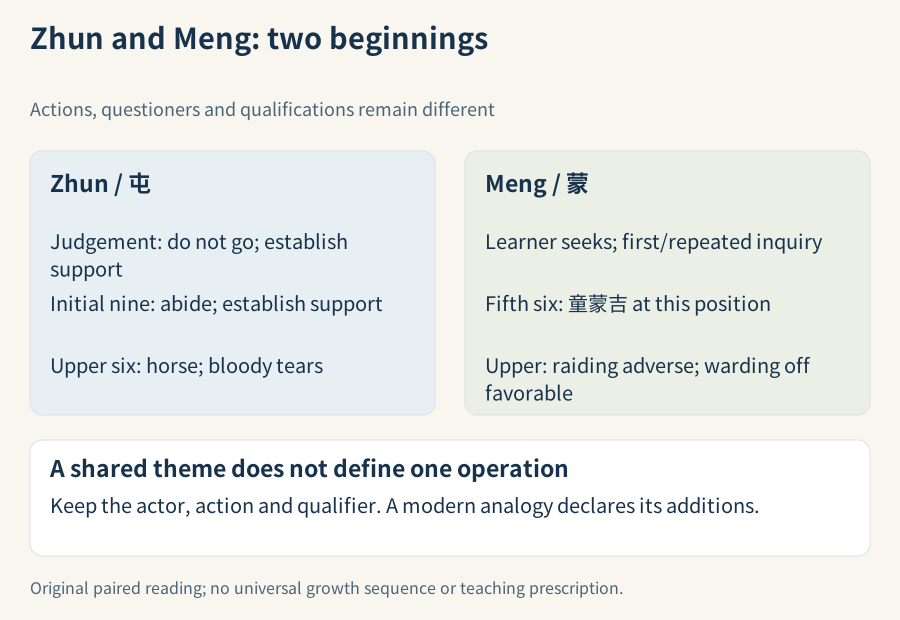
The complete figure is shown below. Select it to enlarge the labels. Open full-size figure · PNG
A useful exercise is to annotate a modern paraphrase with its additions. “Find support before moving” draws on actual Zhun objects but combines them into a present instruction. “Keep asking until you understand” is an educational preference that cannot be cited as the selected Meng judgement's own rule. Neither comparison becomes ancient wording simply because it sounds sensible.
The pair trains us to preserve the action, the actor and the qualification before generalizing. It also shows why adjacency is enough to organize a reading exercise, but not enough to make two scenes identical. Xu and Song will sharpen that point through an especially clear opposition: one permits crossing a great river where the other restricts it.
Sources and further reading
屯卦辞(经);卷2, scan12; manuscript folio unverified。Selected witness/source page
蒙卦辞(经);卷2, scan18; manuscript folio unverified。Selected witness/source page
屯所选爻辞(经);卷2, scan14; manuscript folio unverified。Selected witness/source page
屯所选爻辞(经);卷2, scan17; manuscript folio unverified。Selected witness/source page
蒙所选爻辞(经);卷2, scan21; manuscript folio unverified。Selected witness/source page
蒙所选爻辞(经);卷2, scan22; manuscript folio unverified。Selected witness/source page
別046-0003写本目录字段(Commons承接);Catalogue fields; ancient page number inapplicable。Selected witness/source page
Short quotations retain the selected manuscript’s classical forms. Punctuation, translations, comparisons and diagrams are original. Manuscript era is a catalogue field and unverified folios stay blank. Source scans are not republished; finite paired reading is not a complete 64-hexagram critical edition or validated life prediction.
Evidence and source roles
These roles distinguish ancient text, older commentary, historical scholarship and tool reproduction. The numbered notes in the article retain the precise scan pages and explanations. Library and academic sources do not endorse predictive claims.
- YC2-E02-TUN-JUDGMENT · Ancient text evidence: 屯卦辞(经)
Text layer in the witness: Classical hexagram statement in the identified manuscript. Interposed Wings, old annotation and subcommentary are excluded from the selected words. - YC2-E02-MENG-JUDGMENT · Ancient text evidence: 蒙卦辞(经)
Text layer in the witness: Classical hexagram statement in the identified manuscript. Interposed Wings, old annotation and subcommentary are excluded from the selected words. - YC2-E02-TUN-INITIAL-NINE · Ancient text evidence: 屯所选爻辞(经)
Text layer in the witness: Classical line statement in the identified manuscript. Interposed Wings, old annotation and subcommentary are excluded from the selected words. - YC2-E02-TUN-UPPER-SIX · Ancient text evidence: 屯所选爻辞(经)
Text layer in the witness: Classical line statement in the identified manuscript. Interposed Wings, old annotation and subcommentary are excluded from the selected words. - YC2-E02-MENG-SIX-FIVE · Ancient text evidence: 蒙所选爻辞(经)
Text layer in the witness: Classical line statement in the identified manuscript. Interposed Wings, old annotation and subcommentary are excluded from the selected words. - YC2-E02-MENG-UPPER-NINE · Ancient text evidence: 蒙所选爻辞(经)
Text layer in the witness: Classical line statement in the identified manuscript. Interposed Wings, old annotation and subcommentary are excluded from the selected words. - YC2-E00-CATALOGUE · Historical-manuscript library catalogue: 別046-0003写本目录字段(Commons承接)
Text layer in the catalogue: Historical-witness catalogue fields imported by the institutional-linked Commons mirror. The Muromachi label and catalogued responsibilities are metadata, not a dated copying inscription or authenticated autograph.