Qian and Kun can first be compared through what their sentences ask a reader to notice: an action, the place of that action, an object, and a qualification. This produces a more useful contrast than assigning one permanent personality to each title. The present reading uses the classical judgements and selected lines in one identified manuscript. Its annotation and subcommentary remain visible source layers, but their interpretations are not inserted into the quotations below.
The first collection explained why text layers matter. Here the distinction lets us ask a narrower question: which differences are already expressed in the classical words, before a later explanation turns them into a larger account of heaven, earth or human conduct?
Begin with the words attached to each title
The Qian judgement is 乾元亨利貞. Kun begins 坤元亨利牝馬之貞 and continues through a journey, finding or losing companions, and 安貞吉.[1,2] Sharing 元亨利貞-related vocabulary does not make their statements interchangeable. Kun gives 貞 a specifically named image, the mare, and adds an itinerary with further qualifications.
We retain yuan, heng, li and zhen as traditional terms at this first comparison. A fluent English formula can hide decisions about whether they name qualities, favorable judgements or an orientation toward constancy. Our point does not depend on settling their entire interpretive history: Kun visibly adds words and objects that a translation must account for.
牝馬 means a mare. That is a literal feature of the image. Turning it directly into a rule for the behavior of modern women would add an audience and obligation that this finite passage does not specify. Conversely, removing the mare to make the sentence more comfortable would erase something the historical text actually names. A responsible reading can preserve the image while keeping its later social applications separately attributable.
A journey has qualifications, not only a direction
Kun's judgement includes 君子有攸往先迷後得主利 and 西南得朋東北喪朋安貞吉.[2] The manuscript's classical words run through an interposed annotation layer. Our punctuation is editorial; in particular, a division around 得主利 is an interpretive choice, not punctuation authenticated in the original composition.
We can nevertheless observe secure contrasts without forcing that division. 往 introduces going somewhere. 先迷 and 後得 introduce differently qualified moments. The southwestern and northeastern phrases give contrasting companion conditions. Reading only a general label such as receptivity would leave all these actual differences unexplained.
For the same reason, the line cannot be reduced to universal immobility or obedience. It explicitly contains a journey. Whether a later interpreter associates finding a guiding figure with an ethical role requires that interpreter's own text; the presence of 主 alone does not authenticate every such conclusion.
Qian's elevated lines are not one unconditional ascent
Two selected Qian lines already qualify the idea that its role is simply to advance. The fifth nine reads 九五飛龍在天利見大人; the upper nine reads 上九亢龍有悔.[3,4] The first locates the flying dragon in the sky and names an advantageous encounter with 大人. The second attaches remorse or regret to the excessively elevated dragon.
These are distinct positions, not a dated biography that everyone must pass through. Their juxtaposition is still analytically useful: an elevated image does not carry one automatic result at every position. A reading that translates Qian's role as constant success cannot explain 有悔 at the upper nine. A reading that treats the fifth line as a modern promotion forecast adds a calendar, profession and person absent from the selected words.
Kun also contains contrasting kinds of action
Kun's second six reads 六二直方大不習无不利.[5] A close translation can render the central qualities as straight, square and great, followed by without practice and nothing unfavorable. The manuscript writes 无 at that place; our direct quotation keeps that visible form. The statement's favorable wording belongs to the named second line, rather than licensing the conclusion that every Kun position has the same result.
The upper six instead reads 上六龍戰于野其血玄黃.[6] Dragons contend in the open country, and their blood is described as dark and yellow. Even before examining a commentary's account of those colors, the classical sentence supplies conflict and injury rather than uncomplicated harmony. That difference tests an overly simple reading of Kun as always compliant or always peaceful.
An explanation of why dragons appear in Kun would need further evidence from the relevant interpretive layer. This article keeps the smaller, well-supported claim: the image is actually present here, and an account of Kun's role must leave room for its particular position and scene.
Compare the same kinds of evidence
| Reading unit | Qian selection | Kun selection | What the comparison preserves |
|---|---|---|---|
| Whole judgement | 元亨利貞 | Mare, journey and companion qualifications | Added objects and clauses matter |
| Selected favorable line | Fifth nine, encounter with 大人 | Second six, named qualities and 无不利 | Different positions and conditions |
| Upper line | Elevated dragon and remorse | Contending dragons and colored blood | The title alone does not settle the scene |
| Present interpretation | A role described through actions and limits | A role described through actions and limits | No fixed modern identity assigned |
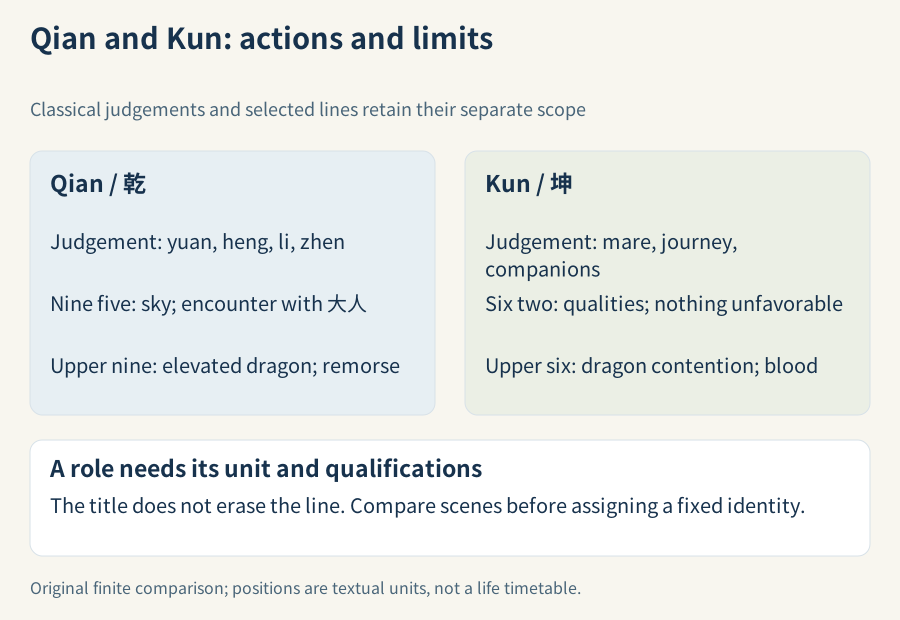
The complete figure is shown below. Select it to enlarge the labels. Open full-size figure · PNG
The table aligns comparable units. It does not claim that a whole judgement and a single line have equal scope, or that the two upper lines are identical events. This matters when a neat contrast is tempting: initiating and supporting may be useful later interpretations, but they cannot replace the actions, objects and exceptions that need explaining.
A role is a reading result with a stated scope
Try two descriptions. “Qian always advances; Kun always follows” cannot accommodate Qian's upper remorse or Kun's journey and contention. “These selections present different ways that action, position and qualification are linked” is narrower, but it can account for those words without discarding them.
A later Wing may make the contrast part of a wider cosmology or ethical discussion. We can read that response next, with its own attribution. At this stage, the useful habit is to identify the unit, preserve the qualification and say which layer supplies the proposed role. The next pair, Zhun and Meng, applies that habit to two different kinds of beginning.
Sources and further reading
乾卦辞(经);卷1, scan2; manuscript folio unverified。Selected witness/source page
坤卦辞(经);卷2, scan2; manuscript folio unverified。Selected witness/source page
乾所选爻辞(经);卷1, scan9; manuscript folio unverified。Selected witness/source page
乾所选爻辞(经);卷1, scan9; manuscript folio unverified。Selected witness/source page
坤所选爻辞(经);卷2, scan6; manuscript folio unverified。Selected witness/source page
坤所选爻辞(经);卷2, scan9; manuscript folio unverified。Selected witness/source page
別046-0003写本目录字段(Commons承接);Catalogue fields; ancient page number inapplicable。Selected witness/source page
Short quotations retain the selected manuscript’s classical forms. Punctuation, translations, comparisons and diagrams are original. Manuscript era is a catalogue field and unverified folios stay blank. Source scans are not republished; finite paired reading is not a complete 64-hexagram critical edition or validated life prediction.
Evidence and source roles
These roles distinguish ancient text, older commentary, historical scholarship and tool reproduction. The numbered notes in the article retain the precise scan pages and explanations. Library and academic sources do not endorse predictive claims.
- YC2-E01-QIAN-JUDGMENT · Ancient text evidence: 乾卦辞(经)
Text layer in the witness: Classical hexagram statement in the identified manuscript. Interposed Wings, old annotation and subcommentary are excluded from the selected words. - YC2-E01-KUN-JUDGMENT · Ancient text evidence: 坤卦辞(经)
Text layer in the witness: Classical hexagram statement in the identified manuscript. Interposed Wings, old annotation and subcommentary are excluded from the selected words. - YC2-E01-QIAN-NINE-FIVE · Ancient text evidence: 乾所选爻辞(经)
Text layer in the witness: Classical line statement in the identified manuscript. Interposed Wings, old annotation and subcommentary are excluded from the selected words. - YC2-E01-QIAN-UPPER-NINE · Ancient text evidence: 乾所选爻辞(经)
Text layer in the witness: Classical line statement in the identified manuscript. Interposed Wings, old annotation and subcommentary are excluded from the selected words. - YC2-E01-KUN-SIX-TWO · Ancient text evidence: 坤所选爻辞(经)
Text layer in the witness: Classical line statement in the identified manuscript. Interposed Wings, old annotation and subcommentary are excluded from the selected words. - YC2-E01-KUN-UPPER-SIX · Ancient text evidence: 坤所选爻辞(经)
Text layer in the witness: Classical line statement in the identified manuscript. Interposed Wings, old annotation and subcommentary are excluded from the selected words. - YC2-E00-CATALOGUE · Historical-manuscript library catalogue: 別046-0003写本目录字段(Commons承接)
Text layer in the catalogue: Historical-witness catalogue fields imported by the institutional-linked Commons mirror. The Muromachi label and catalogued responsibilities are metadata, not a dated copying inscription or authenticated autograph.