“Twelve juan” describes the scale of a text's organization. It does not alone establish a single voice, one uninterrupted act of writing or progression like a modern course. A reading of Sanming tonghui needs separate evidence from bylines, quoted material, editorial assessments and later witnesses.
This phase principally reads the Qin Shen'an/Wenming witness catalogued as 1926, with locations recorded for each section. [1] An official catalogue of an earlier witness and the Qing Siku assessment supply comparative material. Each use of “copy,” “author” and “later printing” belongs to its own source.
A byline first establishes what a page prints
The Qin witness opens juan 1 on scan 17, printed page 1, with 原造化之始 and the byline 育吾山人著, “written by Yuwu Shanren.” [2] This gives the page a responsibility statement. It does not identify every sentence in the complete book as that person's new composition.
Immediately beneath it are explicit labels including “Laozi says” and “Lie Yukou says.” [2] These demand another layer of attribution. Introducing a work under its witness's byline and naming the quoted voice of a particular sentence can coexist. Removing every “says” would make collected material look like one uninterrupted monologue without source differences.
Volume count and a responsibility statement therefore cannot replace sentence-level attribution. Twelve juan can contain multiple materials. How they were collected, when they entered and which edition changed particular words still require textual and witness evidence.
How the Siku assessment identifies authorship
On scan 3 of the Siku Sanming tonghui volume-1 object, printed assessment page 1, the opening reads 臣等謹案三命通會十二卷,原本不著撰人姓名,卷首但題育吾山人著. Our translation: “We respectfully examine Sanming tonghui in twelve juan. The source copy does not name its author; its opening only states ‘written by Yuwu Shanren.’” [3]
“We respectfully examine” identifies the speaking voice. This is a Qing catalogue assessment, not Ming main text or Qin Shen'an's commentary. It subsequently uses its inspected byline and other bibliographic material to attribute the work to Wan Minying. [3]
Retain its scope when reading “the source copy does not name its author.” “Source copy” is the assessors' description of their material. It cannot establish that every early printing lacks an author's name. The current official catalogue for object 06589 itself identifies Wan Minying and records a signed preface. [4] A catalogue field, an opening byline and a preface signature occupy different positions and have different evidential roles.
The comparison asks how an authorship judgment is supported. An alias and a modern catalogue field do not give every quoted sentence in the complete book the same personal author.
Its judgment about later printings has a scope too
The assessment continues on scan 4: 中間所載仕宦八字,往往及明季之人,蓋後來坊刻所攙入,亦已非原本之舊. Our translation: “The officials' birth configurations included within it often extend to people of the late Ming; presumably these were inserted by later commercial printings, which no longer preserve the old source copy unchanged.” [3]
This Qing editorial judgment supplies a reason: the relationship between named people's period and the text's dating. Preserve it, while noting that we have not independently checked which individual cases were added or in which witness each first appears.
Changing “the assessors attribute additions to later commercial printings” into “we have demonstrated that all these examples were later additions” would invent collation that has not been done. Ignoring the assessment entirely would instead encourage readers to treat a transmitted copy as a transparent container for a fixed original.
On scan 5, printed page 2, the assessment praises the gathering of multiple accounts with 皆能採撮羣言得其精要. Scan 6 ends with 乾隆四十四年九月恭校上, an editorial submission date in the ninth month of Qianlong year 44. [3] Its evaluation of collected voices and the explicit quotations in our selected opening can inform one another. They do not reconstruct every act of compilation.
Do not confuse an early catalogue with a downloaded object
The National Central Library's official 06589 record catalogues a twelve-juan Sanming tonghui printing dated Wanli 6, 1578, with Wan Minying preface information. [4] This reliable record establishes how an early holding is described.
The downloaded Commons files titled NCL-06589 have unresolved identity links to that catalogue. Upload-history numbers, the visible holdings sticker and the printed central-margin title do not all match the record. [5] A 1578 preface date in an image does not independently establish that object's printing date.
We therefore do not describe those downloads unconditionally as verified 1578 originals. We use the more clearly catalogued Qin/Wenming witness for the main text and state “catalogued as 1926.” The earlier record remains bibliographic evidence; its identity and page positions are not transferred to the later witness.
This clarifies evidence while preserving the six planned questions. An unresolved image identity does not need a guessed date to keep the narrative moving. An actually checkable witness gives subsequent comparison a firmer basis.
| Material | What it supports here | A leap to avoid |
|---|---|---|
| Inspected “Yuwu Shanren” byline | The page's actual responsibility statement | Every quotation was first written by one person |
| “Laozi says” and similar labels | Voices quoted at this location | Guaranteed character identity with every early witness |
| Siku assessment | The assessors' authorship, collection and later-addition judgments | Our independent proof of every addition |
| Official 06589 catalogue | The description of an early library holding | Every same-titled download is matched to that object |
| Qin/Wenming 1926 catalogue | The identity of this phase's later witness | All classical material was composed in 1926 |
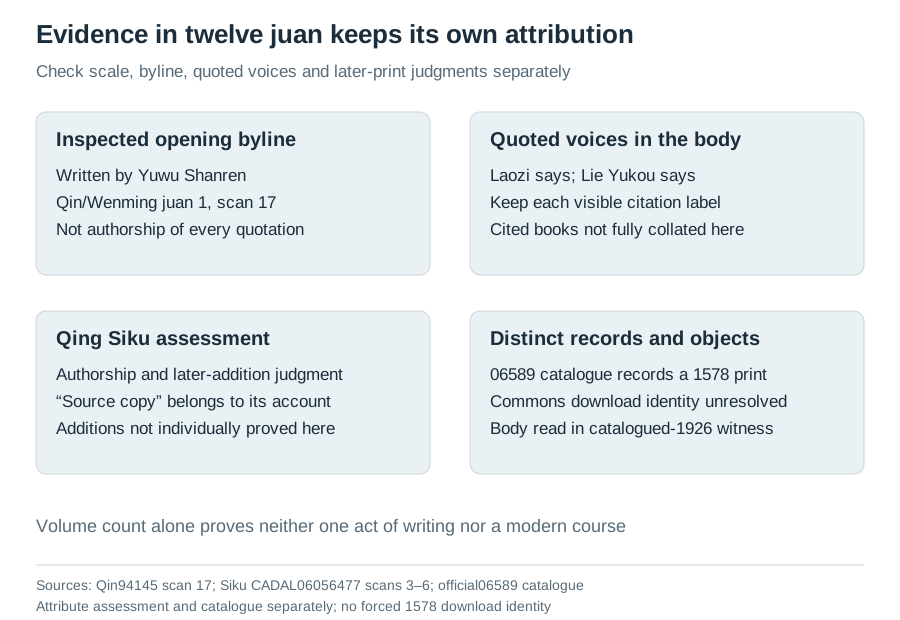
The complete figure is shown below. Select it to enlarge the labels. Open full-size figure · PNG
Why this changes reading order
A compilation can place cosmology, symbol explanations, rules, poems and birth examples beside one another. Their tasks need not match. After reading an origin account, the later use of Five Phases does not automatically turn that account into a conclusion about an individual chart.
Readers can build a question route: Does this section explain names, give a lookup, limit a condition or discuss an example? Who speaks? Does the next section begin another task? Such a route helps modern learning but remains our organization, rather than proof that the book was written in one act as the same course.
When two passages differ, retain each question and source before deciding whether they conflict. Collection does not require us to turn all accounts into one algorithm in advance.
Three fictional evidence cards
Card A says: “Twelve juan, therefore every section is sequential teaching by the same author.” It substitutes scale for writing and compilation evidence and leaves quoted voices unexamined.
Card B says: “The assessors attribute late-Ming officials' examples to later commercial insertions; specific people and witness positions still need verification.” It retains the actual judgment and its reason without claiming our unperformed work.
Card C says: “Sections in the Qin witness have actual locations; the early catalogue remains separate; the uncertain downloaded identity is not forced.” It allows later readers to check the adopted witness instead of combining several objects into one purported original.
These are fictional reading cards, not birth calculations or cases about real people. We have not collated twelve complete juan or established predictive effectiveness. Explanations, the table and diagram are our original work.
Sources and related reading
Qin Shen'an/Wenming Sanming tonghui catalogue, 1926, holdings MG/B992.3/15/:1,:3. The principal object read here; its publication year does not date all its classical material. View the catalogue
Same object, juan 1, scan 17, printed page 1, Yuwu byline and Laozi/Lie Yukou labels under 原造化之始. View byline and quoted voices
Siku Sanming tonghui volume-1 object CADAL06056477, assessment scans 3–6: scan 3 printed 1; scan 4 continuation on additions; scan 5 printed 2; scan 6 submission date. Assessment and main-text voices remain distinct. View the assessment image
National Central Library official 06589 record: twelve juan, Wan Minying, 1578 printing and preface attribution. We cite catalogue fields here. View the official record
Commons objects titled NCL-06589. Their match to the catalogue remains unverified; preface year is not a printing-year proof. Part 1 description; part 2 description
For textual voices, see the main text and its old note. Continue with the generation discussion's historical cosmology.
Evidence and source roles
These roles distinguish ancient text, older commentary, historical scholarship and tool reproduction. The numbered notes in the article retain the precise scan pages and explanations. Library and academic sources do not endorse predictive claims.
- SM1-P02 · Qing imperial catalogue assessment: 三命通會提要(四庫全書)
Text layer in the witness: 清代馆臣提要 - SM1-P03 · Ancient text evidence: 原造化之始
Text layer in the witness: 单行正文;明示引用标签;同页育吾山人著题署 - SM1-B01 · Library catalogue record: Qin/Wenming NLC94145 catalogue
- SM1-B03 · Library catalogue record: Official NCL06589 early-witness catalogue
- SM1-B04 · Scan-object identity check: Commons06589 image-identity limitation