When Sanming tonghui discusses the generation of the Five Phases, its initial concern is not an individual birth chart. It asks how heaven, earth, seasons and the myriad things form an ordered world. Establish that explanatory problem before deciding what its argument supports.
This phase uses the Qin Shen'an/Wenming witness catalogued as 1926. In juan 1, scan 17, printed page 1, the heading is 原造化之始. 論五行生成 appears at the end of scan 22, printed page 6, with its body beginning on scan 23, printed page 7. [1–3] These are actual locations in this witness. The catalogue publication year does not date every concept within the classical text or establish that this is a verified 1578 original printing.
The opening makes several voices audible
Under 原造化之始, the text explicitly introduces Laozi: 老子曰無名天地之始。有名萬物之母。有物混成先天地生. Our translation: “Laozi says: The nameless is the beginning of heaven and earth; the named is the mother of the myriad things. Something formed together exists before heaven and earth.” It then introduces Lie Yukou with 列禦寇曰有形生於無形, “Lie Yukou says: What has form arises from what has no form,” followed by Taiyi, Taichu, Taishi and Taisu. [1] Punctuation is ours.
The visible 曰, “says,” makes attribution part of the explanation. This witness quotes other voices. Removing the citation labels would turn every proposition into an apparent first assertion by the compiler. We record that the book quotes Laozi and Lie Yukou here, without claiming that these few lines match every earlier witness word for word.
The statements address form and formlessness, what precedes heaven and earth and the appearance of things. They propose an origin framework for world order. Replacing “formless” with a modern physical entity or treating “formed together” as an established cosmological model would require argument beyond this passage.
Faithful historical explanation can retain the strength of the claims: the text really does attempt to explain how the world begins. Care does not require weakening it into an empty metaphor. It requires clear attribution and an account of the evidence actually available.
The generation discussion pairs heaven and earth
The opening of 論五行生成 reads 天高寥廓,六氣回旋,以成四時。地厚幽深,五行化生,以成萬物. Our translation: “Heaven is high and expansive; the Six Qi circulate to form the four seasons. Earth is thick and deep; the Five Phases transform and generate the myriad things.” It calls this inexhaustible and difficult to fathom, then says that sages establish methods of reckoning and that it cannot escape number. [2]
At least three actions appear here. The text connects heaven to the seasons and earth to things; describes the vastness and difficulty of change; then asserts that number makes its order investigable. The claim of difficulty does not cause the text to abandon regularity. Difficulty and reckoning create a tension that defines its explanatory task.
Separating these actions prevents a leap from “the classical text discusses reckoning” to “it already supplies a precise modern calculation with validated results.” A claim that order can be investigated does not provide complete input specifications, error handling or empirical testing.
| Selected expression | Its work in the passage | What this reading does not establish |
|---|---|---|
| Heaven, Six Qi and four seasons | A cosmological account of seasonal change | A modern measurement method or complete weather model |
| Earth, Five Phases and myriad things | A connection between generation and classification | Experimental proof that matter has only five kinds |
| Inexhaustible and hard to fathom | Vast change and difficulty of understanding | Exemption of all judgments from testing |
| Methods of reckoning and number | A claim that order can be investigated | Reliable life predictions from any birth input |
The final column is our evidence check, not a negative sentence added to the old text. What the passage addresses and what a present-day assertion would need are neighboring but distinct records.
Generating and completing numbers have their own context
On the same printed page, the text arranges traditional numbers such as Water 1, Fire 2, Wood 3, Metal 4 and Earth 5 with directions and yin/yang, continuing through generating and completing relations. Near its end it says 五運之紀,則太過者其數成,不及者其數生. Our translation: “In the reckoning of the Five Movements, excess takes completing numbers and insufficiency takes generating numbers.” [2]
These numbers belong to the passage's traditional generating/completing and movement-qi account. They cannot be directly imported as the input weights for a site's element bars or converted into health or destiny percentages.
We quote this sentence to identify the kind of numerical language included in the cosmology. Numbers can make an explanation look precise, but first ask what they do in classification, reckoning or correspondence. Without the same objects, units and calculation conventions, they cannot be exchanged between systems.
This article does not use historical movement-qi concepts to explain or diagnose disease. When a passage names the body, organs or qi transformation, retain its historical attribution. Reading material has not become evidence about an actual person's body.
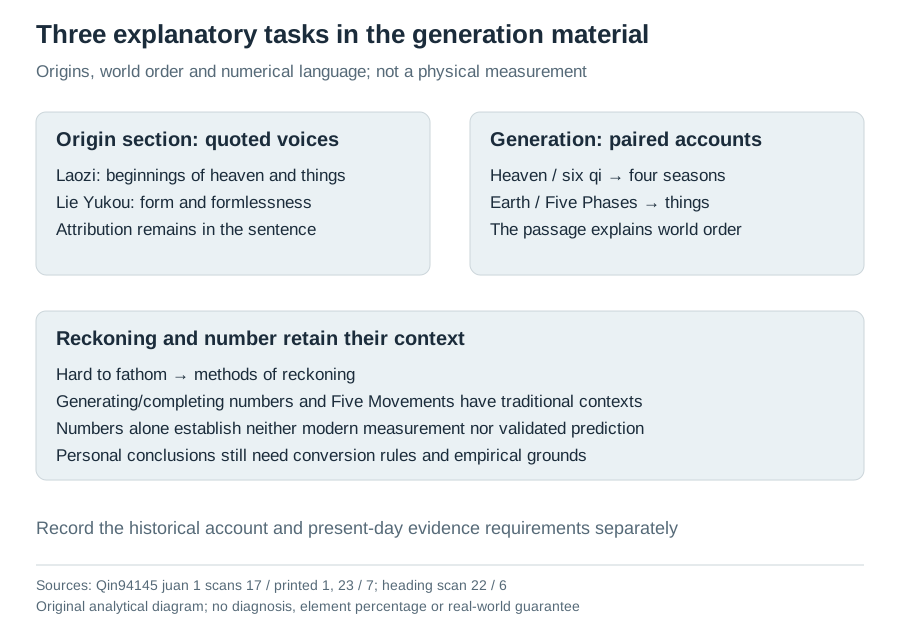
The complete figure is shown below. Select it to enlarge the labels. Open full-size figure · PNG
Cosmology alone does not complete a personal prediction argument
Moving from world order to a judgment about someone requires additional steps: which birth information is relevant, how rules convert it into symbols, which sentences concern individuals rather than seasons and what warrants a conclusion about actual outcomes.
The selected generation passage does not complete those steps. It helps explain why later technical material uses seasons, yin/yang, phases and number, but does not independently establish the effectiveness of its judgments about lives.
Historical reading remains useful. We can study how this compilation brings explanatory traditions together and makes cosmology a setting for technical discussion. Preserving that connection removes the need to force the text into a modern scientific summary or reduce it to a generation table.
Three fictional notes test the explanation
Note A says: “The book quotes an account of form arising from formlessness, then another section connects heaven, earth, seasons, things and number.” This is a local reading result checkable against the two headings and passages.
Note B says: “The book uses numbers, so every judgment has been scientifically validated.” It treats an explanatory tool as evidence of testing that has not been supplied. Numbers occur in many systems; their presence does not establish the corresponding empirical verification.
Note C says: “I still need to examine how later material moves from seasons and phases to specific chart conditions, recording a source for each.” It retains a next question rather than allowing a large origin framework to replace subsequent checks.
These are fictional reading notes, without birth data or chart results. Our explanations and diagram are original; no modern commercial commentary or translation is reproduced.
Three questions to retain
Does the passage explain origins, changing world order or a personal chart condition? What rules give its numbers and symbols their work? Which evidence would still be needed to make its statement a present-day factual claim?
Those questions preserve the organization of this historical cosmology and bound modern interpretation. This is a reading of two selected passages, not a critical edition of the entire book or confirmation of predictive ability.
Sources and related reading
Qin Shen'an/Wenming Sanming tonghui witness, catalogued as 1926, juan 1, scan 17, printed page 1, 原造化之始 and its Laozi/Lie Yukou citation labels. Attribution follows the inspected page. View the opening
Same object: 論五行生成 heading at the end of scan 22, printed page 6; selected body on scan 23, printed page 7. Generating/completing numbers and excess/insufficiency belong to this section. View the generation discussion
Object catalogue and mechanical-scan designation. Catalogue year, preface year and the age of concepts remain separate. View the witness identity
For degree conditions, see excess and insufficiency in generation and control. For the symbols, see Five Element cycles.
Evidence and source roles
These roles distinguish ancient text, older commentary, historical scholarship and tool reproduction. The numbered notes in the article retain the precise scan pages and explanations. Library and academic sources do not endorse predictive claims.
- SM1-P03 · Ancient text evidence: 原造化之始
Text layer in the witness: 单行正文;明示引用标签;同页育吾山人著题署 - SM1-P04 · Ancient text evidence: 論五行生成
Text layer in the witness: 单行正文 - SM1-B01 · Library catalogue record: Qin/Wenming NLC94145 catalogue