Recording who generates or controls whom is not enough. Ask which conditions the passage uses to explain how a relation works. We examine two neighboring Sanming tonghui sections through the question of excess and insufficiency while retaining each section's language.
In the Qin Shen'an/Wenming witness, catalogued as 1926, juan 1, scan 25, printed page 9, the actual heading is 論五行生尅. This inspected single-page essay does not literally contain 太過 or 不及. It uses strong/weak, substantial/insubstantial, yin/yang, intense/hard and firm/soft contrasts. [1] Excess and insufficiency appear in the neighboring 論五行生成 on scan 23, printed page 7, within generating/completing numbers and Five Movements. [2] Both locations help address the question; they cannot be combined into one quotation.
How this essay organizes its material
The essay first connects phases, generation, control, seasons, directions and qi, then discusses Wood, Fire, Metal, Water and Earth. It next uses mother-and-child imagery to organize generation and counter-control, ending with five relative conditions and a conclusion. [1]
That sequence matters. The opening supplies a natural and temporal explanatory setting; the middle links relations into a chain; the end presents restraint through contrasts. It is unlike a modern unconditional arrow diagram or an exercise assigning five scores before applying a fixed threshold.
Treat “mother” and “child” as organizing images. For example, after Wood generates Fire, Fire controls Metal in another relation; the passage uses that sequence to describe a child's response to restraint affecting its mother. We can record how it links relationships without applying the metaphor to actual relatives or inferring family obligations and destinies.
Five contrasts qualify control
The continuous closing series reads 強可攻弱,土得木而達。實可勝虛,水得土而絕。陰可消陽,火得水而滅。烈可敵剛,金得火而缺。堅可制柔,木得金而伐. [1] Our translation: “The strong can attack the weak: Earth encounters Wood and opens. The substantial can overcome the insubstantial: Water encounters Earth and is cut off. Yin can diminish yang: Fire encounters Water and is extinguished. Intensity can oppose hardness: Metal encounters Fire and is damaged. Firmness can control softness: Wood encounters Metal and is felled.” Punctuation and grouping are ours.
Each item contains more than two phase names. It supplies a relative contrast and a result word:
| Conditional language | Relation in this saying | Its result word |
|---|---|---|
| Strong / weak | Wood acts on Earth | 達, opening |
| Substantial / insubstantial | Earth acts on Water | 絕, cutting off |
| Yin / yang | Water acts on Fire | 滅, extinguishing |
| Intense / hard | Fire acts on Metal | 缺, damage |
| Firm / soft | Metal acts on Wood | 伐, felling |
The table retains the contrasts rather than replacing them with “vigor above 50%.” These sentences supply no shared numerical unit or instruction that all five pairs use an interchangeable threshold.
The result words differ as well. Earth's opening under Wood and Water's cutting off under Earth cannot be flattened into an identical effect merely because both involve control. We observe how the essay describes each relation; it has not supplied a complete procedure for evaluating a particular birth chart.
Its conclusion does not discard every controlling relation
The series continues 故五者流行而更轉,順則相生,逆則相尅。如是則各各為用,以成其道而已. Our translation: “Thus the five circulate and transform: in the forward direction they generate, in the reverse they control. In this way each has its use, completing its course.” [1]
The connective 故 gathers the preceding explanations; forward and reverse distinguish generation and control; “each has its use” retains both within the account of circulation. Extracting a control arrow and calling all restraint bad would omit the essay's own conclusion.
The expression “has its use” also retains its local task. It describes the functioning of these relations. It cannot simply be exchanged for a monthly yongshen definition in Ziping zhenquan. A shared character 用 does not merge the complete roles assigned by two different passages.
One reading requirement follows: preserve conditions, effects and the conclusion together. The text does not thereby prove that all restraint benefits actual lives or authorize fortune ratings of people.
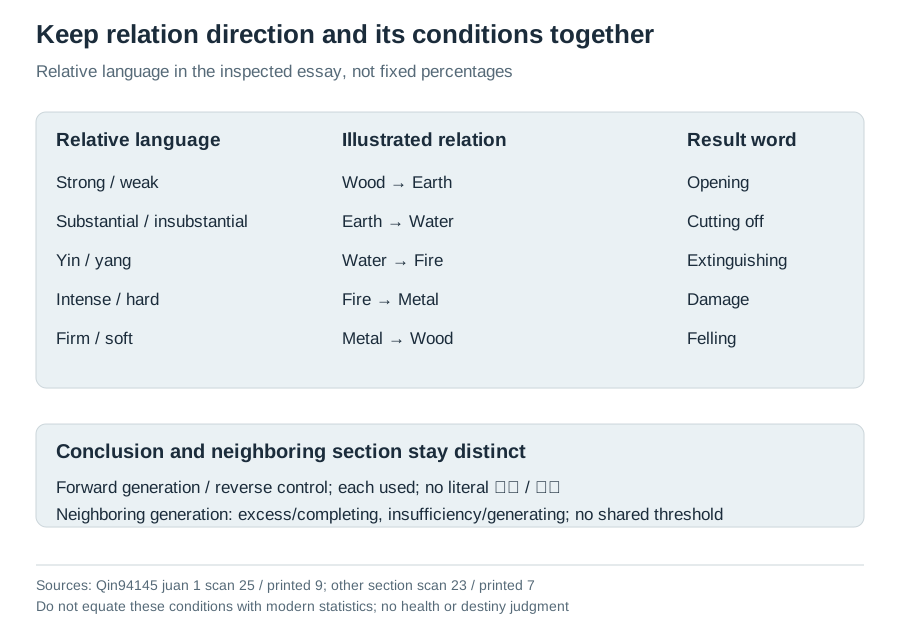
The complete figure is shown below. Select it to enlarge the labels. Open full-size figure · PNG
Excess and insufficiency in the neighboring section
The inspected generation page says 五運之紀,則太過者其數成,不及者其數生: “In the reckoning of the Five Movements, excess takes completing numbers and insufficiency takes generating numbers.” Its surroundings discuss Three Yin/Three Yang, generating/completing numbers and qi transformation. [2]
Those terms have their own technical context. We can record that it connects two states with completing and generating numbers. We cannot move those number classes directly into the strong/weak table and declare that every degree word has been quantified.
Adjacent sections make comparison worthwhile; adjacency does not make concepts synonymous. A conversion would need objects, rules and corresponding evidence. We must not invent an absent mapping to make a neat table.
The title's excess/insufficiency question therefore prompts attention to relationships that are not established by names alone. Its answer remains separated into the control essay's relative conditions, the generation essay's number language and our modern summary.
What comparison with Yuanhai adds
The inspected Yuanhai expressions “Water becomes abundant and Wood drifts” and “Earth becomes thick and Metal is buried” explicitly limit a supportive relation at excess. Our earlier Jishan paragraph reading examines that passage.
We do not draw the same support/excess examples again. The Sanming selection adds the organization of natural explanations, mother-child chains, five contrasts and a conclusion. It shows how a short essay makes multiple grounds cooperate rather than only offering one local reversal.
The comparison is still bounded to the selected witnesses and passages. It does not establish direct borrowing, or turn two texts' use of relational limitations into empirical verification of prediction.
Two fictional records test the retained conditions
Record A says: “Metal controls Wood, so any appearance of Metal and Wood is bad.” It removes the firm/soft contrast, the result word and the “each has its use” conclusion, then changes a historical explanation into a judgment on any real combination.
Record B says: “The essay's Metal-to-Wood example uses firm/soft language and gives felling as its result. Its conclusion retains uses for generation and control. I still need to find how a specific technical passage applies conditions to a particular configuration.” It preserves the textual task without generating a life judgment from two elements.
Adding “firm means a fixed percentage” to B would require an additional calculation convention and source. A label or chart cannot replace that step.
These are fictional reading records without people or birth-chart results. The essay's historical qi language is not used here to explain illness, health or treatment.
Keep a condition record
A useful note retains direction, the source condition, result word, context and location. If another section supplies numbers, identify their system too. This makes degree a serious question without concealing differences under an unsupported universal score.
The source page supports that local record. It does not establish a complete collation, a measurement of bodily state by element bars or verified destiny. Bilingual explanations, the table and analytical diagram are our original work.
Sources and related reading
Qin Shen'an/Wenming Sanming tonghui witness, catalogued as 1926, juan 1, scan 25, printed page 9, complete selected 論五行生尅 essay, its contrasts and conclusion. The absence of literal excess/insufficiency terms is bounded to this witness and section. View the control discussion
Same object, scan 23, printed page 7, 論五行生成 generating/completing numbers and Five Movements; heading at the end of scan 22, printed page 6. View the other section's number language
Object catalogue and mechanical-scan designation. 1926 is a catalogue year; this object is not presented as a verified 1578 original printing. View the witness identity
For the setting, see the generation discussion's historical cosmology. For the symbols, see Five Element cycles.
Evidence and source roles
These roles distinguish ancient text, older commentary, historical scholarship and tool reproduction. The numbered notes in the article retain the precise scan pages and explanations. Library and academic sources do not endorse predictive claims.
- SM1-P04 · Ancient text evidence: 論五行生成
Text layer in the witness: 单行正文 - SM1-P05 · Ancient text evidence: 論五行生尅
Text layer in the witness: 单行正文 - SM1-B01 · Library catalogue record: Qin/Wenming NLC94145 catalogue