The origin discussion explains names and narrates ancient figures. It does not thereby complete every calendar calculation or predictive verification. First distinguish narrative, symbol explanation and an inspectable rule.
We read 論支干源流 in the Qin Shen'an/Wenming witness, catalogued as 1926, juan 1, scan 26, printed page 10. [1] Its actual heading orders “branches and stems” as 支干. We retain the planned question about stems and branches without reversing the printed title.
What the trunk-and-branch analogy does
The opening reads 夫干猶木之幹,強而為陽。支猶木之枝,弱而為陰. Our translation: “The stem is like a tree's trunk, strong and yang. The branch is like its boughs, weak and yin.” [1]
This explains names and a relationship. Familiar tree imagery makes two symbolic categories understandable. The analogy does not measure a person's strength or replace calculation of a birth time.
Turning “strong/yang stem, weak/yin branch” directly into a fixed strength score for every character in every chart would change the sentence's task. A category can have a naming story while the strength of a particular relationship still needs conditions in the relevant passage.
We retain the analogy's historical language without using it to rate real people's gender, ability or worth. Understanding how words are organized and making assertions about people require different evidence.
The ancient narrative supplies an origin framework
The next sentence is 昔盤古氏明天地之道,達陰陽之變,為三才首君. Our translation: “In antiquity, Pangu understood the way of heaven and earth and changes in yin and yang, becoming the first ruler of the Three Powers.” [1] The passage continues through other ancient figures, placing symbolic names within an account of cosmic and ancient order.
“In antiquity” and named figures signal an origin narrative. The book's narration supplies neither modern archaeological material nor independent chronological evidence. We can accurately report what it says about Pangu's understanding without declaring that this study has proved a legendary figure established the entire system.
The story can still be investigated seriously: how it gives terminology antiquity and connects cosmic and human order. Verifying a specific historical fact about symbols would require evidence appropriate to that fact, rather than one authoritative name in a narrative.
Keep the cited-book label when reading definitions
The same page introduces another voice: 蔡邕獨斷曰干,幹也,其名有十,亦曰十母, followed by Jia through Gui. It then says 支,枝也,其名十有二,亦曰十二子, followed by Zi through Hai. [1]
Our explanation: the book quotes Cai Yong's Duduan to describe the ten stem names, also called Ten Mothers, and twelve branch names, also called Twelve Children. This is a transition from origin narrative to cited terminology: two lists, counts and naming explanations under an explicit label. Removing that label would wrongly merge the definition into the preceding Pangu story.
We checked how Sanming quotes this material, not the complete Duduan itself. We therefore do not claim that every witness of the cited work has identical wording or that all its historical assertions have been independently established.
| Reading unit | Selected material | Result that can be retained |
|---|---|---|
| Naming analogy | Stem as trunk, branch as bough | How this passage organizes two categories |
| Ancient narrative | Pangu, heaven/earth and yin/yang | How the book narrates origins and authority |
| Explicit quotation | Duduan, Ten Mothers and Twelve Children | Groups and counts quoted in this witness |
| Modern cycle demonstration | Two lists advance together for sixty steps | A finite symbolic result under stated conventions |
| Judgment about an actual life | Experience or future events | A different task requiring rules and empirical testing |
The table does not make narrative and terminology an automatic proof chain. Each row supplies evidence for its own question.
What a sixty-step cycle can verify
To separate a symbolic operation from prediction, we give a finite demonstration: put the ten stems and twelve branches in their stated list order, start both at their first item, advance each one place per step and wrap each list at its end. [2]
Under those explicit conventions, both return to the starting pair at step 60. We actually enumerated the first sixty pairs and checked that none repeats early. This verifies a finite cycle property without birth information or a claimed chart for a person.
It is useful because one symbolic operation can be checked separately. It does not establish which civil date receives which pair or decide time zones, seasonal boundaries and day changes. Those conversions still need calendar evidence and stated modern implementation choices.
Nor do sixty states establish sixty possible life outcomes. Moving from a label to an individual forecast is another argumentative task.
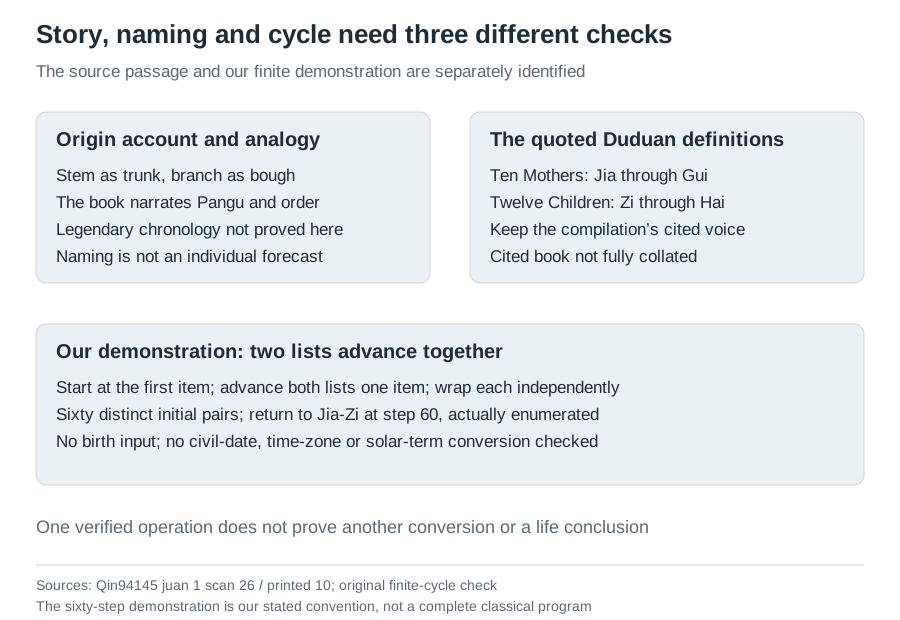
The complete figure is shown below. Select it to enlarge the labels. Open full-size figure · PNG
A fictional record without skipped steps
Record A says: “The book attributes these symbols to ancient people, so my future can be completely determined by them.” It jumps from an origin story to prediction, omitting data conversion, inference rules and real-world testing.
Record B says: “This demonstration returns after sixty steps, so every software birth conversion is correct.” It expands a verified list operation into unchecked date conversion. A program can cycle correctly while mishandling time input or a boundary convention.
Record C separates the book's ancient narrative, its cited ten/twelve terminology and our verified sixty-step cycle. It adds the next question: “Which rule maps an actual date to a symbol?” This keeps each obtained result and the next distinct verification task.
These are fictional symbol notes, not birth-chart readings. We state the demonstration's ordering and start; they are not presented as a modern program specification already supplied by the classical book.
What an origin discussion prepares
Origin material helps explain how the work organizes stem, branch, yin/yang and ancient authority language. It also demands preservation of cited voices. It does not independently complete every calendar conversion or predictive inference.
In the time sections, ask what a sentence establishes: a reference, month label, hour label or boundary. Which input does it require, and what does a modern implementation add? Naming, calculation and interpretation then remain separately inspectable.
This study reads one selected origin location and checks one finite demonstration. It does not collate the complete Sanming or its cited work. The bilingual explanation, table and diagram are original; historical narrative and modern evidence evaluation remain separately labeled.
Sources and related reading
Qin Shen'an/Wenming Sanming tonghui witness, catalogued as 1926, juan 1, scan 26, printed page 10, 論支干源流: opening analogy, Pangu narrative and the same-page 蔡邕獨斷曰 definitions. Citation follows the inspected page; Duduan has not been fully collated here. View the origin passage
Our original finite-cycle check: the ordered ten-stem and twelve-branch lists advance synchronously, yield sixty distinct pairs before returning at step 60 and use no birth input. Sixty Jiazi basics
Object catalogue and mechanical-scan designation; 1926 is the catalogue year. View the witness identity
Review Heavenly Stems and Earthly Branches, then continue with classical time and modern input.
Evidence and source roles
These roles distinguish ancient text, older commentary, historical scholarship and tool reproduction. The numbered notes in the article retain the precise scan pages and explanations. Library and academic sources do not endorse predictive claims.
- SM1-P06 · Ancient text evidence: 論支干源流
Text layer in the witness: 单行正文;明示引用标签 - SM1-M03 · Site methodology explanation: Original finite sixty-step symbol demonstration
- SM1-B01 · Library catalogue record: Qin/Wenming NLC94145 catalogue
Download the finite symbolic-cycle record (JSON; no birth input)