Sea Metal and Sand Metal both contain “Metal,” yet the text explains them through different images. Identify the stem-branch pairs receiving a name and its stated rationale before adding material proportions or destiny percentages.
We select passages from 總論納音 and 論納音取象 in juan 1 of the Qin Shen'an/Wenming witness, catalogued as 1926. The two Metal examples occupy independent paragraphs on the same page; they are not combined into one continuous quotation. [1–2]
The general discussion supplies another classification setting
On scan 29, printed page 13, 總論納音 says 六十甲子納音,本六十律旋相為宮法也。一律合五音,凡氣始於東方而右行,音起於西方而左行. [1]
Our explanation: the passage relates the sixty Jiazi Nayin categories to a traditional account of sixty pitch standards rotating the leading tone, five tones and directional movement. We can record that background without claiming a complete source study of its musical and numerical material or a modern acoustically validated algorithm.
The cited-book name at the page's opening remains glyph-sensitive here. We quote the clear selected portion rather than supply an established personal author for it. [1] Familiarity with a common book title does not resolve every source character.
This passage also does not define a Nayin name as a proportion of an element in a chart. It does not specify which visible or hidden stems are counted or how the month is weighted. Such statistics need separate rules.
The imagery section tells us how to read an analogy
On scan 34, printed page 18, 論納音取象 includes 聖人借意而喻之,不可著意執泥. Our translation: “The sages borrow a meaning to make an analogy; do not attach to it rigidly.” [2]
That sentence gives a textual basis for reading imagery. It does not make every modern association equally justified. Still examine how each paragraph makes its comparison.
Keep both interpretive room and evidence: which named pairs receive the image, which verbs, states and conditions the passage uses and what our explanation adds. Without those records, an attractive sea or metal picture can replace the actual text.
Sea Metal: enclosure before visible form
One paragraph asks 甲子乙丑何以取象為海中之金 and answers 蓋氣在包藏,有名無形,猶人在母腹也. [2]
Our translation: “Why do Jia-Zi and Yi-Chou take the image of Metal in the sea? Because qi is enclosed, named but without visible form, like a person in the mother's womb.” It provides a name to explain, a state and an analogy.
This is not a measurement of metal content in seawater. Its emphasis is enclosure and manifestation; it cannot yield an element percentage for a person or establish an actual pregnancy, development or health judgment.
A modern picture of water and a metal block would be our illustration of the name. “Named but without visible form” particularly warns against letting a fully formed block in the picture become evidence that the passage already describes visible formation.
Sand Metal: formation, separation and refining
Another paragraph reads 甲午乙未則氣已成物,質自堅實,混於沙而別於沙,居於火而煉於火,乃曰沙中金也. [2]
Our translation: “For Jia-Wu and Yi-Wei, qi has already become a thing with firm substance. Mixed with sand yet distinguished from it, placed in fire and refined by it, it is therefore called Sand Metal.” The state differs from the preceding enclosure image. Both belong to Metal without becoming interchangeable descriptions.
“Distinguished” and “refined” provide action clues. We can describe formation followed by separation and refining imagery. The passage cannot directly authorize occupational advice that a person with one of these pairs must work in metals or undergo specified hardship.
| Selected image | Named pairs | Source states and actions | Focus of our explanation |
|---|---|---|---|
| Sea Metal | Jia-Zi, Yi-Chou | Enclosed, named without form, womb analogy | Enclosure before visible manifestation |
| Sand Metal | Jia-Wu, Yi-Wei | Formed, firm, distinguished from sand, refined by fire | Separation and refining after formation |
The table draws on two separately cited paragraphs. It is not a sequence every person must live through, and its four pairs are not presented as an uncalculated birth chart.
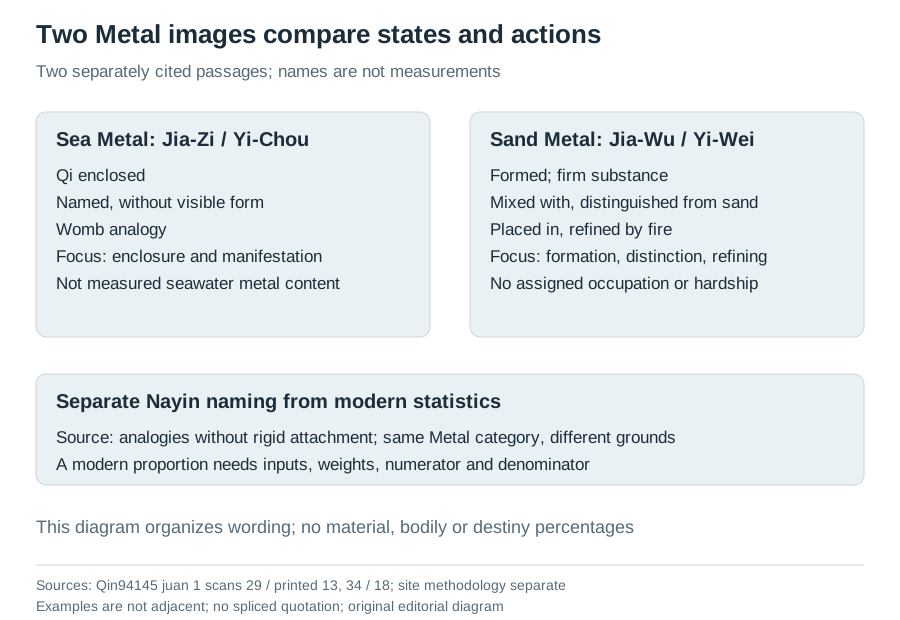
The complete figure is shown below. Select it to enlarge the labels. Open full-size figure · PNG
A Metal category does not establish a statistical denominator
Naming and proportional calculation ask different questions. One assigns a Nayin name to specified pairs and explains its image. The other must define the counted objects, inclusion scope, weights and total.
Our current methodology describes the site's element display as a rule-weighted comparison combining visible stems, hidden stems and month-branch context. It explicitly distinguishes this from simple character counting and destiny percentages. [3] That modern display needs its own inputs and conventions; a Nayin word does not replace them.
When a page gives a percentage, ask what supplies the numerator and denominator, whether weights are normalized and which rule version is used. Even an inspectable display rule gives a result within that rule system. It is not a measurement already supplied by the Sea Metal or Sand Metal passage.
Knowing a pair's Nayin name therefore does not fill the element bars for a complete chart. Naming inputs and statistical inputs remain separate.
Two fictional reading cards
Card A says: “Jia-Zi is Sea Metal, so the complete chart is 100% Metal.” It jumps from one pair's name to a whole-chart proportion without defining included factors or calculating a denominator.
Card B says: “The inspected paragraph assigns Jia-Zi and Yi-Chou to Sea Metal, with enclosure and lack of visible form as its rationale. To examine modern element statistics, I must separately check complete inputs and rule weights.” It preserves the imagery's substance and identifies another calculation task.
A Metal color can aid retrieval in B's table. If it instead suggests measured bodily metals or future wealth, the visualization exceeds what either text or calculation supports.
These are fictional reading records without birth calculations. We compare two actual images rather than generate sixty template pages, and do not use them for health, investment or life guarantees.
Keep the sentence behind the name
Nayin reading can continue beyond a memorable label. Preserve rationale, actions and conditions to see differences within Metal. Retain the warning against rigid attachment as well, keeping analogy distinguishable from literal measurement.
This is a bounded comparison of two paragraphs, not a complete collation of Nayin material or proof of its musical genealogy. Bilingual explanations, the table and diagram are original; source scans and modern commercial translations are not republished with the articles.
Sources and related reading
Qin Shen'an/Wenming Sanming tonghui witness, catalogued as 1926, juan 1, scan 29, printed page 13, 總論納音 selected continuous clear passage. The uncertain initial cited-book name is not supplied. View the general discussion
Same object, scan 34, printed page 18, 論納音取象: its analogy warning, Sea Metal paragraph and Sand Metal paragraph. The examples are separately cited rather than spliced into one sentence. View the imagery
Current site methodology: rule weights, included categories and purpose limits of the element display. This is a modern display convention. View methodology
Source catalogue and mechanical-scan designation; catalogue year and classical composition remain distinct. View the witness identity
For the symbols, see the sixty Jiazi cycle and Five Element cycles.
Evidence and source roles
These roles distinguish ancient text, older commentary, historical scholarship and tool reproduction. The numbered notes in the article retain the precise scan pages and explanations. Library and academic sources do not endorse predictive claims.
- SM1-P07 · Ancient text evidence: 總論納音
Text layer in the witness: 单行正文;省去起首待辨被引书名 - SM1-P08 · Ancient text evidence: 論納音取象
Text layer in the witness: 单行正文 - SM1-M01 · Site methodology explanation: Site element-display convention
- SM1-B01 · Library catalogue record: Qin/Wenming NLC94145 catalogue