A classical text can describe deriving months from years and hours from days, and distinguish a seasonal division from its midpoint. A modern calculator must additionally handle Gregorian dates, places, clock times and boundary conventions. These connected tasks cannot be completed by one classical mnemonic.
We read three actual headings and short passages in juan 2 of the Qin Shen'an/Wenming witness, catalogued as 1926, alongside the site's public methodology. No fictional birth input is presented as a calculated chart, and the book is not treated as a modern time-zone program.
What the seasonal passage says about boundaries
Scan 98, printed page 20, bears 論四時節氣. The selected passage reads 四立者,四時之節氣也。丑之終,寅之始,則為節;月之半,則為中. [1]
Our translation: “The Four Beginnings are the seasonal divisions of the four seasons. The end of Chou and beginning of Yin constitute a division; the month's halfway point constitutes a midpoint.” Preserve its language connecting seasonal beginnings, the Chou/Yin transition and division/midpoint. It raises a boundary question relevant to later month labels.
“The month's halfway point” cannot be directly substituted with midnight on the fifteenth of every Gregorian month. The short passage supplies neither that civil-date conversion nor an absolute UTC transition instant for every location. Actual input requires calendar material and a time basis.
Likewise, a symbolic Chou-to-Yin boundary does not establish which side contains a particular birth record. The words identify a checking task rather than complete the check.
Month and hour derivation use different references
Scan 109, printed page 31, bears 論遁月時; its heading contains no 日, “day.” It says 所以遁月從年,遁時從日。遁月即甲己之年正月起丙寅,二月丁卯,順行十二月. [2]
Our translation: “Thus derive the month from the year, and the hour from the day. For month derivation, a Jia or Ji year begins its first month with Bing-Yin and its second with Ding-Mao, proceeding through twelve months.” The two derivations have different reference values. The month example links a year group, first and second labels and continued sequence.
Organizing that sequence as a rule does not settle the civil conversion and exact transition time used to identify the year and month. The hour material continues on scan 110, printed page 32. [2] Replacing the heading with a more familiar “month, day and hour derivation” would conceal the actual title. Deriving the hour from the year rather than the day would alter its explicit dependency.
Record the reference first, then investigate how its value is obtained. Deriving an hour label when the day label is known is one question. Which day and traditional hour contain a modern clock record is another prior question.
The four-pillar statement does not remove conversion tasks
Scan 110 independently begins 論年月日時 and says 凡論人命,年月日時排成四柱。遁月從年,則以年為本。遁時從日,則以日為主。古法以年看,子平以日看. [3]
Our translation: “In discussing a person's configuration, arrange year, month, day and hour as four pillars. Deriving the month from the year makes the year its basis; deriving the hour from the day makes the day its reference. The old method examines by year, Ziping by day.” It states the components, repeats dependencies and distinguishes the two viewpoints it names. Present that distinction as this passage's claim rather than a completed history of every method.
“Arrange as four pillars” does not independently handle repeated clock times, time-zone changes or modern day-boundary choices. Those absent details do not authorize us to invent a modern specification for the book. An implementation states its own conventions and limits.
| Layer | Inspected statement | Additional check |
|---|---|---|
| Division and midpoint | Chou/Yin transition; month's halfway point | Actual transition date, time and time basis |
| Month label | Derived from year; Jia/Ji first month Bing-Yin | Adopted year, month boundary and conversion basis |
| Hour label | Derived from day | How the day is obtained and hour boundaries handled |
| Four-pillar assembly | Year, month, day and hour become pillars | Complete civil-record-to-symbol workflow |
| Modern interface | Date, local clock time and place | Time-zone data, correction and implementation version |
This separates tasks rather than expanding a classical shorthand into an unstated modern program.
Attribute the site's conventions separately
The current methodology uses the recorded Gregorian birth date, local clock time and selected location among its inputs. The location supplies a reference longitude and IANA time-zone identifier; the runtime obtains the historical UTC offset for the entered date. The site applies its declared solar-time correction before passing adjusted date and time fields to the calendar library. [4]
These are implementation conventions, not words in the selected Sanming passages. Other implementations may use different place references, day boundaries or corrections. Compare inputs and conventions before interpreting different outputs.
The methodology also records limits: historical offsets depend on runtime time-zone data; repeated or missing local clock times are not explicitly disambiguated; overseas solar-term transitions are not independently aligned on an absolute UTC timeline. The default day-pillar convention changes at midnight, with separate late-Zi hour-stem handling. [4]
A display precise to the minute therefore does not automatically remove boundary risks. The classical division/midpoint language reminds us to check boundaries; it does not fill missing implementation behavior.
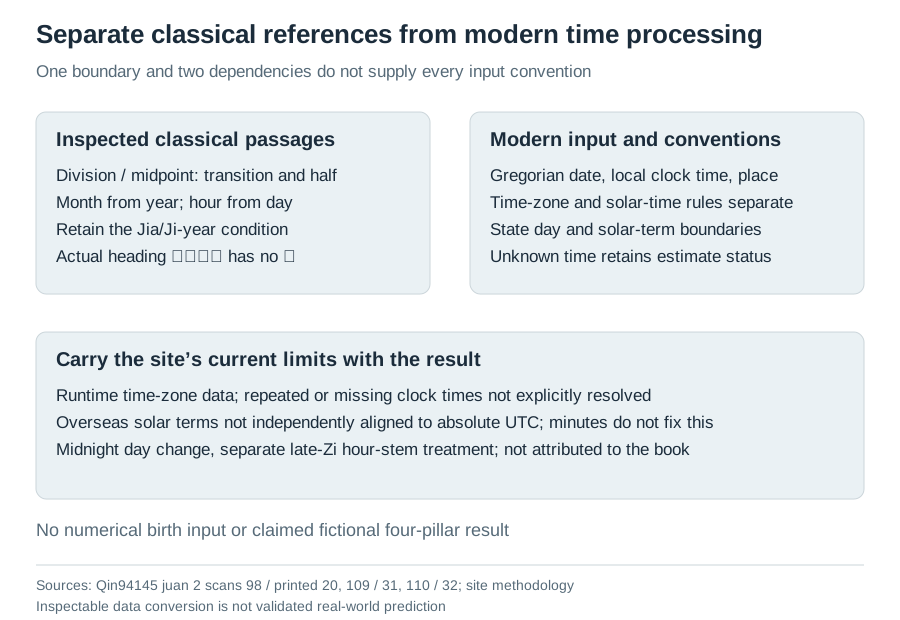
The complete figure is shown below. Select it to enlarge the labels. Open full-size figure · PNG
A fictional input card
This is a fictional checking record without numerical birth dates or calculated pillars.
Its first field retains the evidence: “The original record gives local clock time; the place is known; the time zone and then-applicable offset need checking.” The second retains the classical question: “The month depends on the year and the hour on the day; near a seasonal or daily transition, establish which side supplies the reference.” The third records the tool's conventions: “Check correction, day change and seasonal time basis.”
The card cannot yet yield a definite chart, but it identifies missing information. If the birth time is unknown, a required interface value does not turn noon into a documented birth time. The current site labels such output as estimated; preserve that precision with the result. [4]
Another erroneous card says: “The text says the first month is Bing-Yin, so every Gregorian January can be entered as Bing-Yin.” It omits the Jia/Ji-year condition and the month boundary. Even a clear mnemonic can be misread when moved to another input system.
Retain dependencies and identify remaining conventions
The inspected dependencies are usable: months derive from years, hours from days and year/month/day/hour form the four pillars. Retain the attention to seasonal divisions and transition positions too. Mapping a birth record to those labels still requires complete time information and implementation conventions.
An inspectable conversion and a reliable real-world forecast remain different tasks. We do not treat a calendar result as verification of personality, health, wealth or future events.
This reads three actual headings and selected passages rather than collating all the book's temporal material. Bilingual explanations, the task table and diagram are original. Modern conventions are separately attributed to site methodology, so the book does not take responsibility for rules it does not state.
Sources and related reading
Qin Shen'an/Wenming Sanming tonghui witness, catalogued as 1926, juan 2, scan 98, printed page 20, 論四時節氣: Four Beginnings, division/midpoint and transition passage. View boundary language
Same object, scan 109, printed page 31, actual 論遁月時 heading, different references and Jia/Ji-year month example; hour discussion continues on scan 110, printed page 32. View the references
Same object, scan 110, printed page 32, independent 論年月日時 heading, pillar assembly and reference distinction. View the new section
Current site methodology: civil time, solar-time convention, calendar workflow and implementation limits. These are modern statements. View methodology
Object catalogue and mechanical-scan designation; catalogue year is separate from preface and composition dates. View the witness identity
For inputs, see birth time, place and true solar time. For symbolic and evidential layers, see stems and branches: story or prediction proof?.
Evidence and source roles
These roles distinguish ancient text, older commentary, historical scholarship and tool reproduction. The numbered notes in the article retain the precise scan pages and explanations. Library and academic sources do not endorse predictive claims.
- SM1-P09 · Ancient text evidence: 論四時節氣
Text layer in the witness: 单行正文 - SM1-P10 · Ancient text evidence: 論遁月時
Text layer in the witness: 单行正文 - SM1-P11 · Ancient text evidence: 論年月日時
Text layer in the witness: 另起独立篇题后单行正文 - SM1-M02 · Site methodology explanation: Site civil-time and implementation conventions
- SM1-B01 · Library catalogue record: Qin/Wenming NLC94145 catalogue