Sanming tonghui says to examine the Month Command first for Direct Officer, yet separately discusses Year Virtue Officer and Officer on the hour. Reducing all three to “Officer is good” loses each heading's question. Turning the first instruction into “Officer elsewhere never counts” is equally premature. Separate the relational name, positional entry point and complete conditions before considering their connections.
We read the Qin Shen'an/Wenming witness catalogued as 1926. Juan 5, scan 62, printed page 3 contains 論正官. Scan 67, printed page 8 has the separate large-type headings 歲德正官 and 時上正官. [1][2][3] These are actual page boundaries in the adopted witness. A Siku index or an early download of uncertain identity cannot replace them.
The general heading defines a relation and an order of examination
論正官 opens with Jia encountering Xin and Yi encountering Geng as examples of control through a Yin–Yang pairing. A subsequent continuous passage says 止許一位,多則不宜。正官先看月令,然後方看其餘。以五行之氣,惟月令當時為最. Our translation: “Only one position is permitted; many are unsuitable. For Direct Officer, first examine the Month Command, then the remainder. In considering Five Phases qi, the Month Command's being in season is foremost.” [1]
These sentences perform different tasks. Jia–Xin gives a relational example. “Only one” supplies this passage's numerical restriction. “First … then” gives an order of examination. Being in season supplies the reason for that priority. Compressing all four into an Officer score would both lose conditions and confuse different kinds of statement.
“Then the remainder” itself retains consideration of other positions. It does not allow the reader to jump from one Officer label to the final result. Nor does this passage establish that year, month and hour entries must be mutually exclusive. Reading priority and exclusivity need their own evidence.
The short preference cues cannot replace the main text
Small-type preference and avoidance cues stand beside the general heading, followed by the single-line large-type main text. The conditions quoted here come from that main text; the small type is not treated as a modern editor's new commentary. [1] Such cues help retrieval but do not replace the prose's account of which factors occur together.
A separate continuous passage on the page begins 又須日主健旺,得財印兩扶,柱中不見傷煞,行運引至官鄉. Our translation: “It additionally requires a vigorous day master, support from both Wealth and Seal, no Hurting [Officer] or Sha in the pillars, and movement through a cycle leading into Officer's domain.” Only then does the text give its “great riches and distinction” judgment, continuing with damaging conditions including punishments, clashes, breaks, harms, Hurting Officer and Seven Sha. [1]
“Additionally requires” is indispensable. It joins the day master, Wealth–Seal, damaging relations and the cycle in one qualified discussion. Riches and distinction remain the old text's evaluative language, not a promise of present-day income, career or status, or a rule demonstrated by modern statistical testing. Keeping only the result would discard precisely the structure this article examines.
Year Virtue Officer adds a year entry and a historical account
歲德正官 begins 取年上干支官為歲德,喜忌與月令正官同論. Our translation: “Officer taken from the year's stem and branch is Year Virtue; its preferences and avoidances are discussed as for Month Command Direct Officer.” [2] This identifies a year-based entry while requiring comparison with the monthly treatment. It neither deletes the previous priority nor removes qualifications.
The same paragraph then invokes official families and inherited ancestral office. A “when” clause adds the month's Wealth–Officer domain, a cycle toward their flourishing domains, a vigorous day master and freedom from damage. A subsequent passage again specifies flourishing Wealth–Seal and support for the person, without Seven Sha or Indirect Officer. [2]
The historical account belongs to the source. It does not establish a reader's family class, relatives' occupations or inheritance opportunities. The structural addition is that this is more than a year position: that entry is connected to month, cycle, personal strength and absence of damage.
Hour Officer places similarity and lighter force in one sentence
時上正官 states 時上官星與月亦同,但力輕微, “The Officer star on the hour is likewise comparable with the month, but its force is slight.” After claims about later life or descendants, it specifies 要有印助,月令通生旺官氣,及見財生,或行財官印生旺運,方可發福. Our translation: “There must be Seal support, the Month Command connecting with vital and flourishing Officer qi, and generation by Wealth; or a cycle in which Wealth, Officer and Seal have vitality and flourish, before benefit can occur.” [2]
Both “likewise” and “but” matter. One establishes a comparison; the other marks the entry's account of differing force. “Requires,” “or” and “only then” subsequently organize qualifications and an alternative path. We can preserve Seal assistance, the month’s connection with vital and flourishing Officer qi, Wealth generation and favorable cycle language without converting the “or” into a modern Boolean requirement that every named item must occur simultaneously.
Likewise, extracting the later-life sentence cannot guarantee an outcome at a particular age. Positional classification, support and flourishing conditions, and the source's predictive language deserve separate records. A poem on the left is explicitly introduced by 古歌云, “an old verse says.” It is another expression layer, not the continuation of this quoted prose.
| Actual entry | Inspected comparison or restriction | What a reading record retains |
|---|---|---|
| General 論正官 | Month Command before others; one position; additional conditions | Definition, order, restriction and evaluation are distinct |
| 歲德正官 | Year stem–branch; preferences compared with month; month, cycle, strength and no damage | The year entry does not finish the judgment |
| 時上正官 | Comparable with month but lighter; Seal, monthly vital/flourishing Officer qi, Wealth generation or cycle | The connections “likewise,” “but,” “or” and “only then” |
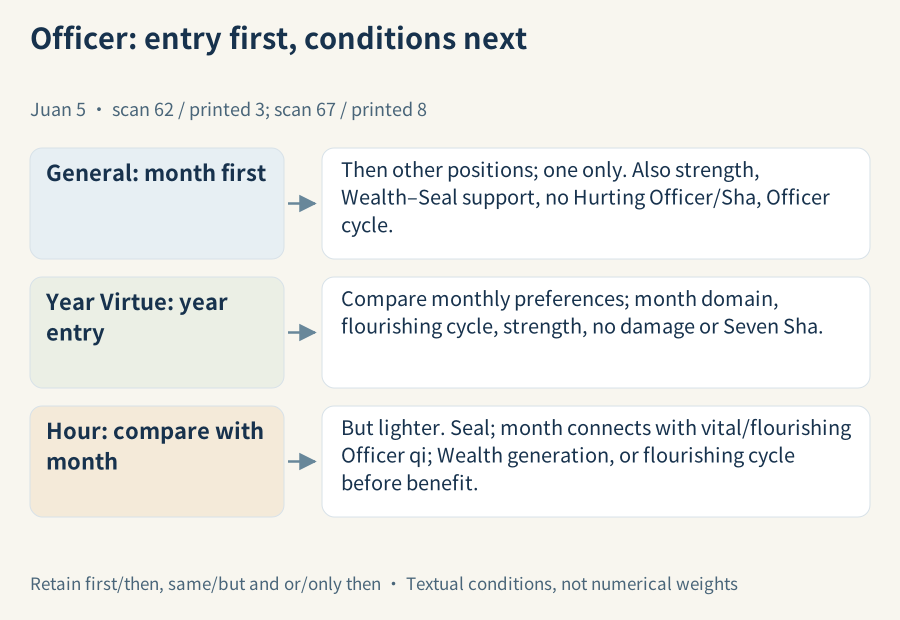
The complete figure is shown below. Select it to enlarge the labels. Open full-size figure · PNG
Compare the entries before solving them into one answer
A useful record has four fields: entry point, comparison target, conditional connectors and historical evaluation. This fixes the object of comparison. The shared name does not automatically make the passages identical, and a difference in force does not automatically make them contradictory.
Fictional note A says: “All three discuss Officer, so their positions are interchangeable.” It ignores monthly priority, year naming and the hour passage's force distinction. Note B says: “The general section limits the number, so Officer at multiple positions already gives a complete judgment.” It deletes the subsequent day-master, Wealth–Seal and cycle requirements.
Note C keeps three entries and their conditions separately, adding: “Month Command priority is this passage's order; year and hour headings actually occur in this witness; we have not combined them into a whole-chart algorithm.” This preserves scope for subsequent comparison without making a modern study summary impersonate the compilation's universal rule.
These are reading notes, not fictional birth charts or personal cases. Diagram connections represent textual organization, not numerical weights. Our scope is the listed pages and original analysis, not complete-book collation or validation of destiny claims.
Sources and related reading
Qin Shen'an/Wenming Sanming tonghui, juan 5, 論正官, scan 62, printed page 3. Main prose and small-type heading cues are distinguished; punctuation is ours. View general heading and conditions
Same witness, juan 5, scan 67, printed page 8, actual headings 歲德正官 and 時上正官. Main prose and separately labelled old verse are not merged. View year and hour entries
Object NLC416-13jh000624-42998, catalogued as 1926, Qin Shen'an/Wenming, holdings :2,4. Catalogue year, preface year and independent imprint are not interchangeable. View the catalogue
Read names and social metaphors first. For basics, see Ten Gods and the Day Master. Continue with Officer–Sha naming and selection.
Evidence and source roles
These roles distinguish ancient text, older commentary, historical scholarship and tool reproduction. The numbered notes in the article retain the precise scan pages and explanations. Library and academic sources do not endorse predictive claims.
- SM2-P02 · Ancient text evidence: 論正官
Text layer in the witness: Main prose, distinct from small-type preferences/aliases - SM2-P03 · Ancient text evidence: 歲德正官;時上正官
Text layer in the witness: Two separate large-type headings and main prose; old verse separately labelled - SM2-B01 · Library catalogue fields imported by Commons: 秦慎安校、文明书局《三命通會》传本,书目著录1926;NLC42998