Knowing which relation Seal, Food, Officer or Wealth names does not yet explain why it has that name. Sanming tonghui gives 論古人立印食官財名義 its own heading. The discussion combines relations to the day stem, social metaphors and subsequent qualifications. Reading those layers together reveals the work performed by a name without treating the name as a completed judgment.
This phase uses the Qin Shen'an/Wenming witness catalogued as 1926. The passage is in juan 5, scan 60, printed page 1. [1][2] The identity of the proposed 1578 downloads in the original plan remains unresolved. Our character readings, heading boundaries and locations belong to the adopted later witness, not to a verified 1578 original printing.
The discussion begins by locating a relation
The opening says 徐子平論格局,獨以印食官財四者為綱. Our translation: “In discussing patterns, Xu Ziping takes Seal, Food, Officer and Wealth alone as the four organizing principles.” It then asks why these names were established, moves through Yin–Yang and the Five Phases and states 今指甲乙為例,以日干論, “Now take Jia and Yi as examples, discussing them through the day stem.” [1] The Xu label marks the discussion's stated attribution or subject. It does not authenticate the entire essay as his autograph.
The crucial move is to establish a viewpoint. Jia and Yi are both Wood, but Jia is Yang and Yi is Yin. The subsequent treatment of Ren–Gui, Bing–Ding, Geng–Xin and Wu–Ji must be read relative to that day stem. Without this viewpoint, “Officer” easily becomes an actual official and “Wealth” a person's total assets.
Here the four names first organize four directions: what generates me, what I generate, what controls me and what I control. Social comparisons then explain the naming. Calling the four an organizing framework does not mean this page lists every subdivision in a modern Ten Gods introduction, or turns the four into scores for favorable and unfavorable outcomes.
Two printed forms participate in the explanation of Seal
A continuous passage reads 生我者有父母之義,故立名印授。印蔭也,授受也. Our translation: “What generates me has the meaning of parents, hence the name yinshou; yin is sheltering favor, and shou is receiving or conferring.” It proceeds from parental protection to 朝廷設官分職,賜以印綬,使之掌管, the court assigning offices and granting official seals and their cords as authority to administer. [1]
The inspected page first prints 印授 and later 印綬. We retain that difference when explaining its connections between protection, reception and official insignia. We do not silently replace every occurrence with the familiar modern spelling 印綬. The parental comparison concerns a source and what is received; the official-seal comparison concerns a warrant and conferred duties. Both explain a name in this historical text. Neither proves that a chart brings qualifications, office or actual parental support.
The question 官而無印,何所憑據, “Without a seal, on what warrant does an official rely?”, should not immediately become a compulsory rule joining every Officer occurrence in a chart to Seal. The task at this location is explanation of names. Later discussions of Officer, Wealth and Seal need their own structural conditions.
Food describes more than an object being eaten
The text introduces Food Spirit through 我生者有子孫之義, “What I generate has the meaning of descendants.” It subsequently says 人得食則益,物被食則損, “A person receiving food benefits; the thing eaten is diminished,” and compares descendants providing nourishment with children supporting their parents. [1]
These statements shift viewpoints. One act of eating has different implications for the eater and the eaten object. What I generate is then described as capable of providing support in return. “I generate” is the direction of a relation, “Food” the borrowed image, and provision of nourishment an added account of function.
This is a historical explanatory framework, not a nutritional argument or an obligation imposed on someone with a particular chart label. The reader's first task is to follow the shifts in roles. An awkwardly printed portion of the Food paragraph has not been repaired from a familiar circulating sentence. The secure continuous excerpts and their context suffice for this analysis; fluent prose is not a reason to invent a character unsupported by the image.
Officer and Wife–Wealth retain their historical social language
The Officer paragraph independently begins 尅我者是我受制於人之義,故立名官煞。官者管也,煞者害也. Our translation: “What controls me means that I am subject to another's control, hence the names Officer and Sha. Officer means governing; Sha means harming.” It explains this through appointment by the court, belonging to public service and being subject to its commands. [1]
Office here is not only honor. It also supplies images of administration, service and restraint. Translating the label directly into “career success” would discard the explanation of its governing and harmful aspects.
A separate Wealth paragraph begins 我尅者是人受制於我之義,故立名妻財, “What I control means that another is subject to my control, hence the name Wife–Wealth.” It uses a wife's dowry land and property, and assistance within marriage, as its comparison. [1] This is a patriarchal historical household model. We can explain how it links marriage and resources without endorsing that equivalence as women's modern social value or using it to judge actual relationships and assets.
The Officer and Wealth paragraphs each establish their own starting relation. Extracting “governing” and “wealth” does not produce a modern social law. Technical classification, historical institutions and present-day ethical claims are separate questions.
| Relation on this page | Historical comparison | What the name alone does not establish |
|---|---|---|
| Generates me | Parental protection, reception and official insignia | Qualifications, authority or actual care |
| I generate | Descendants, food and support returned | Effective or beneficial output in every case |
| Controls me | Official administration and subjection | Public employment, harm or success |
| I control | Wife–Wealth, marital resources and assistance | Actual assets, a partner's value or a relationship outcome |
Why the ending returns to polarity and controlling Sha
The essay does not end with four vocabulary cards. Near the bottom it says 中間陰陽從類,陰陽配合,各有至理存焉, distinguishing association by kind and pairing between Yin and Yang. It then adds 甲喜食丙,以丙能制庚煞,而甲始得安其身,不喜食丁. Our translation: “Jia favors taking Bing as Food because Bing can control Geng Sha, allowing Jia to secure itself; it does not favor taking Ding as Food.” [1]
The connective “because” gives the argument a path. This passage's evaluation of Jia and Bing refers to Bing controlling Geng Sha. Although Bing and Ding are both Fire generated by Wood, removing polarity and that control condition would leave an unsupported rule that all output is favorable. We record the page's particular account; we have not thereby created an algorithm for every Food Spirit and Hurting Officer situation in the whole book.
Conversely, the use of governing and harm to explain Officer–Sha does not establish that everything controlling the day stem is invariably unfavorable. Names give relations and metaphors. Subsequent sections add their own combinations, transformations, strength and position. The next article tests how the same Officer name enters different sets of conditions.
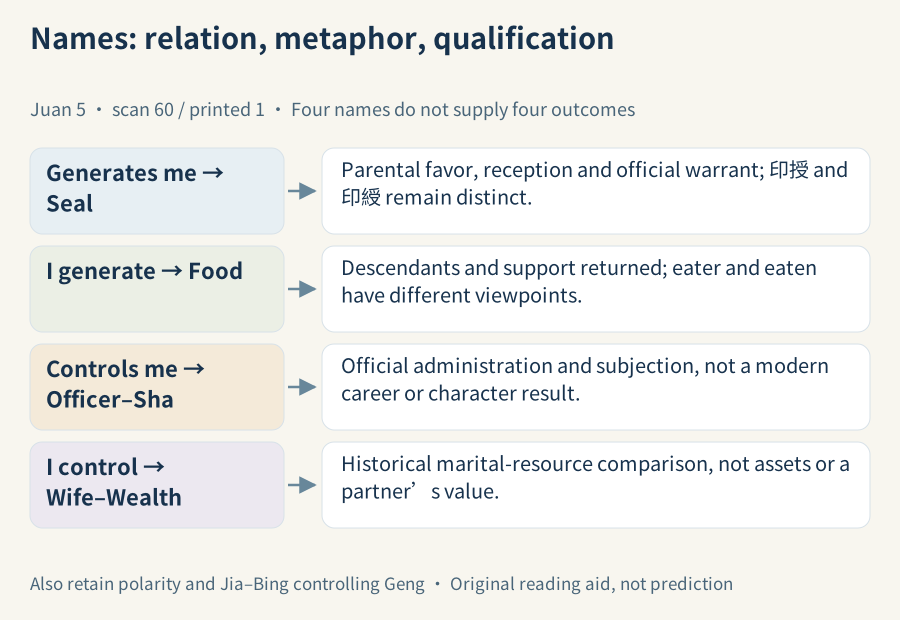
The complete figure is shown below. Select it to enlarge the labels. Open full-size figure · PNG
Replace a premature conclusion with a reading record
Fictional record A says: “Wealth appears, so there will be riches.” It omits the day-stem relation, historical comparison and qualifications, even replacing a category with a real quantity. Record B says: “This page first establishes what I control relative to the day stem, then explains the name through Wife–Wealth; the passage does not establish an asset outcome.” It preserves what the text actually does.
Record C annotates the Jia–Bing passage: “Relation: Jia generates Bing. Subdivision: retain Jia, Bing and Geng. Reason: Bing can control Geng Sha. Evaluation: the old text therefore favors it here.” This is still not a birth calculation. It makes the reason checkable and leaves a useful connection for the next comparison.
These records, table and diagram are original reading aids. We have inspected selected passages of this witness, not collated the complete book or demonstrated predictive effectiveness for actual lives.
Sources and related reading
Qin Shen'an/Wenming Sanming tonghui, juan 5, 論古人立印食官財名義, scan 60, printed page 1. The quotations are single-line main text; punctuation and explanations are ours. 印授 and 印綬 retain their page-specific distinction. View the page
The same object, NLC416-13jh000624-42998, catalogued as 1926, Qin Shen'an, Wenming, holdings MG/B992.3/15/:2,4. The catalogue year does not replace an independent imprint not seen in this inspection or establish the identity of earlier same-titled downloads. View the object and catalogue
For relations, start with Ten Gods for beginners and the Day Master. For witness layers, see twelve juan and compilation evidence. Continue with the different Officer subtopics.
Evidence and source roles
These roles distinguish ancient text, older commentary, historical scholarship and tool reproduction. The numbered notes in the article retain the precise scan pages and explanations. Library and academic sources do not endorse predictive claims.
- SM2-P01 · Ancient text evidence: 論古人立印食官財名義
Text layer in the witness: Single-line main text; stated Xu Ziping attribution, not authenticated autograph - SM2-B01 · Library catalogue fields imported by Commons: 秦慎安校、文明书局《三命通會》传本,书目著录1926;NLC42998