Officer, Sha, Indirect Officer and Seven Sha appear together, while some names also seem to change with control or transformation. Deciding in advance that one is always good and another always bad makes the subsequent selection discussion look like deletion of bad symbols. The two inspected sections instead distinguish relations, conditions and selection, with separately marked quoted voices.
We use the Qin Shen'an/Wenming witness catalogued as 1926. Juan 5, scan 72, printed page 13 has 論偏官. Scan 79, printed page 20 prints the full heading 官煞去留並官鬼互變雜論, “Miscellaneous discussion of Officer–Sha removal and retention, together with mutual transformation of Officer and Ghost.” [1][2][3] Its character is 煞; quotations preserve it. The original planned Chinese article title uses modern 杀. We do not turn the spelling difference into a demonstrated conceptual distinction.
Relational examples and control qualifications occupy different layers
論偏官 first gives 甲見庚、乙見辛, Jia encountering Geng and Yi encountering Xin, as its relational examples. It then uses historical comparisons about like kinds not pairing and the seventh position's control to explain the names. [1] These are the source's comparisons, not judgments about modern gender, relationships or character.
The same page says 故有制謂之偏官,無制謂之七煞. Our translation: “Thus, with control it is called Indirect Officer; without control, Seven Sha.” [1] The relation remains, while naming acquires a control qualification. A record can distinguish the day-stem relation, the conditions under which this passage calls it Indirect Officer or Seven Sha, and the reasons for the subsequent evaluation.
Turning “with control, called Indirect Officer” into “Indirect Officer is inherently favorable” silently converts a condition into a label's fixed property. Stopping at the words Seven Sha without reading the same essay's Seal assistance, Wealth support, Food control and Blade pairing is equally incomplete.
Why Wealth receives opposite qualified evaluations
One continuous passage considers a vigorous day master and Seal assisting transformation, then Wealth providing support. It explicitly distinguishes 如身強煞弱,有財星則吉 from 身弱煞強,有財引鬼盜氣: a strong person with weak Sha and Wealth is treated favorably, whereas a weak person with strong Sha and Wealth is described through reinforcement and depletion. [1] The latter includes old poverty and early-death predictions. We analyze its argumentative direction without applying those claims to a reader's wealth or lifespan.
Wealth participates in the supporting chain in both statements, but the relative qualifications differ. Consequently, the page's quoted instruction to consider Wealth when encountering Sha cannot become “Wealth always fixes Seven Sha.” The variables distinguish the cases; they are not decorative caveats.
Seal assisting transformation and Wealth providing support are also not interchangeable pleasant words. They follow different relations and receive their own quoted support in the paragraph. A 經云 label establishes that the page introduces a saying as “the canon says.” This inspection has not independently collated every text that label may refer to.
Food control and Blade pairing are distinct operations
Another passage begins 有食神制, “there is Food Spirit controlling it,” followed by a canon-labelled evaluation. It then says 本有羊刃配合, “there is already Yang Blade pairing,” gives further quotations and requires 無太過不及, neither excess nor insufficiency. [1] Control, pairing and their limits cannot be reduced to a single arrow saying “get rid of Sha.”
The original also uses honorable-person and petty-person imagery to explain borrowed force and authority. We can describe the metaphor without classifying actual people as virtuous, petty or dangerous from chart labels. Diagram words such as control, combination and transformation assistance represent the text's relations, not psychological diagnoses.
The full miscellaneous heading changes the scope of selection
The separate heading on scan 79 includes transformation of Officer and Ghost as well as removal and retention. Its opening explicitly says 喜忌篇云, “Xiji pian says,” and discusses both removing Officer while retaining Sha and removing Sha while retaining Officer. It includes Officer on the month with Sha on the hour, the reverse arrangement, and repeated appearances in the pillars. [2]
It does not prescribe removing Sha in every case. An effective factor removing Officer while retaining Sha leads to discussion as Indirect Officer; removing Sha while retaining Officer leads to discussion as Direct Officer. Monthly and hourly placement remain relevant. Selection is qualified, not automatic preference for the gentler-sounding name.
“Xiji pian says” is this page's quoted voice. We have not inferred character-for-character agreement with another witness's Xiji pian from the label. Nor do we append the later, separately marked 元理賦云 saying as though it continued one uninterrupted quotation.
Capacity to remove must be established
The prose continues 凡看去留,要詳柱中官煞孰重孰輕,天干透者易去,月支所藏者難去. Our translation: “In examining removal and retention, distinguish which of Officer and Sha is heavier or lighter; what is exposed in the heavenly stems is easier to remove, what is stored in the month's branch harder.” It then requires the removing factors, Hurting Officer or Food Spirit, to have operative force before removal is accomplished. [2]
At least three layers therefore enter the reading: relative weight, exposed-stem or stored-month-branch position, and the acting factor's capacity. The same paragraph distinguishes Food Spirit on the five Yang days from Hurting Officer on the five Yin days, adding Blade combination to the latter's removal-of-Officer and retention-of-Sha qualification. [2] We record that distinction rather than deleting a symbol whenever an output label appears.
The word “remove” does not describe a website function deleting birth stems or branches. The prose discusses selection or changed operation of a relation. Original input symbols should remain distinct from interpretive operations. We have neither encoded these passages as an automatic selection algorithm nor validated their predictions of actual outcomes.
| Reading layer | What this passage records | What premature simplification loses |
|---|---|---|
| Naming | Jia–Geng examples; with or without control | Conditions between relation and evaluation |
| Relational paths | Seal, Wealth, Food and Blade; relative strength | Different operations become one good–bad label |
| Selection | Both directions; month–hour arrangement; exposed/stored and operative force | Whether and why selection takes effect |
| Quoted voice | Xiji pian, canon sayings and Yuanli fu separately | Collected passages become a fabricated single voice |
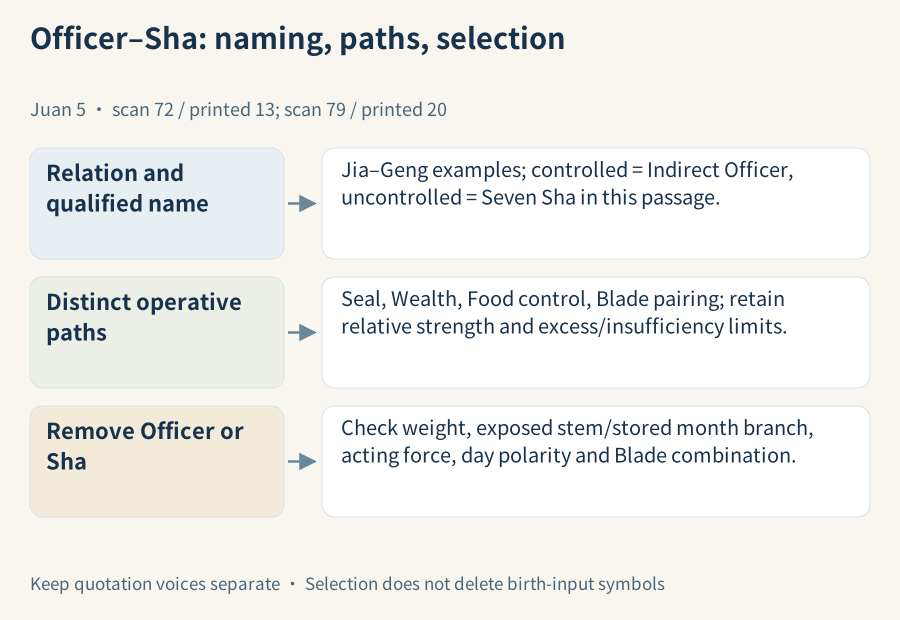
The complete figure is shown below. Select it to enlarge the labels. Open full-size figure · PNG
Three fictional extraction methods
Record A says only “Indirect Officer good; Seven Sha bad.” It cannot explain Wealth's different evaluations under strong-person/weak-Sha and weak-person/strong-Sha qualifications. Record B says “Food Spirit appears, so Sha has been removed,” omitting weight, exposure or storage, force and day-polarity conditions.
Record C says: “The page establishes a relation and qualified naming; the miscellaneous discussion permits two selection directions; exposed or stored position, the acting factor's capacity and quoted source must still be checked.” It does not calculate a birth chart, but fixes what needs further examination.
Compare this with the preceding Officer subtopics. A shared term may perform different work under different questions. A compilation need not first become a condition-free label table. Our table, diagram and explanations are original; the inspected scope is the specified witness pages, not a completed collation of the whole book.
Sources and related reading
Qin Shen'an/Wenming Sanming tonghui, juan 5, 論偏官, scan 72, printed page 13. Main prose, small-type aliases and 經云 labels remain distinct; punctuation is ours. View relations and control
Same witness, 官煞去留並官鬼互變雜論, scan 79, printed page 20. Xiji pian and Yuanli fu voices remain separate; prose includes weight, exposure/storage, force and day polarity. View the selection discussion
Catalogue for NLC416-13jh000624-42998, 1926, Qin Shen'an/Wenming: this phase's adopted later witness. View the catalogue
The preceding article covers Officer subtopics. For basics see Ten Gods and the Five Phases cycles. Continue with Wealth relations and qualified judgments.
Evidence and source roles
These roles distinguish ancient text, older commentary, historical scholarship and tool reproduction. The numbered notes in the article retain the precise scan pages and explanations. Library and academic sources do not endorse predictive claims.
- SM2-P04 · Ancient text evidence: 論偏官
Text layer in the witness: Main prose with separately identifiable 經云 labels; small-type aliases distinct - SM2-P05 · Ancient text evidence: 官煞去留並官鬼互變雜論
Text layer in the witness: Main prose; 喜忌篇云 and 元理賦云 distinctly introduced - SM2-B01 · Library catalogue fields imported by Commons: 秦慎安校、文明书局《三命通會》传本,书目著录1926;NLC42998