In these headings, Wealth first names a technical relation to the day stem, then enters each passage's evaluation. Direct and Indirect Wealth do not divide salaries from investment income in advance, and much Wealth does not automatically mean much money. Separate discussions and a combined treatment in Sanming tonghui allow those distinctions to be examined in actual text.
The adopted Qin Shen'an/Wenming witness is catalogued as 1926. In juan 5, 論正財 is at scan 82, printed page 23; 論偏財 begins at scan 86, printed page 27, with qualifications continuing on scan 87, printed page 28; 偏正財合論 is at scan 89, printed page 30. [1][2][3][4] We compare actual boundaries rather than assembling several pages into a fabricated continuous quotation.
Direct and Indirect pairing does not identify modern income sources
The Direct Wealth entry gives Jia encountering Ji and Yi encountering Wu. Indirect Wealth gives Jia encountering Wu and Yi encountering Ji. [1][2] Both concern what the day stem controls, with a difference in polarity pairing. This technical entry is checkable; it does not automatically classify actual receipts as wages, side work, speculation or any other income source.
Direct Wealth uses being controlled by me and a wife bringing property into marriage to explain its name. The Indirect entry says 非妻所帶,乃衆人之財也, “Not property brought by the wife, but the wealth of other people,” and discusses siblings dividing it. [1][2] Wife–Wealth and others' wealth are the page's historical comparisons. They neither establish a modern partner's value nor directly identify shared assets or financial investments.
A reading that immediately translates Indirect Wealth into unconventional profit bypasses the day-stem relation and adds an occupation or income classification not established by the cited passage.
Direct Wealth adds capacity to its conditions of use
The Direct Wealth analogy considers having the force to make use of resources. Its ensuing continuous passage says 用財要得時乘旺,不偏正混亂,不重疊多見,自家日主有力,皆能發福. Our translation: “Using Wealth requires timeliness and flourishing, no confused mixture of Direct and Indirect, no repeated abundance, and an effective day master; these permit benefit.” [1] The question is more than presence: it includes timing, flourishing, mixture, repetition and the person's capacity.
The next sentence sets two combinations alongside each other: 若財多身弱,柱無印助,財少身強,柱有比劫,太過不及,皆不為福. Our translation: “When Wealth is abundant but the person weak, without Seal support in the pillars; or Wealth scant and the person strong, with Peer/Rob Wealth in the pillars, excess and insufficiency are both unfavorable.” [1]
These are different combinations. Extracting only “much Wealth, weak person” loses the same sentence's Seal qualification. Extracting only “much Wealth” cannot explain why more is not always evaluated better. We interpret the technical and metaphorical language without diagnosing health from “vigor” or predicting marriage from Wife–Wealth. 經云 and 又云 introduce other sayings on the page. Their attribution labels remain visible; the cited works have not been independently collated here.
Indirect Wealth separates Wealth's state from the person's capacity
After its page break, 論偏財 says 如財弱,必待歷旺鄉而榮。財盛無往不利,但恐身勢無力,不能勝任. Our translation: “When Wealth is weak, flourishing must await passage into its flourishing domain. With abundant Wealth, every direction is advantageous, but the concern is that the person's force is insufficient to bear it.” [2] The “but” qualifies the preceding expansive language. Omitting it makes the reading incomplete.
Weak or abundant Wealth is one description; ability to bear it is another. They interact in this passage without becoming a modern account balance. A flourishing domain also belongs to the old cycle discussion, not an investment market or a date of guaranteed returns.
The same page compares Wealth at the Month Command with its absence in year and month but presence on day and hour. Whether the hour is well situated, competing factors, clashes and control, and cycles enter the account. [2] Youth, middle or later life, and riches followed by poverty are the source's temporal prediction language. Our addition is to identify how positions and qualifications connect, not promise actual wealth at an age.
The combined discussion adds another entry point
The actual third heading is 偏正財合論, with Indirect before Direct. It begins 精紀有, introducing a Jingji account of “generated Wealth,” then states 凡命入貴格,除貴外,須有生合財 and supplies examples of relational combinations. Our translation of the secure qualification: “For a configuration entering a distinguished pattern, beyond distinction there must also be Wealth through generation and combination.” [3]
The noteworthy structure is “beyond … there must also be,” not a free-standing distinction guarantee. The combined discussion does more than add two definitions: generation, combination and positional entries expand its question. We record the page's attribution to Jingji without claiming a character-by-character comparison with that separately uncollated work.
A final character in one string of old examples remains for independent inspection. We have neither supplied it from a familiar sentence nor used the string to calculate a birth chart. The secure qualification suffices to show an additional requirement, but does not establish one complete modern algorithm for every Wealth discussion.
| Heading | Initial entry | What the inspected evaluation adds |
|---|---|---|
| 論正財 | Jia–Ji, Yi–Wu and Wife–Wealth analogy | Timing, mixture, repetition, capacity; Wealth–person–Seal–Peer combinations |
| 論偏財 | Jia–Wu, Yi–Ji and others' wealth analogy | Wealth state, capacity, month/hour, competing factors, clashes and cycles |
| 偏正財合論 | Generation and combination within a joint discussion | An additional generation–combination qualification beyond the distinguished pattern |
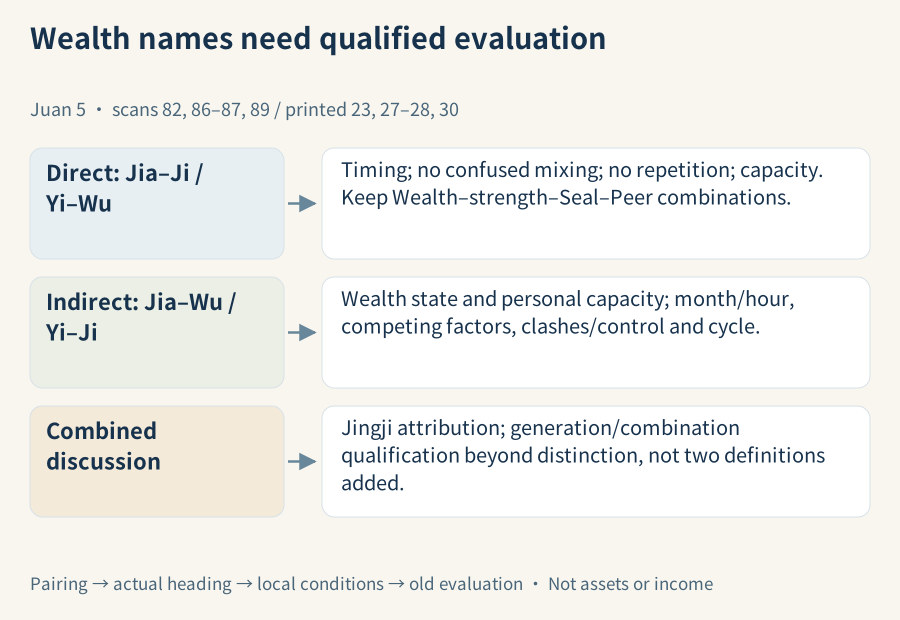
The complete figure is shown below. Select it to enlarge the labels. Open full-size figure · PNG
What is missing between one name and one conclusion?
Keeping classification and evaluation in separate fields makes omissions visible. Fictional note A says: “Jia encounters Ji, therefore riches are certain.” Its relational example is correct, but the conclusion does not follow from that classification. Note B says: “The abundant-Wealth sentence suffices; the concern about insufficient personal force can be ignored.” It selectively removes the same passage's limitation.
Note C records “relation—actual heading—this paragraph's conditions—the author's evaluation,” including its page. Passages sharing a Wealth label may enter through different conditions; passages with different Wealth labels may share some questions about strength and position. Comparison follows actual prose, not a ranking of headings as good or bad.
These explanations and diagram are original reading aids. The fictional examples concern extraction methods, not people. We do not turn Wealth into a reader's income, assets or marriage outcome, claim complete-book Wealth collation, or demonstrate modern predictive effectiveness.
Sources and related reading
Qin Shen'an/Wenming Sanming tonghui, juan 5, 論正財, scan 82, printed page 23. Definition, use and excess/insufficiency combinations are main text; punctuation is ours. View Direct Wealth
論偏財 begins at scan 86, printed page 27, view the heading; qualifications continue at scan 87, printed page 28, view the continuation. Across-page and nonadjacent material is not presented as one long continuous quotation.
偏正財合論, scan 89, printed page 30. The Jingji attribution remains; the unresolved example string is excluded from quotation and calculation. View the combined discussion
NLC416-13jh000624-42998 catalogue, 1926, Qin Shen'an/Wenming: the adopted later witness. View the catalogue
The preceding article covers Officer–Sha selection. Basics: Ten Gods and the Day Master. Continue with Seal and Inverted Food's relational chain.
Evidence and source roles
These roles distinguish ancient text, older commentary, historical scholarship and tool reproduction. The numbered notes in the article retain the precise scan pages and explanations. Library and academic sources do not endorse predictive claims.
- SM2-P06 · Ancient text evidence: 論正財
Text layer in the witness: Main prose with distinct 經云 / 又云 sayings and small-type cues - SM2-P07 · Ancient text evidence: 論偏財
Text layer in the witness: Heading and main prose on scan86; main-text continuation on scan87 - SM2-P08 · Ancient text evidence: 偏正財合論
Text layer in the witness: Main prose introduced by 精紀有 - SM2-B01 · Library catalogue fields imported by Commons: 秦慎安校、文明书局《三命通會》传本,书目著录1926;NLC42998