The section on configuration levels retains the historical language of high and low status, gui and jian. A careful reading acknowledges that the work makes evaluative judgments while asking what it actually compares. Turning those terms directly into a percentage score for people introduces a scale, a calculation and real-world validation that the passage does not define.
Our witness is NLC46443, the Qin/Wenming combined second volume with an actual January 1926 imprint. The section starts at the end of scan 28, printed 15, and ends in the upper part of 30, printed 17, before the next heading. The principal comparison is on 29, printed 16. We do not import a circulating forty-eight-chapter numbering system or merge the subsequent reversal section backward into this one.
Keep the historical evaluation visible
Scan 29 describes a range from very high to very low status and innumerable variations, then states that its broad principles lie in relational fit or its absence and force or its absence: “有情無情、有力無力.”[1] The historical status range and the relational account both matter. Discussing structure alone can hide the social evaluation printed in the old work; judging actual readers by status terms skips the relationships through which its argument proceeds.
Gui and jian are not defined income brackets, education scores, professional grades or measures of moral worth. We study how this old configuration discourse evaluates its objects. Keeping that historical scope does not remove its judgments. It identifies whose judgments they are and prevents them becoming our judgments about present-day people.
Likewise, youqing should not be translated as personal kindness or affection here, and youli should not become someone's willpower. They function within a discussion of whether configured relationships suit the task and exert the operation being discussed. Concrete examples, rather than an imagined personality, supply the relevant context.
The same Officer comparison changes when Injury is present
The page gives a concise contrast: “如正官佩印,不如透財;而四柱帶傷,反推佩印.” Direct Officer paired with Seal is initially compared unfavorably with disclosed Wealth; when the four pillars carry Injury, the comparison favors the Seal pairing instead.[2] The however and reversal cannot be dropped from an accurate abstract.
Two connected cards preserve the argument. One records the initial Officer comparison. The next adds the Injury qualification and the changed preference for Seal. The second card does not introduce a different configuration name that is permanently higher on a chart; a new problem near the original object changes which supporting relationship the author prefers.
The sentence supplies no complete four-pillar configuration. We therefore do not announce that all complete births should follow a fixed Wealth-versus-Seal order. Nor is this exactly the task of the previous purity discussion. Purity asks whether jointly used relationships fit; this passage asks which support is preferable under a stated problem. A single league table conceals that difference.
| Layer in the passage | What is retained | Unsupported substitution |
|---|---|---|
| Historical evaluation | Extreme gui to extreme jian | Ranking real people's character or worth |
| Broad principles | Relational fit and force | A defined percentage scale with weights |
| Officer comparison | Seal pairing and disclosed Wealth | Wealth always outranks Seal |
| Additional qualification | Injury present; Seal pairing preferred | One configuration name keeps a permanent position |
| Concluding limitation | This is only a broad outline | An exhaustive computational rule for the book |
Relational fit and force remain different questions
The text places two pairs of terms together rather than saying that fit makes force irrelevant. A study note can ask separately whether the relationship addresses what the structure needs and whether its operation has the qualifications to work. These are original analytical fields for reading, not newly imposed universal definitions or numerical thresholds.
The Officer contrast offers a concrete instance of changing suitability: Injury changes the relative preference between supports. The selected passage does not provide an executable numerical ruler for force in every possible complete configuration. Counting phase occurrences and awarding one, two or three points cannot be inferred from the metaphor of great weight, and such counting would also lose the object acted upon.
Our diagram therefore uses separate checks for relational suitability and degree of operation. It provides no total score, percentage or population ranking. Its purpose is to return readers to the conditional comparison, rather than place the work's old social-status language inside an apparently modern data display.
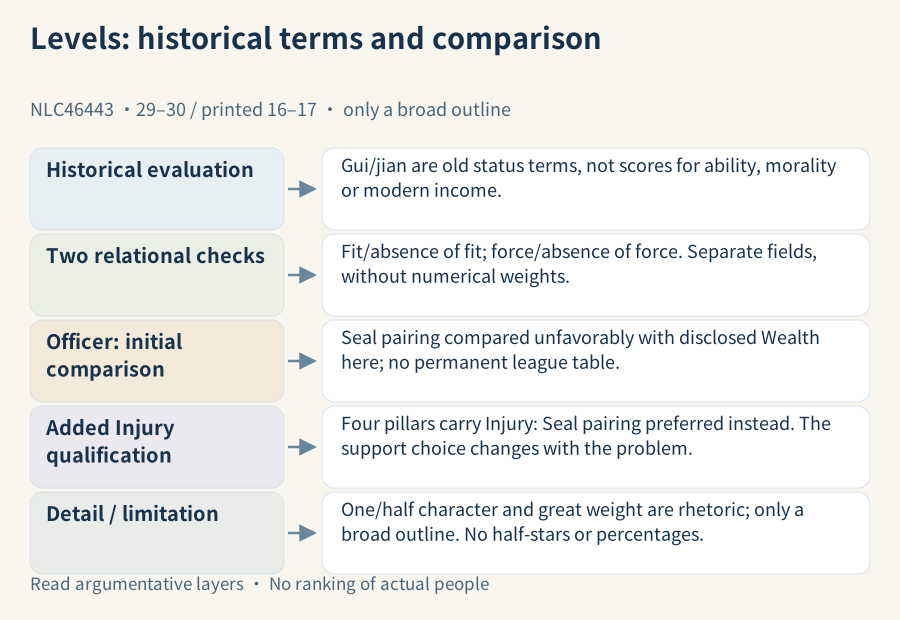
The complete figure is shown below. Select it to enlarge the labels. Open full-size figure · PNG
One character and half a character are rhetorical language
The conclusion says that one character may have enormous force and half a character may spoil the beauty of the whole configuration, before describing the discussion as only a broad outline.[3] These expressions emphasize sensitivity to detail. They do not supply a half-star rating or assign a fixed number of points to each character.
Half a character particularly resists literal numerical conversion. Treating it as half a factor and adding invented weights moves from rhetorical description to a new model. What can be retained is the argument's sensitivity: the same proposed support can change its suitability under an additional condition such as Injury. The intensity of the old wording does not validate a scoring method.
Only a broad outline also limits the coverage. The author's acknowledgment of many changes does not mean that qualifications can be ignored, and it does not allow us to fill every missing field. A note that records a relative comparison, without a complete configuration or independent measuring scale, is more faithful than an apparently exact score.
What would a numerical conversion require?
Suppose an abstract rewrites the passage as Wealth adds ten points and Seal adds five. Assessing that statement would require defining the unit, identifying the comparison objects, explaining how Injury alters the weights, establishing validation data, and handling ties. None of those fields is supplied by the inspected paragraph. Listing them exposes how much the proposed interface would add.
This does not forbid scholarly analysis of historical rankings. It distinguishes the text's statements, our interpretation and unproved real-world inferences. The available material supports conditional relational comparison and the study of historical concepts. It does not support screening readers for ability, career prospects or life achievements.
Even replacing noble with successful does not solve the problem: successful would still need a modern definition and evidence linking it to the source's categories. A softer word can carry the same unsupported transfer. Keeping the author's vocabulary visible, with its scope explained, makes the historical judgment easier to inspect.
Write a comparison that can be read back to its source
A sound abstract can say that the section outlines configuration comparison through relational fit and force within historical status discourse; its Officer example changes the preferred Wealth/Seal support when Injury is added; its conclusion limits the account to an outline. Each clause returns to identified words and pages without assigning anyone a score.
The next question can then ask why a relationship initially described as forming a configuration may lead to its failure, or why the opposite can occur. That extends the inquiry into dependency and operation. It does not convert configuration levels into a real person's rising and falling life curve.
Sources and further reading
NLC46443, 論用神格局高低, printed 一六, scan 29. Identified source page
NLC46443, 論用神格局高低, printed 一六, scan 29. Identified source page
NLC46443, 論用神格局高低, printed 一七, scan 30. Identified source page
NLC46443, 实际刊记:出版与发行, no numbered printed leaf, scan 74. Identified source page
Punctuation, translation, analysis and diagrams are original. Research facsimiles and modern commentary are excluded. Return to Formation Rescue and Change; basic relationships are introduced in Ten Gods.
Evidence and source roles
These roles distinguish ancient text, older commentary, historical scholarship and tool reproduction. The numbered notes in the article retain the precise scan pages and explanations. Library and academic sources do not endorse predictive claims.
- ZP2-P09 · Ancient text evidence: 論用神格局高低
Text layer in the witness: Identified 1926 witness main text, single-line print; original punctuation, translation and analysis; not modern Xu commentary - ZP2-P10 · Ancient text evidence: 論用神格局高低
Text layer in the witness: Identified 1926 witness main text, single-line print; original punctuation, translation and analysis; not modern Xu commentary - ZP2-P11 · Ancient text evidence: 論用神格局高低
Text layer in the witness: Identified 1926 witness main text, single-line print; original punctuation, translation and analysis; not modern Xu commentary - ZP2-P31 · Ancient text evidence: 实际刊记:出版与发行
Text layer in the witness: Actual end colophon, separately arranged publication/distribution fields; inspected for the preceding first phase