Change of yongshen and purity or mixture are printed consecutively in this witness, but they ask different questions. Change concerns a shift in the path of selection. Purity or mixture concerns whether jointly used relationships cooperate after such changes. Reducing both discussions to fewer phases meaning greater purity explains neither the shift nor the example in which two disclosed factors are still called pure.
We read the two actual sections in NLC46443, the Qin/Wenming combined second volume with a verified January 1926 imprint. Change begins late on scan 26, printed 13, and ends before the purity heading on 28, printed 15. Purity ends on that same page before the new section on configuration levels. This is a reading of limited ancient main-text passages; it does not import modern commentary or impose modern chapter numbers.
Change retains an original entrance
Scan 27 says that Ding born in Hai month is originally Direct Officer; with the branches fully including Mao and Wei, it changes to Seal. Ji born in Shen month is originally Hurting Officer; with Geng hidden and Ren disclosed, it changes to Wealth.[1] Both examples state an original relationship before naming its alteration.
That starting point matters. A card reading simply Officer becomes Seal or Injury becomes Wealth loses the day stem and month through which the original relationship is identified. Ding/Hai and Ji/Shen are not interchangeable backgrounds. They supply the entrances against which the later statements operate.
The operations also differ. The Ding/Hai example explicitly retains Mao and Wei in the branch configuration. The Ji/Shen example distinguishes hidden Geng from disclosed Ren. A diagram should label branch gathering separately from the distinction between hidden and disclosed stems, rather than representing both with an unlabeled transformation arrow.
In this section, changing to belongs to the argument about selection. It does not by itself establish every combination-transformation doctrine in every other text. Nor does it describe literal physical changes in metal or water. These names are traditional model vocabulary, and the passage uses them to explain its relational selection path.
A change does not automatically improve the configuration
The same continuous passage continues: “變之而善,其格愈美;變之不善,其格遂壞.” If the change is favorable in the author's framework, the configuration improves; if unfavorable, it deteriorates.[1] Both directions remain in the sentence. Presenting change as an automatic upgrade deletes its explicit unfavorable alternative.
Selection change and assessment after change therefore need separate fields. One records the conditions and shift; the other examines the resulting relationships. Better and worse are the historical author's configuration judgments. They are not our evaluations of a person's moral character, mental health, worth or economic prospects.
The examples also supply only fragments. Ding in Hai month identifies a day stem and month branch, not complete day and month pillars. The listed Mao and Wei are not each assigned a pillar position in the selected sentence. Completing a birthday or filling missing branches would add information rather than clarify the inspected source.
Purity allows two factors to be used together
The opening on purity and mixture follows change and defines purity as “互用而兩相得者是也”: joint use in which the two suit one another.[2] Joint use and compatibility together define the term. The definition does not require only one Ten God, only one phase, or a numerical minimum of characters.
Its concrete example reads: “如辛生寅月,甲丙並透,財與官相生,兩相得也.” Xin in Yin month, with Jia and Bing both disclosed, has Wealth and Officer generating in a mutually fitting relationship.[3] Both disclosed factors are explicitly present; this is not an example of reducing the configuration to one.
The day stem, month, disclosed Jia/Bing and generating relationship belong together. The example disproves an abstract that equates multiple factors with mixture. It does not establish a replacement rule that any two generating factors must always count as pure. The particular entrance and disclosure qualifications still have to be retained.
Mixture likewise concerns the relationship
The contrasting definition says: “何謂雜?多用而兩不相謀者是也.” Mixture involves multiple use without the two working together. The following example is Ren in Wei month with Yi and Ji both disclosed: Officer and Hurting Officer control one another and fail to cooperate.[4]
Removing the final relational qualification leaves only multiple use, which conflicts with the previous example of joint disclosure being pure. Both examples contain two disclosed stems. Their difference lies in the identified objects and their generating or controlling connection, rather than in an item count alone.
Not working together describes relationships in this configuration argument. It should not become a diagnosis that a person cannot cooperate with colleagues or has poor social skills. Likewise, pure is not an ethical judgment about a reader or a cultural group. The historical terms can be studied carefully without transferring their valuation to people.
| Question being read | Source example | Operation or judgment retained |
|---|---|---|
| How does the original selection shift? | Ding in Hai month, branches fully including Mao/Wei | Officer to Seal, with branch qualification |
| How do hidden and disclosed states alter the path? | Ji in Shen month, hidden Geng and disclosed Ren | Injury to Wealth, retaining both states |
| Why can two disclosures be pure? | Xin in Yin month, Jia/Bing both disclosed | Wealth and Officer generate and fit together |
| Why are two disclosures called mixed? | Ren in Wei month, Yi/Ji both disclosed | Officer and Injury control and fail to cooperate |
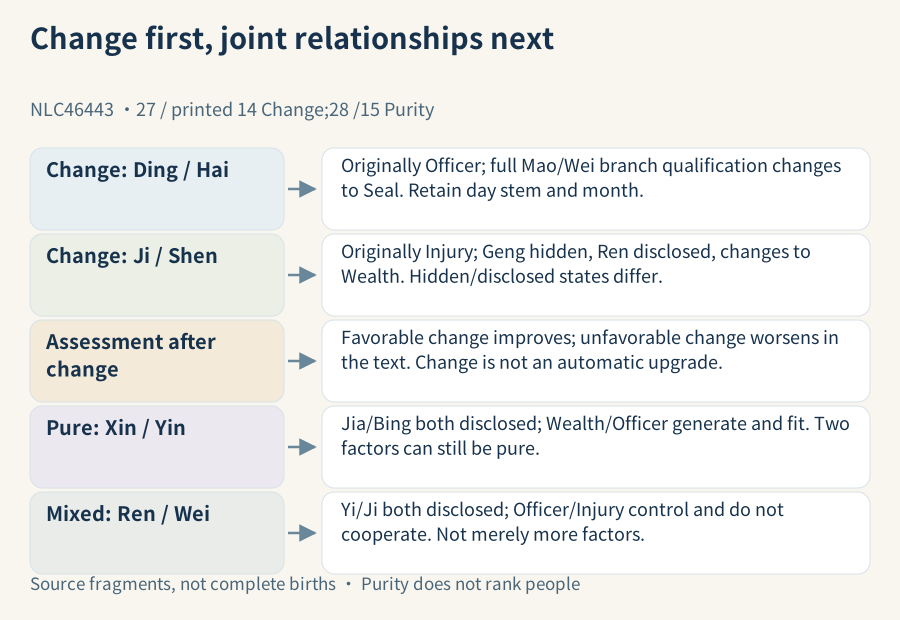
The complete figure is shown below. Select it to enlarge the labels. Open full-size figure · PNG
Read the argument in two passes
The first pass follows original selection, additional conditions and stated shift. The second follows which factors are jointly used, what relationship connects them and whether the author calls them mutually fitting. One pass asks about alteration; the other asks about coordination. These passes organize a reading and do not create an automatic two-click prediction procedure.
Change should also not be made into a career chronology. The source fragments give no ages or event years. Originally is a starting point in the configuration explanation, not evidence that a person first held one profession and later another. Inventing a life sequence would import data the paragraph does not contain.
Removing one clause exposes an overbroad abstract
Delete Wealth and Officer generate from the Xin/Yin example, leaving Jia and Bing both disclosed: the reason it is called pure has disappeared. Delete Officer and Injury control from the Ren/Wei example: the reason for mixture likewise disappears. Since both still contain joint disclosure, the removed relationship is precisely what the comparison needs.
The same exercise applies to change. Removing Mao/Wei from Ding/Hai or disclosed Ren from Ji/Shen removes qualifications for the stated shift. These cards show why identifying an entrance is only a beginning: selection must be followed through its alteration, and multiple use must be examined through relationships. This preserves the text's own distinctions without turning purity into a measure of human worth or change into a fabricated full birth.
Sources and further reading
NLC46443, 論用神變化, printed 一四, scan 27. Identified source page
NLC46443, 論用神純雜, printed 一五, scan 28. Identified source page
NLC46443, 論用神純雜, printed 一五, scan 28. Identified source page
NLC46443, 論用神純雜, printed 一五, scan 28. Identified source page
NLC46443, 实际刊记:出版与发行, no numbered printed leaf, scan 74. Identified source page
Punctuation, translation, analysis and diagrams are original. Research facsimiles and modern commentary are excluded. Return to Formation Rescue and Change; basic relationships are introduced in Ten Gods.
Evidence and source roles
These roles distinguish ancient text, older commentary, historical scholarship and tool reproduction. The numbered notes in the article retain the precise scan pages and explanations. Library and academic sources do not endorse predictive claims.
- ZP2-P05 · Ancient text evidence: 論用神變化
Text layer in the witness: Identified 1926 witness main text, single-line print; original punctuation, translation and analysis; not modern Xu commentary - ZP2-P06 · Ancient text evidence: 論用神純雜
Text layer in the witness: Identified 1926 witness main text, single-line print; original punctuation, translation and analysis; not modern Xu commentary - ZP2-P07 · Ancient text evidence: 論用神純雜
Text layer in the witness: Identified 1926 witness main text, single-line print; original punctuation, translation and analysis; not modern Xu commentary - ZP2-P08 · Ancient text evidence: 論用神純雜
Text layer in the witness: Identified 1926 witness main text, single-line print; original punctuation, translation and analysis; not modern Xu commentary - ZP2-P31 · Ancient text evidence: 实际刊记:出版与发行
Text layer in the witness: Actual end colophon, separately arranged publication/distribution fields; inspected for the preceding first phase