The section on formation, failure and rescue in Ziping zhenquan asks what happens to a selected configuration when other relationships support, damage or rescue it. It does more than give the Ten Gods another favorable/unfavorable list. A useful reading separates four questions: what is being used, what supports its formation, which relationship damages it, and what specifically addresses that damage. Merely finding Seal or a combination does not answer all four.
Our witness is Qin Shen'an's corrected Wenming combined volume 2, NLC46443. Its actual end colophon on scan 74 records January 1926. The present section begins on scan 25, printed 12, and ends on 26, printed 13, before the new heading on change. The reading concerns selected continuous ancient passages. Printed Shen authorship, old correction responsibilities and modern Xu Lewu commentary remain separate; modern explanatory sentences are not supplied as ancient wording.
Monthly selection and four-pillar configuration do different work
The opening reads: “用神專尋月令。今以四柱配之,必有成敗。何謂成?如官逢財印,又無刑衝破害,官格成也.”[1] Yongshen is sought through the Month Command; when matched with the four pillars, formation or failure follows. Its Officer example then requires Wealth and Seal support and the absence of the specified punishments, clashes, breaks and harms.
The first two sentences are consecutive, but their jobs differ. One supplies the entrance for selection; the other raises the question of what the wider configuration does to that selection. Identifying Officer in the monthly entrance has not already completed the support and damage checks. Treating the monthly label as the final answer erases the transition between these tasks.
Positive and negative qualifications belong to the same example. An excerpt reduced to “Officer encounters Wealth and Seal” omits “and no” damaging conditions. A summary based only on no clashes omits the supporting relationships instead. Neither truncated card is equivalent to the whole sentence, and this example does not give every configuration an identical universal checklist.
Formation here is the historical work's assessment of a traditional relationship structure. It is not our evidence that someone will receive an appointment, earn more money or acquire social standing. Keeping the object and qualifications is more faithful than translating Officer directly into an actual job.
Failure identifies an object that is damaged
The same page asks what failure means and answers: “官逢傷尅刑衝,官格敗也.”[2] Officer remains the subject of the example. Hurting Officer, control, punishment and clash are not presented here as a context-free list of characters that must always be bad everywhere in the book.
This connects the failure discussion to the formation example. Once the reader knows what supports Officer, the later sentence can show what interferes with that structure. A diagram should retain the same Officer node, distinguishing supporting and damaging connections. Two unrelated lists headed good and bad would conceal the particular relationship under examination.
The source also leaves fields unstated. It does not supply complete year, month, day and hour pillars for this example. We do not complete those fields, assign a birthday or create a person's life story to illustrate supposed fulfillment. What can be checked is how the passage organizes objects and qualifications.
Three Officer rescues address three different problems
Scan 26 lists Officer encountering Injury with a disclosed Seal to resolve it, mixed Sha with Sha combined to clear it, and punishment/clash with combinations or gatherings to resolve them.[3] The pairings between problem and response are the substance of the list. Disclosed Seal addresses the stated Injury; combining Sha addresses the mixed Sha; the last listed relationship addresses the punishment/clash.
Disclosure and the object combined matter. Replacing disclosed Seal with simply having Seal removes an operational qualification. Replacing combining Sha with having any combination deletes the object to which the combination is directed. The inspected sentences do not establish one automatic procedure through which every disclosed Seal or every combination invariably succeeds.
| Problem identified in this passage | Corresponding response | Details the study card retains |
|---|---|---|
| Officer encounters Injury | Disclosed Seal resolves it | Officer, Injury and disclosure connected to this damage |
| Mixed Sha | Combining Sha clears it | The mixed object and the particular Sha combined |
| Punishment/clash | Combination or gathering resolves it | The original damaging relationship and the response directed to it |
| Wealth encounters Rob Wealth | Disclosed Food transforms; generating Officer restrains | Wealth and Rob Wealth, with two different operations |
This is a correspondence map for reading. It does not establish universal combination-before-clash priority, and arrows should not be mistaken for verified causal mechanisms in real lives.
The Wealth example has a different entrance
The continuous sentence then changes to Wealth encountering Rob Wealth: “財逢劫而透食以化之,生官以制之.”[3] The object and problem have changed. Its verbs also distinguish transformation and restraint. A summary such as “Seal or Food rescues configurations” loses that change while overlooking the disclosure qualification.
A productive exercise traces the objects of each verb. Which factor encounters robbery? What relation is described as transforming it? What restraining task is attached to generating Officer? Different line styles can record these stated verbs, provided readers understand that the notation is original editorial analysis, not a quantitative model printed in the old book.
The Officer and Wealth entrances should likewise remain separate. Joining them into an invented complete birth would supply conditions that the paragraph does not give. The source's compact examples can teach relational reading without claiming a calendar calculation or an outcome test.
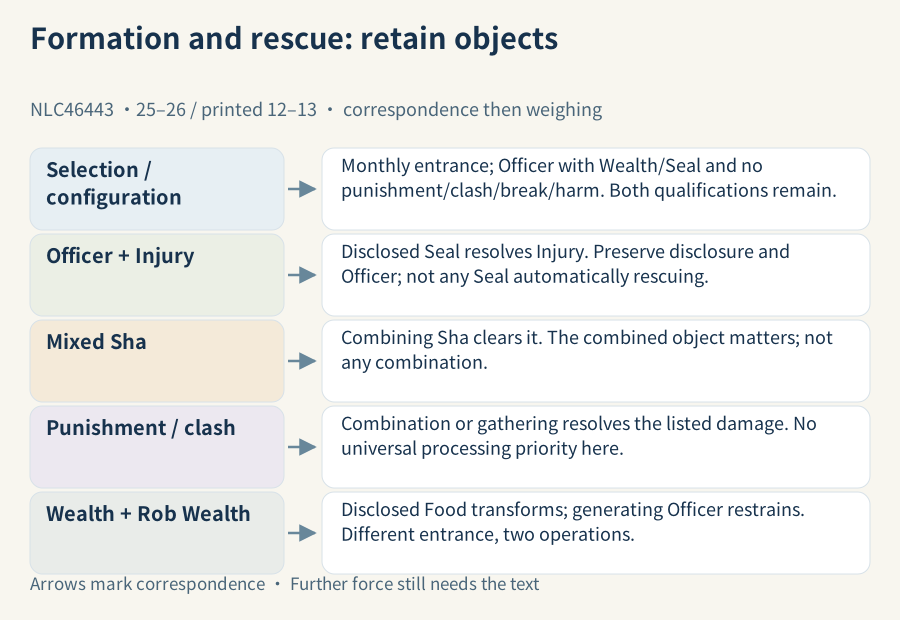
The complete figure is shown below. Select it to enlarge the labels. Open full-size figure · PNG
Weighing relationships is a further task
The section's conclusion includes “其中權輕權重,甚是活變”: weighing lesser and greater force remains highly variable.[4] A list of possible rescuing relationships therefore does not finish the judgment. Knowing what response is named is different from showing that it has the same force in every possible configuration.
This statement does not authorize an interpreter to change conclusions arbitrarily. The earlier concrete correspondences still constrain the reading. A sound note preserves what is actually named, then marks any further qualification that the selected passage does not resolve. Missing information stays missing rather than being repaired with interpretive flexibility.
A graphic reading “Seal found, therefore one hundred percent rescued” converts an unfinished traditional assessment into a numerical guarantee. Conversely, discarding every condition because the text mentions adaptation would lose its clearly specified objects and operations. The passage requires both correspondence and subsequent weighing, rather than either one replacing the other.
Test an abstract by removing one qualification
An editorial exercise can use the phrase Officer encounters Injury and disclosed Seal resolves it. Remove disclosure and ask whether the shortened statement is still equivalent. Then remove Officer encountering Injury and ask whether it now claims that Seal rescues any structure. Both deletions enlarge the claim. Restoring the words repairs the abstract; no person's chart or biography is needed.
Read the four fields back in order: the monthly entrance, support in the wider configuration, damage to an identified object, and a response directed to that damage. Formation, failure and rescue then share a reference rather than functioning as isolated slogans. The following question can ask how selection changes and why jointly used relationships may cooperate or conflict after that change.
Sources and further reading
NLC46443, 論用神成敗救應, printed 一二, scan 25. Identified source page
NLC46443, 論用神成敗救應, printed 一二, scan 25. Identified source page
NLC46443, 論用神成敗救應, printed 一三, scan 26. Identified source page
NLC46443, 論用神成敗救應, printed 一三, scan 26. Identified source page
NLC46443, 实际刊记:出版与发行, no numbered printed leaf, scan 74. Identified source page
Punctuation, translation, analysis and diagrams are original. Research facsimiles and modern commentary are excluded. Return to Formation Rescue and Change; basic relationships are introduced in Ten Gods.
Evidence and source roles
These roles distinguish ancient text, older commentary, historical scholarship and tool reproduction. The numbered notes in the article retain the precise scan pages and explanations. Library and academic sources do not endorse predictive claims.
- ZP2-P01 · Ancient text evidence: 論用神成敗救應
Text layer in the witness: Identified 1926 witness main text, single-line print; original punctuation, translation and analysis; not modern Xu commentary - ZP2-P02 · Ancient text evidence: 論用神成敗救應
Text layer in the witness: Identified 1926 witness main text, single-line print; original punctuation, translation and analysis; not modern Xu commentary - ZP2-P03 · Ancient text evidence: 論用神成敗救應
Text layer in the witness: Identified 1926 witness main text, single-line print; original punctuation, translation and analysis; not modern Xu commentary - ZP2-P04 · Ancient text evidence: 論用神成敗救應
Text layer in the witness: Identified 1926 witness main text, single-line print; original punctuation, translation and analysis; not modern Xu commentary - ZP2-P31 · Ancient text evidence: 实际刊记:出版与发行
Text layer in the witness: Actual end colophon, separately arranged publication/distribution fields; inspected for the preceding first phase