Formation leading to failure and failure leading to formation should first be read as changes in a judgment after relationships are reexamined. The section supplies configuration fragments and asks what an initially forming or damaging relationship does when connected to the wider structure. It gives no event-year table for a person's success followed by failure. Dependencies in the argument are more precise than converting pillar positions into life chronology.
We use NLC46443. The actual section begins midway through scan 30, printed 17, and ends after its opening continuation on 31, printed 18; the climate discussion then begins separately. Both core examples are on 30. The quotation retains the witness's “透丁為用” and “辛生戊戌月.” Punctuation and explanation are original; a familiar circulating reading does not replace the printed characters.
A first formation or failure label remains open to examination
The opening states that varied changes produce formation and failure, and further changes within formation and failure produce reversals.[1] The additional turn matters. An existing assessment is checked again through relationships rather than treated as a permanently closed category.
This extends the preceding comparison but has its own task. Configuration levels changes the preferred Wealth/Seal support under Injury. Here a relationship initially taken as support or damage is examined for an additional operation in a specific configuration. The title does not imply that every failure must become formation or that all formation will fail, and it offers no method for reversing an actual person's fate.
A study note can distinguish the grounds of the initial judgment from the grounds of the revised judgment. Keeping only the final labels hides the reason for revision. Writing first good, later bad likewise encourages a timeline that the fragments do not supply.
Transforming Injury into Wealth can also support Sha
The first continuous example reads: “是故化傷為財,格之成也。然辛生亥月,透丁為用,卯未會財,乃以黨煞,因成得敗矣.”[2] A forming relation, transforming Injury into Wealth, is followed by however and a specific Xin/Hai example with disclosed Ding and Mao/Wei gathering Wealth. Wealth then supports Sha, producing the author's reversal toward failure.
Removing the first half loses why this is described as failure arising from formation. Removing the second loses the counterexample. Both are needed: a Wealth path initially treated as a forming outlet also connects, under the stated conditions, to something the author treats as problematic.
The printed word after disclosed Ding is yong, use. We retain “透丁為用” rather than replacing use with Sha because the later clause discusses supporting Sha. Interpretation must not be poured backward into the quotation. Ding, Mao and Wei likewise remain the named qualifications, rather than being generalized into any disclosed stem or any gathered group.
Ren cannot cross Wu to control Bing: direction matters
The second example first calls Officer/Seal encountering Injury a failure, then specifies: “然辛生戊戌月,年丙時壬,壬不能越戊尅丙,而反能洩身為秀,是因敗得成矣.”[3] Xin is in Wu-Xu month, with year Bing and hour Ren. Ren is the subject of the blocked operation, Bing its target, and Wu the stated intervening factor.
Xin in Xu month is a less complete transcription. It omits the printed month stem Wu, which also matters to the following obstruction. The diagram must not reverse the statement into Bing crossing Wu to control Ren, or claim that Ren controls Wu and opens the path. Those substitutions change the objects and directions of the actual sentence.
The author then attributes another operation to Ren: instead releasing the self as expressive refinement. Instead marks the change from the feared Officer-damaging path to this different role. This is an assertion in the work's traditional configuration model, not a physical statement about water crossing matter, and not an independently validated real outcome.
| Contrast | Initially assessed relationship | Added qualifications in the source | Continuing operation and judgment |
|---|---|---|---|
| Formation leading to failure | Injury transformed into Wealth | Xin in Hai month, Ding disclosed as use, Mao/Wei gather Wealth | Wealth also supports Sha; the author revises toward failure |
| Failure leading to formation | Officer/Seal encountering Injury | Xin in Wu-Xu month, year Bing and hour Ren | Ren cannot cross Wu to control Bing, instead releasing the self |
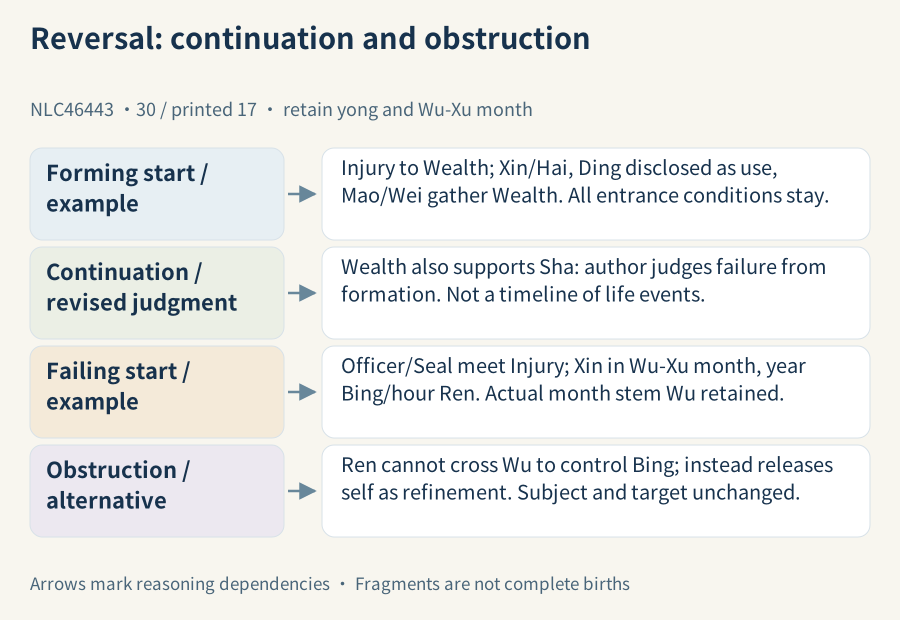
The complete figure is shown below. Select it to enlarge the labels. Open full-size figure · PNG
Sequence is argumentative dependency, not a pillar clock
Both examples can be read as an initial statement, a specific however, a check of where the operation leads, and a revised conclusion. Sequence here concerns dependence between reasoning steps. Year Bing and hour Ren provide positions; they do not automatically mean appointment early in life followed by injury later.
Our arrows consequently mark relationships and rechecking, rather than the first and second halves of someone's life. Calling the left column childhood and the right old age would confuse position with event time. Even where other sections discuss periods or annual influences, this article must stay within the information given by its own cited fragments.
The distinction also prevents a hidden addition to the title. Earlier and later relations can be a useful way to organize reading, but the present examples do not by themselves define a universal processing order for every stem and branch. Their particular blocking and continuing operations remain the evidence.
An intact fragment is still not a complete birth
Restoring Wu-Xu month makes the quotation more complete without making it a complete birth chart. The second fragment still leaves year, day and hour branches among its unlisted fields. The first likewise supplies no complete four pillars or civil-calendar date. We record the characters used by the author without inventing a person, calculating a birthday or testing the fragment against supposed life outcomes.
That boundary permits detailed analysis. One can identify an actual month stem, subject, target and obstruction while keeping other data fields empty. Precision about what is present removes any need to fabricate the absent fields merely to make the example feel concrete.
Check slogans by tracing the next connection
A Wealth means formation card misses what Wealth subsequently supports in the first example. An Injury means failure card misses whether the feared Officer-control path is accepted under the second example's stated obstruction. Both cards name an entrance while omitting continuation or blocking.
The additional reading tool is dependency checking: when something is assessed as forming or failing, trace its target, its possible obstruction and any alternative role stated in the passage. Formation and failure then become judgments attached to operations rather than isolated labels. The next section asks a related question: does an Officer/Seal configuration still receive its general assessment when climatic qualifications are brought into the argument?
Sources and further reading
NLC46443, 論用神因成得敗因敗得成, printed 一七, scan 30. Identified source page
NLC46443, 論用神因成得敗因敗得成, printed 一七, scan 30. Identified source page
NLC46443, 論用神因成得敗因敗得成, printed 一七, scan 30. Identified source page
NLC46443, 实际刊记:出版与发行, no numbered printed leaf, scan 74. Identified source page
Punctuation, translation, analysis and diagrams are original. Research facsimiles and modern commentary are excluded. Return to Formation Rescue and Change; basic relationships are introduced in Ten Gods.
Evidence and source roles
These roles distinguish ancient text, older commentary, historical scholarship and tool reproduction. The numbered notes in the article retain the precise scan pages and explanations. Library and academic sources do not endorse predictive claims.
- ZP2-P12 · Ancient text evidence: 論用神因成得敗因敗得成
Text layer in the witness: Identified 1926 witness main text, single-line print; original punctuation, translation and analysis; not modern Xu commentary - ZP2-P13 · Ancient text evidence: 論用神因成得敗因敗得成
Text layer in the witness: Identified 1926 witness main text, single-line print; original punctuation, translation and analysis; not modern Xu commentary - ZP2-P14 · Ancient text evidence: 論用神因成得敗因敗得成
Text layer in the witness: Identified 1926 witness main text, single-line print; original punctuation, translation and analysis; not modern Xu commentary - ZP2-P31 · Ancient text evidence: 实际刊记:出版与发行
Text layer in the witness: Actual end colophon, separately arranged publication/distribution fields; inspected for the preceding first phase