Clear, turbid, genuine and apparent can easily sound like verdicts about factual accuracy or personal virtue. We first identify what the selected Jiyao passage describes, then trace how the words enter its relational judgments. This distinction does not sanitize the old book into a value-free technical manual. Its ending expressly includes talent, virtue and moral opposition. We retain that historical fact without using the classifications to evaluate present-day readers.
In the 1936 witness, Clear and Turbid is headed at scan 35, printed page 30; the selected text and explanation are at scan 36, printed page 31, before Genuine and Apparent. The latter occupies scan 37, printed page 32, ending before Hidden and Visible at scan 38. We separate opening sentences from recorded explanation, keeping each adjective attached to its local object.
Clear does not require only one qi
The opening speaks of being clear throughout with jing/shen, and of clearing turbidity to seek clarity.[1,2] One concerns a state, the other a task. Neither licenses starting with “clear means few components” and “turbid means many Five Phase categories.”
The explanation explicitly states that clear need not mean a configuration formed by one qi.[3] This qualification permits the following discussion of several components together. Removing it and classifying solely by the number of categories contradicts the actual restriction.
The next passage names Peer, Food Spirit, Wealth, Sha and Seal, allowing their mixed presence if they follow an appropriate order, are settled, or act as idle factors without breaking the configuration. Only then does it call the result clear. It additionally requires jing/shen and qi momentum, neither withered nor weak, for its favorable judgment.[4]
Mixed presence describes an inventory; calling it clear additionally considers organization, settlement, breaking and momentum. The passage therefore permits multiple components without saying every mixture is clear. “Only then,” “also requires” and “only thus favorable” add conditions in succession. Seeing the label clear cannot erase the final qualification.
Clearing turbidity needs a stated route
The explanation separately mentions one factor having force or a cycle being appropriately situated, followed by sweeping away turbidity.[5] Force and appropriate situation cannot be established by the factor’s name alone. The alternative marker also prevents combining these into one unconditional sequence.
The same passage calls the result a pattern of wealth and rank. We report that traditional status evaluation without converting it into a promise about actual finances. Clearing turbidity is not modern data cleaning. Removing a box from a diagram does not change the material itself, and a clear label cannot establish anyone’s moral innocence.
| Recorded question | Local object | Qualification that remains |
|---|---|---|
| Must clear mean one qi? | Formation and multiple components | Not necessarily one qi forming a configuration |
| How can mixture be called clear? | Organization and functions | Appropriate places, settlement or not breaking; only then clear |
| Is the clear label sufficient? | Jing/shen and qi momentum | Also required; neither withered nor weak |
| How is turbidity cleared? | A forceful factor or cycle function | Force, appropriate situation and the clearing relationship |
The first genuine/apparent entrance concerns factors and command
The opening seeks genuineness in the command and warns that an apparent factor should not disturb the genuine one.[6] Here the adjectives first modify shen, with a command entrance and a disturbing relationship. Keep the prohibition rather than reducing the sentence to two names.
Its example is specific: disclosed Wood and Fire, the Yin month, and no Metal or Water disturbing them lead to the stated use of the genuine factor.[7] Disclosure, month, absence of disturbance and the consequent relation all belong to this example. Mentioning Wood and Fire alone is insufficient. Treating Metal and Water as always apparent or bad extends the claim beyond its scope.
Being used remains a conclusion inside the explanatory structure. Factual verification can check whether Yin month is actually printed here and whether the words belong to this passage. The structural question asks how its stated premises lead to the label. Verifying the printed wording has not thereby verified real-life predictive efficacy.
Command and formation compete without a simple equivalence
The same page compares a genuine factor obtaining command while the apparent obtains formation and many allies, or an apparent factor obtaining command while the genuine obtains formation and many allies. It then says that traces of the distinction are not visible.[8] The apparent-factor-in-command branch specifically prevents treating genuine and in-command as interchangeable terms.
Command, formation and allies provide different information. The passage even retains a result of indiscernibility. We do not invent a majority-vote formula or replace it with an absolute determination. Match each branch’s subject to its qualification before preserving the unresolved conclusion.
This task differs from verifying forged documents or inaccurate reporting. It uses the book’s factors, command, formation and allied-group vocabulary. Factual claims need independent evidence appropriate to those facts. Shared words do not make the tasks of proof identical.
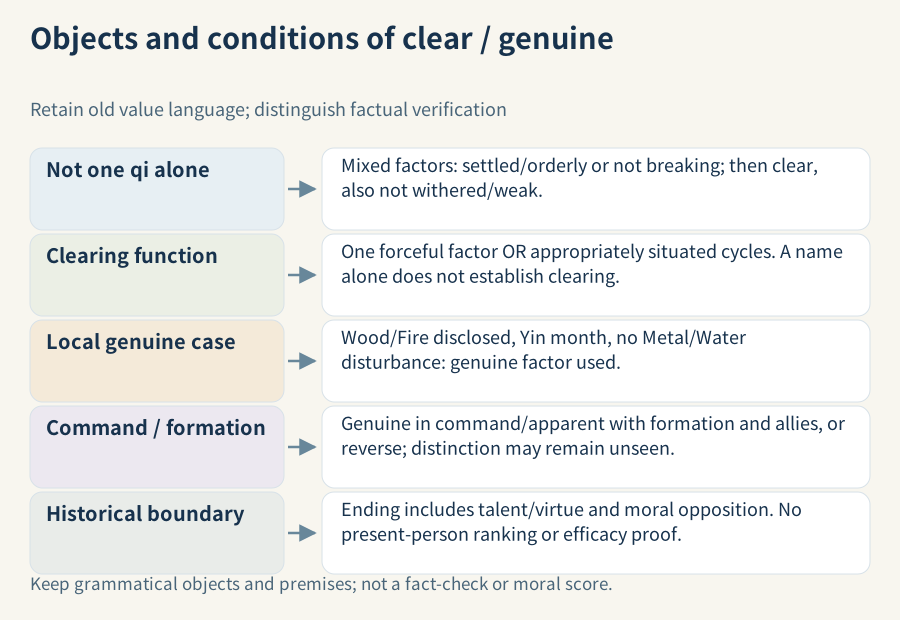
The complete figure is shown below. Select it to enlarge the labels. Open full-size figure · PNG
Retain the old value language rather than deleting it
The ending actually lists gatherings and combining factors, following/transformation and yongshen, jing/shen and images, talent and virtue or moral opposition, life and death, and advance/retreat. It says all have genuine and apparent cases requiring detailed discrimination.[9] Consequently we cannot claim that the book’s terminology never entered moral, status or life evaluations. Those objects were included in its historical explanatory framework.
Retaining that fact helps us understand the model’s reach and value orientation. It does not grant this site an ability to infer a real person’s virtue, health or fate from Five Phase labels. We explain the entrances of the passages actually checked, without supplying modern efficacy evidence for all the old evaluations.
Nor should a wish for neutral terminology lead us to hide the clear/turbid passage’s wealth-and-rank language. State separately how the old explanation evaluates, which characters and premises we verified, and what evidence a new factual or personal judgment would need. This keeps old wording from giving a new claim authority it has not earned.
Check a paraphrase with its object intact
Compare “few components therefore clear” with “not necessarily one qi forming a configuration.” Compare “Wood/Fire genuine, Metal/Water apparent” with the whole disclosed-Wood/Fire-in-Yin-month example and its no-disturbance premise. The first paraphrase removes a qualification; the second removes objects, position and conditions. These faults can be checked at the indicated pages without inventing a reader’s birth chart.
Our result is an object-preserving reading method. For clarity, examine organization, breaking and momentum. For genuineness, examine the present factor-command-formation relationship and its competition, while acknowledging the old expansion into values. Factual reliability, model efficacy and the evaluation of an actual person still require their own evidence and reasons.
Sources and further reading
清濁論, printed 31, scans 36. Source page 1
清濁論, printed 31, scans 36. Source page 1
清濁論, printed 31, scans 36. Source page 1
清濁論, printed 31, scans 36. Source page 1
清濁論, printed 31, scans 36. Source page 1
真假論, printed 32, scans 37. Source page 1
真假論, printed 32, scans 37. Source page 1
真假論, printed 32, scans 37. Source page 1
真假論, printed 32, scans 37. Source page 1
扉页与刊记, title/imprint without a body-page number, scans 1/64. Source page 1 Source page 2
Punctuation, translation, analysis and diagrams are original. Source facsimiles, modern commercial commentary and research/inspection materials are excluded. The final source item separately identifies the 1936 imprint and responsibilities. Return to Relations and Structural Distinctions, or consult the Ten Gods guide.
Evidence and source roles
These roles distinguish ancient text, older commentary, historical scholarship and tool reproduction. The numbered notes in the article retain the precise scan pages and explanations. Library and academic sources do not endorse predictive claims.
- DT2-E04-01 · Ancient text evidence: 清濁論
Text layer in the witness: Raised opening short-text column in this Jiyao witness - DT2-E04-02 · Ancient text evidence: 清濁論
Text layer in the witness: Raised opening short-text column in this Jiyao witness - DT2-E04-03 · Ancient text evidence: 清濁論
Text layer in the witness: Explanation recorded in this Jiyao; largely same-size single columns, not individually signed by commentator - DT2-E04-04 · Ancient text evidence: 清濁論
Text layer in the witness: Explanation recorded in this Jiyao; largely same-size single columns, not individually signed by commentator - DT2-E04-05 · Ancient text evidence: 清濁論
Text layer in the witness: Explanation recorded in this Jiyao; largely same-size single columns, not individually signed by commentator - DT2-E04-06 · Ancient text evidence: 真假論
Text layer in the witness: Raised opening short-text column in this Jiyao witness - DT2-E04-07 · Ancient text evidence: 真假論
Text layer in the witness: Explanation recorded in this Jiyao; largely same-size single columns, not individually signed by commentator - DT2-E04-08 · Ancient text evidence: 真假論
Text layer in the witness: Explanation recorded in this Jiyao; largely same-size single columns, not individually signed by commentator - DT2-E04-09 · Ancient text evidence: 真假論
Text layer in the witness: Explanation recorded in this Jiyao; largely same-size single columns, not individually signed by commentator - DT2-E00-01 · Ancient text evidence: 扉页与刊记
Text layer in the witness: Separately located printed title/imprint/responsibility fields; reused verified identity