A circle of Five Phase generation does not yet answer where Source and Stream begins, where it goes or where it stops. Adding one arrow between two endpoints likewise fails to preserve Connectivity and Blockage’s questions about an intervening obstruction and the conditions for restoring the relationship. We construct limited diagrams from this witness’s wording. Their arrows mark textual relationships, not physical energy, event time or an automatic chart-reading algorithm.
Source and Stream begins at scan 34, printed page 29, and ends before Connectivity and Blockage at scan 35, printed page 30. The latter continues there until Clear and Turbid. Its actual title is Tongge, connectivity/blockage; its explanation also uses tongguan for a resulting passage through. Preserve the distinction rather than replacing the title with a familiar one.
Source, direction and stopping place are separate questions
The opening asks where the root-source starts, toward which place it flows and stops, and how this reveals coming and going.[1] This witness prints 流向, not a silently substituted 流到. Source, direction and stopping place perform separate tasks. Merely showing several elements does not make a diagram a complete account of this argument.
The explanation’s source selection need not begin with whether a factor has command. It takes what is most numerous and most flourishing and can serve as the ancestor of the whole configuration.[2] All those qualifications belong to this local entrance. It does not declare command irrelevant to every judgment in the book, or let a count replace flourishing and the whole-configuration qualification.
Label the start as a source selected under this section’s criteria. Do not automatically designate the day master or a permanent favorite element. Which factors meet the criteria remains a question about the stated material; our diagram supplies no invented numerical score to decide it.
Reaching a desired factor is not the same as staying there
The explanation asks where the source flows and says that, if it reaches the desired factor, stopping there is favorable within the account.[3] If qualifies the endpoint, and staying requires a further observation. Passing through a place and stopping there are not identical descriptions.
A desired factor also cannot be replaced with an element’s permanent favorable name. This passage does not rank one of the five as every configuration’s best destination. It supports a qualified “source to desired stopping place” relationship, not a universal endpoint league table.
Draw only as far as the book’s example allows
The example running from the end of scan 34 to the start of scan 35 names Fire as its source, says it stops in the Metal/Water direction and gives a traditional wealth-and-rank judgment. Further flow into Wood is separately described as release becoming disorder.[10] This supplies a start, a stated stopping place and a further-flow branch.
It does not enumerate a complete Fire–Earth–Metal–Water internal sequence. We therefore add no Earth node and do not split Metal/Water into a supposedly witnessed “first Metal, then Water” series. The diagram identifies Fire and the stated Metal/Water stopping place, noting that the intermediate sequence is not individually given.
Wood belongs to this example’s conditional further-flow branch.[4,10] Extracting it as “all Wood creates disorder” exceeds the source. We analyse the book’s example without completing a civil birth date, person’s identity or life events. Its wealth judgment is not an independently verified historical outcome.
An obstruction needs a position and an object
The explanation asks where an intervening obstruction lies and which factor it blocks.[5] Both fields matter. A red box marked obstruction can remind us of the question; it cannot answer the position and object by itself.
The text then uses favorable/adverse judgment language. We trace what it asks the reader to examine without treating a blocked diagram as evidence of an actual event. Unknown position and object should remain unknown rather than being filled to make the diagram look complete.
Tongge starts with a prior connection and an intervening barrier
Its opening distinguishes two intentions originally connected, an intervening barrier, and the condition that this barrier becomes passable.[6] It does not say to choose any two factors and assume that an inserted third box must make them agree.
The recorded “Metal and Wood obtaining Water” and “Water and Fire obtaining Wood” specify two different endpoint-and-mediator combinations.[7] Water belongs to the first relationship and Wood to the second. Sharing the idea of mediation does not make them interchangeable. Draw their named conditions separately instead of “any third factor connects everything.”
Nor does obtain become a guarantee from the mere appearance of a name. The continuation still examines barriers and their treatment. An original connection has not removed the remaining checks.
Three barrier types receive different verbs
The explanation names intervening obstruction, punishment/clash and appropriation as barriers.[8] It then requires the stated 引用會合 factor within the configuration or cycles, removing the obstruction, harmonizing punishment/clash and controlling appropriation; only then does it call the result tongguan.[9] Removing, harmonizing and controlling attach to their respective objects.
We retain the printed functional phrase 引用會合 rather than impose separate named categories upon it. Obtaining the relevant factor and only then remain qualifications. Adding a generically named combination box does not show that it performs the required task for a particular barrier. Configuration and cycles also remain textual categories rather than being converted into a real life-event chronology.
| Diagram component | Relationship actually supported | Addition to avoid |
|---|---|---|
| Source | Most numerous/flourishing and whole-configuration ancestor | Always day master or one fixed element |
| Stopping place | If desired, and staying there | Treating arrival as equivalent to stopping |
| Fire-source example | Fire to Metal/Water stopping place; further Wood branch | Added Earth, sequential Metal then Water, all Wood adverse |
| Two original connections | Metal/Wood obtaining Water; Water/Fire obtaining Wood | Any third factor as an interchangeable mediator |
| Barrier treatment | Remove, harmonize, control; only then tongguan | A combination name alone guaranteeing success |
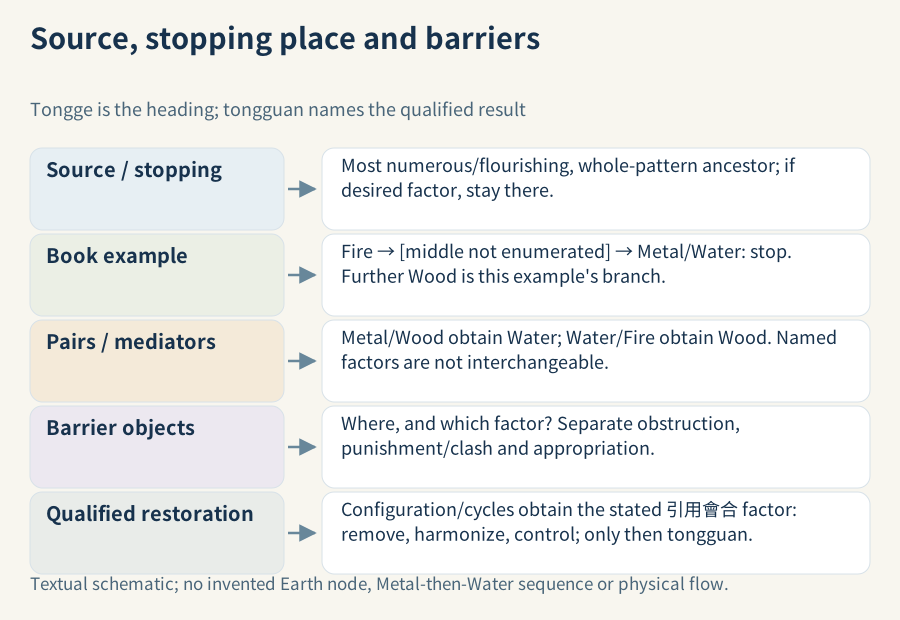
The complete figure is shown below. Select it to enlarge the labels. Open full-size figure · PNG
Check the diagram against its sentences
Ask which passage warrants each arrow: source criteria for the start, if and stay for the endpoint, the unenumerated middle for the example, named factors for the two mediators, and the corresponding treatment verbs and only then for restoration. A node without identifiable textual support should not masquerade as a verified condition in this witness.
The resulting diagram is a traceable reading aid, not a complete theoretical calculator. It preserves the questions of Source and Stream and Tongge, including gaps and conditions. Understanding how this witness arranges relationships and establishing that they determine real lives remain separate evidential tasks.
Sources and further reading
源流論, printed 29, scans 34. Source page 1
源流論, printed 29, scans 34. Source page 1
源流論, printed 29, scans 34. Source page 1
源流論, printed 30, scans 35. Source page 1
源流論, printed 30, scans 35. Source page 1
通隔論, printed 30, scans 35. Source page 1
通隔論, printed 30, scans 35. Source page 1
通隔論, printed 30, scans 35. Source page 1
通隔論, printed 30, scans 35. Source page 1
源流論, printed 29/30, scans 34/35. Source page 1 Source page 2
扉页与刊记, title/imprint without a body-page number, scans 1/64. Source page 1 Source page 2
Punctuation, translation, analysis and diagrams are original. Source facsimiles, modern commercial commentary and research/inspection materials are excluded. The final source item separately identifies the 1936 imprint and responsibilities. Return to Relations and Structural Distinctions, or consult the Ten Gods guide.
Evidence and source roles
These roles distinguish ancient text, older commentary, historical scholarship and tool reproduction. The numbered notes in the article retain the precise scan pages and explanations. Library and academic sources do not endorse predictive claims.
- DT2-E03-01 · Ancient text evidence: 源流論
Text layer in the witness: Raised opening short-text column in this Jiyao witness - DT2-E03-02 · Ancient text evidence: 源流論
Text layer in the witness: Explanation recorded in this Jiyao; largely same-size single columns, not individually signed by commentator - DT2-E03-03 · Ancient text evidence: 源流論
Text layer in the witness: Explanation recorded in this Jiyao; largely same-size single columns, not individually signed by commentator - DT2-E03-04 · Ancient text evidence: 源流論
Text layer in the witness: Explanation recorded in this Jiyao; largely same-size single columns, not individually signed by commentator - DT2-E03-05 · Ancient text evidence: 源流論
Text layer in the witness: Explanation recorded in this Jiyao; largely same-size single columns, not individually signed by commentator - DT2-E03-06 · Ancient text evidence: 通隔論
Text layer in the witness: Raised opening short-text column in this Jiyao witness - DT2-E03-07 · Ancient text evidence: 通隔論
Text layer in the witness: Explanation recorded in this Jiyao; largely same-size single columns, not individually signed by commentator - DT2-E03-08 · Ancient text evidence: 通隔論
Text layer in the witness: Explanation recorded in this Jiyao; largely same-size single columns, not individually signed by commentator - DT2-E03-09 · Ancient text evidence: 通隔論
Text layer in the witness: Explanation recorded in this Jiyao; largely same-size single columns, not individually signed by commentator - DT2-E03-10 · Ancient text evidence: 源流論
Text layer in the witness: Explanation recorded in this Jiyao; largely same-size single columns, not individually signed by commentator - DT2-E00-01 · Ancient text evidence: 扉页与刊记
Text layer in the witness: Separately located printed title/imprint/responsibility fields; reused verified identity