Counting Five Phase names can describe occurrences under a specified recording method. It does not automatically explain what this Jiyao means by decline/flourishing or balance. Our question is how the two explanations qualify general assistance/restraint rules, introduce reversed effects and retain branches that do not require balance. Quantity can still serve another section’s task; resisting a simple tally does not establish that this book excludes quantity everywhere.
We use the 1936 Jiyao. Decline and Flourishing is headed at scan 29, printed page 24; its selected opening and explanation appear at scan 30, printed page 25. Balance follows on that page and ends before Firmness and Softness at scan 31. We distinguish the opening sentences from the explanations recorded here without assigning every unsigned explanation to one commentator.
What question has a count answered?
A tally must specify what is counted. Counting visible characters and including factors stored in branches describe different inventories. Even when the recording method is clear, an occurrence count has not yet supplied a factor’s function, its stated degree or the appropriate direction of response.
The opening stresses knowing the “true pivot of decline and flourishing” and says this carries one “more than halfway” toward the subtlety of the subject.[1] We read that as the old text’s rhetorical emphasis on a method, not a tested predictive success rate. What the pivot involves must be investigated through the explanation; the praise does not verify itself.
General assistance and restraint meet limiting branches
The explanation first says that flourishing calls for discharge (洩) or shang, harm (傷), while decline welcomes help and assistance. These describe functions within the historical scheme. It immediately adds: when something declining remains within flourishing, it must not be diminished; when something flourishing remains within decline, it must not be increased.[2] The general direction and limitations on applying it indiscriminately occur in the same passage.
Turning only the first sentence into “flourishing means subtract; decline means add” leaves no place for its two prohibitions. The internal distinction must remain visible. Giving the entire material one label cannot show that every part calls for the same adjustment. Nor do we insert the name of a particular element where the selected words do not identify that object.
This establishes one concrete difference between quantity and function. A tally aggregates by category, while the passage asks about a different relationship within that aggregate. It supplies no function converting that internal state into a score. We therefore record the premise and the prohibited response instead of inventing a numerical formula.
Extreme is not a numerical threshold supplied by us
The next branch states: “What is extremely flourishing must not be diminished, for diminution is already within it. What is extremely declining must not be increased, for increase is already within it.”[3] Extreme distinguishes this branch from the general case. Remove that word and the paraphrase becomes “all flourishing must not be diminished,” obscuring the earlier ordinary rule.
“Within it” is this explanation’s wording. We can identify its connection between an extreme state and an internally present function, without translating it into a modern feedback mechanism or adding a rule that a particular number of characters constitutes extreme. No such numerical threshold is supplied by the selected passage.
The continuation also mentions cases apparently calling for diminution that become adverse when diminished, and cases calling for increase that become harmful when increased.[4] It distinguishes an apparent response from the effect described in the old argument. Those adverse judgments do not verify a present-day safety risk or an actual event. As a reading instruction, they prevent the response’s name alone from completing the reasoning.
Balance includes contrast and reported sayings
The next opening praises recognition of the “proper principle of balance.”[5] Its explanation calls being both centered and harmonious a key method. It then places sayings about a pattern needing a “defect” beside a saying about removing that defect within the configuration, using “although,” “yet” and “says” before returning to balance.[6]
The witnessed connecting character is 云, “says.” It should not be replaced with 於 to make the following words one uninterrupted grammatical construction. Keeping it reveals reported sayings and comparison. Defect and injury belong here to the vocabulary of a configuration; this is not a medical diagnosis.
The additional question is which relationship needs addressing and how removal of a defect is established within the pattern. Equal counts of five categories do not answer that question. Nor does the first saying automatically mean that more defects are better: the explanation has already placed it within a contrast.
Keep the exceptions to centeredness and harmony
The same passage gives a weak day master with flourishing Wealth and Officer as a case that need not be centered, and a strong yongshen as another that need not be harmonious, while retaining the old text’s favorable status language.[7] These are stated premises, not permission to treat any imbalance as the same case.
It also mentions unusually one-sided qi as not necessarily requiring both centeredness and harmony.[8] We preserve this witness’s exceptions rather than rewriting it as “equal counts are invariably best.” The associated wealth and rank language remains a traditional evaluation; it is not a promise about income, work or the worth of a modern person.
| Selected layer | Words or relationship retained | Question a simple tally has not answered |
|---|---|---|
| General decline/flourishing | Flourishing: discharge or shang (harm); decline: help and assistance | Which entrance applies to the material? |
| Internal branch | Decline within flourishing, flourishing within decline, and prohibitions | Can all parts undergo the same adjustment? |
| Degree branch | Extreme flourishing or decline | How is the extreme qualification established? |
| Balance and contrast | Centered and harmonious; although/yet/says; removal of a defect | Has the relationship to be addressed been distinguished? |
| Balance exceptions | Weak day master with flourishing Wealth/Officer; strong yongshen | Are the specific exception premises present? |
Compare timing and quantity through actual entrances
The selected sections do not provide a separate seasonal table. We cannot invent a uniform spring-to-winter scoring scheme and attribute it to them. A comparison with seasonal command must identify the different passage being consulted.
Firmness and Softness, examined in this collection’s sixth reading, provides a concrete contrast: Geng/Xin born in the traditional seventh month, with Gui Water described as increasing sharpness, followed by the proposal of Ren Water.[10] Its reason is that Ren can lead through Geng’s disposition.[11] Keep Geng/Xin and the seventh-month qualification; we do not convert that traditional month into civil-calendar July. Gui and Ren both belong to Water, yet their functions differ in this recorded example. This shows why category count, traditional month and relational function need separate fields, rather than supplying a scoring table for every season.
The Source and Stream passage examined in this collection’s third reading says not necessarily to discuss being in command or out of command, but to select what is most numerous and most flourishing and can serve as the whole configuration’s ancestor as its source.[9] This is a different entrance: selecting a source. It retains both quantity and flourishing, and locally permits not starting with command. It does not prove that timing is irrelevant to every judgment, or that quantity is never considered in the book.
Attach the tally, command status, source qualification and direction of adjustment to the question each answers. Source and Stream selects where a route begins. Decline and Flourishing checks internal states and degree after a general response. Balance retains appropriate relationships and exceptions. Compressing them all into “the most numerous element is best” erases their distinct tasks.
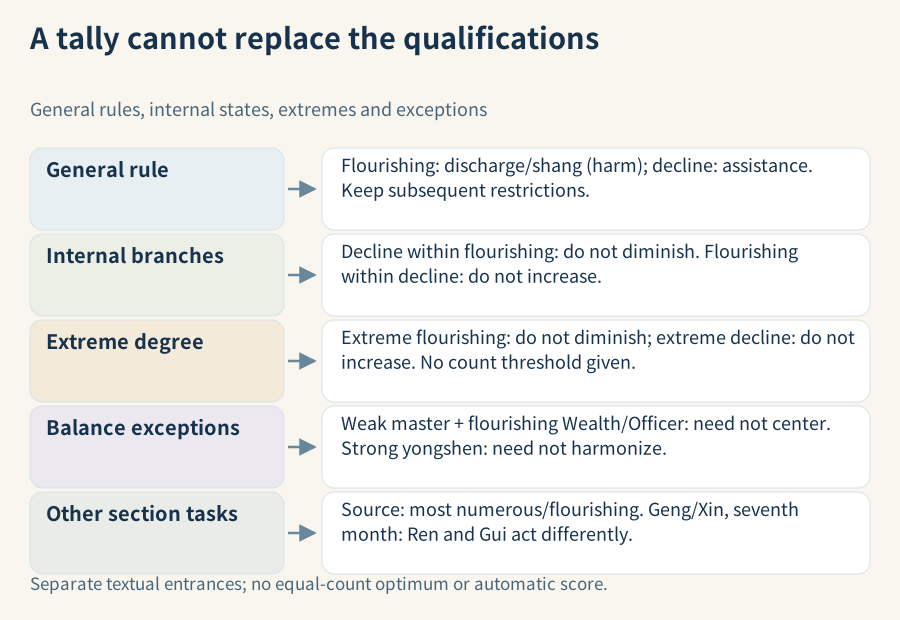
The complete figure is shown below. Select it to enlarge the labels. Open full-size figure · PNG
Check the wording before producing a score
Place the same page’s general response beside its extreme-case prohibition and identify the additional qualification. Restore weak day master and flourishing Wealth/Officer before paraphrasing “need not be centered.” These exercises check whether a quotation or paraphrase has kept its premises; the relevant wording can be revisited on the indicated page.
They do not generate an actual birth chart or use an invented score to validate the theory. Our limited finding is that occurrences alone cannot replace these conditions, while quantity may still perform a local task elsewhere. Record object, degree, internal relationship, response and section entrance before interpreting this witness’s argument.
Sources and further reading
衰旺論, printed 25, scans 30. Source page 1
衰旺論, printed 25, scans 30. Source page 1
衰旺論, printed 25, scans 30. Source page 1
衰旺論, printed 25, scans 30. Source page 1
中和論, printed 25, scans 30. Source page 1
中和論, printed 25, scans 30. Source page 1
中和論, printed 25, scans 30. Source page 1
中和論, printed 25, scans 30. Source page 1
源流論, printed 29, scans 34. Source page 1
剛柔論, printed 26, scans 31. Source page 1
剛柔論, printed 26, scans 31. Source page 1
扉页与刊记, title/imprint without a body-page number, scans 1/64. Source page 1 Source page 2
Punctuation, translation, analysis and diagrams are original. Source facsimiles, modern commercial commentary and research/inspection materials are excluded. The final source item separately identifies the 1936 imprint and responsibilities. Return to Relations and Structural Distinctions, or consult the Ten Gods guide.
Evidence and source roles
These roles distinguish ancient text, older commentary, historical scholarship and tool reproduction. The numbered notes in the article retain the precise scan pages and explanations. Library and academic sources do not endorse predictive claims.
- DT2-E02-01 · Ancient text evidence: 衰旺論
Text layer in the witness: Raised opening short-text column in this Jiyao witness - DT2-E02-02 · Ancient text evidence: 衰旺論
Text layer in the witness: Explanation recorded in this Jiyao; largely same-size single columns, not individually signed by commentator - DT2-E02-03 · Ancient text evidence: 衰旺論
Text layer in the witness: Explanation recorded in this Jiyao; largely same-size single columns, not individually signed by commentator - DT2-E02-04 · Ancient text evidence: 衰旺論
Text layer in the witness: Explanation recorded in this Jiyao; largely same-size single columns, not individually signed by commentator - DT2-E02-05 · Ancient text evidence: 中和論
Text layer in the witness: Raised opening short-text column in this Jiyao witness - DT2-E02-06 · Ancient text evidence: 中和論
Text layer in the witness: Explanation recorded in this Jiyao; largely same-size single columns, not individually signed by commentator - DT2-E02-07 · Ancient text evidence: 中和論
Text layer in the witness: Explanation recorded in this Jiyao; largely same-size single columns, not individually signed by commentator - DT2-E02-08 · Ancient text evidence: 中和論
Text layer in the witness: Explanation recorded in this Jiyao; largely same-size single columns, not individually signed by commentator - DT2-E03-02 · Ancient text evidence: 源流論
Text layer in the witness: Explanation recorded in this Jiyao; largely same-size single columns, not individually signed by commentator - DT2-E06-03 · Ancient text evidence: 剛柔論
Text layer in the witness: Explanation recorded in this Jiyao; largely same-size single columns, not individually signed by commentator - DT2-E06-04 · Ancient text evidence: 剛柔論
Text layer in the witness: Explanation recorded in this Jiyao; largely same-size single columns, not individually signed by commentator - DT2-E00-01 · Ancient text evidence: 扉页与刊记
Text layer in the witness: Separately located printed title/imprint/responsibility fields; reused verified identity