Ti/yong and jing/shen raise related but distinct questions in this witness. Ti/yong asks what serves as the explanatory subject and what function is used. The selected jing/shen passage compares surplus and insufficiency and asks how diminution or addition should respond. Both resist a one-sided reading, but that does not turn them into one permanent correspondence table. We follow the passages recorded in the 1936 Jiyao rather than importing the modern phrase “body and mind.”
Ti/yong begins at scan 27, printed page 22, and ends before Jing/shen at scan 29, printed page 24. Jing/shen continues on that page until Decline and Flourishing. The selected opening sentences stand in separately raised columns; much of the subsequent explanation occupies columns of the same type size. Layout supplies a clue, while wording and position help distinguish layers. These explanations are not individually signed, so we call them explanations recorded in this Jiyao.
The opening sets a task rather than a fixed table
The opening states: “The way has ti and yong; it cannot be discussed from one end alone. What matters is assisting or restraining it appropriately.”[1] This leaves several questions open: the subject, the function, the target of assistance or restraint, and what makes the response appropriate. Extracting only “has ti and yong” and permanently equating ti with the day master would bypass the different entrances actually listed below.
Assistance and restraint are also not actions to choose from a name alone. “Appropriately” requires an object and a reason within the stated relationship. The sentence supplies no universal subtraction score and does not say that assistance is always preferable to restraint. Its explanation examines functions after specifying how the subject has been selected.
One entrance takes the day master as ti
The recorded explanation begins “There are those who take the day master as ti,” then names the outline’s Food Spirit, Wealth and Officer as factors used for it. It continues with a qualification: the day master is weak, and factors in the outline assist it, with restraint directed at the strong factor entering the description of yong.[2] “There are those who” must survive the paraphrase. This is one entrance, rather than a definition that ti always means day master.
The second sentence adds information rather than merely repeating the first. Weakness is a premise; assistance and restraint describe tasks within a relationship. Naming Food Spirit, Wealth and Officer is therefore different from explaining what those factors do under the stated conditions. A list of names alone does not supply the reason for “used for it.”
Nor should weakness silently become a low occurrence count. This selected passage offers no numerical weakness table. We can show the role that weakness plays in the argument without inventing a calibrated score. That preserves both the premise and the information not supplied by this excerpt.
Another entrance takes the outline as ti
The same page gives “There are those who take the outline as ti, and a favorable factor as yong.” It then says the day master cannot use the outline, and specifies the outline’s Wealth, Officer and Food Spirit as excessively flourishing. In that situation it takes Seal and Peer factors at the year, month or hour positions for generating assistance.[3]
The subject has changed, and the reason for selecting a function must be considered again. “Cannot use” and “excessively flourishing” cannot be removed to obtain a general rule that any outline containing these three names always calls for Seal or Peer. The original positional wording also remains relevant. We do not expand year/month/hour into any position or treat mere appearance as sufficient efficacy.
| Reading entrance | Recorded subject | Qualification retained | Task discussed here |
|---|---|---|---|
| Takes day master as ti | Day master | Weakness; outline assistance and restraint of strong factors | Naming Food Spirit, Wealth and Officer does not complete the argument |
| Takes outline as ti | Outline | Cannot use the outline; its Wealth/Officer/Food Spirit excessively flourishing | Year/month/hour Seal and Peer generating assistance |
| Shared question | First identify the chosen ti | Who is assisted or restrained, and why appropriately | Return to the opening’s qualified response |
The continuation at scan 28 still calls for distinguishing ti and yong and mentions seeking another “living route.”[4] We do not turn that phrase into permission to choose labels arbitrarily. It occurs in an explanation still asking for a distinction, and does not prove that every designation can be reset at will. Preserve the qualifications already stated before tracing the continuation’s further attempt to find a function.
Jing/shen asks a different relational question
Its opening reads: “A person has jing and shen; they cannot be sought from one side alone. What matters is diminishing or increasing them to obtain what is appropriate between them.”[5] We retain the terms while consulting the following Five Phase explanation. The modern psychological sense of “spirit” cannot replace that local account.
The explanation says that, “as a general tendency,” Metal and Water are taken as jing qi, Wood and Fire as shen qi, while Earth makes them substantial.[6] The qualifier matters. This is the allocation recorded in this explanation, not a diagnosis of anyone’s mental state, body or moral worth. “Makes substantial” also arrives without a physiological measurement unit.
Simply memorizing Metal/Water and Wood/Fire still omits the comparison the passage actually makes. It distinguishes shen insufficient with jing in surplus from jing insufficient with shen in surplus.[7] Which side is insufficient and which has surplus is reversed. The same inventory of named factors does not make these two relationships identical.
Appropriate proportion is not an equal tally
The selected conclusion calls for diminution and addition according to advance and retreat, without excess or insufficiency.[8] These are relational or degree terms. They require further discrimination; they do not automatically mean equal numbers of all five categories.
We also refrain from installing our own modern dynamic-equilibrium algorithm in their place. The excerpt gives no threshold, measurement unit or experiment. Our figure can display the text’s objects and questions, but cannot present a calibrated physical flow or practical supplementation advice.
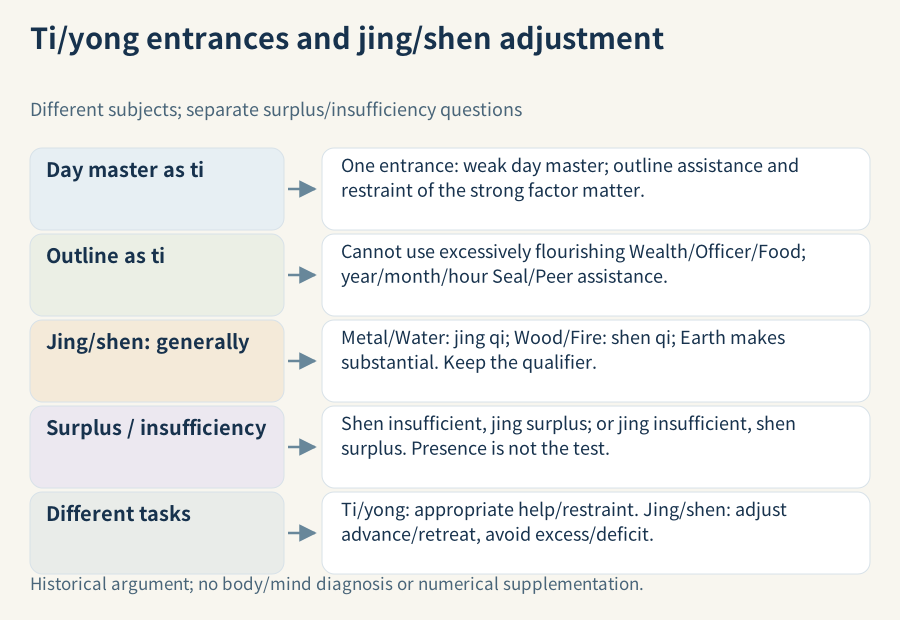
The complete figure is shown below. Select it to enlarge the labels. Open full-size figure · PNG
Connect the questions without merging their definitions
The two ti/yong entrances first ask what is taken as ti, then explain a function that can be used. The selected jing/shen passage first allocates its named roles, then compares surplus, insufficiency and adjustment. Together they show why names alone do not complete an argument. They do not supply one identical definition scheme.
This also establishes a boundary for comparison with another book. Ziping Zhenquan’s Month Command yongshen and assisting factor must be read through that witness’s definitions. The shared word yong does not merge all their entrances. A useful comparison lists subject, position, relationship and qualification separately before identifying similarities and differences.
A textual check makes the point concrete. Rewriting the table’s second row as “the outline has Wealth, Officer and Food Spirit, therefore take Seal and Peer” removes excessive flourishing and inability to use it. Rewriting jing/shen as “Metal and Water always mean jing qi, so their presence is enough” removes both the general-tendency qualifier and the surplus-insufficiency comparison. Restoring those words restores questions about objects and functions. This checks fidelity of a paraphrase; it does not judge any real birth.
Our resulting method is specific: retain the alternative entrance, weakness and excessive flourishing, and the relative jing/shen states before discussing assistance, restraint, diminution or addition. The old claims remain historical explanatory material. Evidence about present-day predictive efficacy or an actual person’s life would require a separate inquiry.
Sources and further reading
體用論, printed 22, scans 27. Source page 1
體用論, printed 22, scans 27. Source page 1
體用論, printed 22, scans 27. Source page 1
體用論, printed 23, scans 28. Source page 1
精神論, printed 24, scans 29. Source page 1
精神論, printed 24, scans 29. Source page 1
精神論, printed 24, scans 29. Source page 1
精神論, printed 24, scans 29. Source page 1
扉页与刊记, title/imprint without a body-page number, scans 1/64. Source page 1 Source page 2
Punctuation, translation, analysis and diagrams are original. Source facsimiles, modern commercial commentary and research/inspection materials are excluded. The final source item separately identifies the 1936 imprint and responsibilities. Return to Relations and Structural Distinctions, or consult the Ten Gods guide.
Evidence and source roles
These roles distinguish ancient text, older commentary, historical scholarship and tool reproduction. The numbered notes in the article retain the precise scan pages and explanations. Library and academic sources do not endorse predictive claims.
- DT2-E01-01 · Ancient text evidence: 體用論
Text layer in the witness: Raised opening short-text column in this Jiyao witness - DT2-E01-02 · Ancient text evidence: 體用論
Text layer in the witness: Explanation recorded in this Jiyao; largely same-size single columns, not individually signed by commentator - DT2-E01-03 · Ancient text evidence: 體用論
Text layer in the witness: Explanation recorded in this Jiyao; largely same-size single columns, not individually signed by commentator - DT2-E01-04 · Ancient text evidence: 體用論
Text layer in the witness: Explanation recorded in this Jiyao; largely same-size single columns, not individually signed by commentator - DT2-E01-05 · Ancient text evidence: 精神論
Text layer in the witness: Raised opening short-text column in this Jiyao witness - DT2-E01-06 · Ancient text evidence: 精神論
Text layer in the witness: Explanation recorded in this Jiyao; largely same-size single columns, not individually signed by commentator - DT2-E01-07 · Ancient text evidence: 精神論
Text layer in the witness: Explanation recorded in this Jiyao; largely same-size single columns, not individually signed by commentator - DT2-E01-08 · Ancient text evidence: 精神論
Text layer in the witness: Explanation recorded in this Jiyao; largely same-size single columns, not individually signed by commentator - DT2-E00-01 · Ancient text evidence: 扉页与刊记
Text layer in the witness: Separately located printed title/imprint/responsibility fields; reused verified identity