The Month Command and Birth Time lines both place an active human-origin factor inside a larger position, but use different spatial metaphors. Month is a house, the active factor its orientation; birth time is a tomb, the active factor its site. These cannot be reduced to month and clock-hour labels or turned into property and mortality advice.
NLC9444's Month Command section is midway through scan 33, printed 28. Birth Time begins lower on the same page and continues to 34, printed 29, before Source/Flow. The titles and text/explanation layers remain distinct. We analyze selected passages under the verified 1936 imprint without deriving modern term boundaries, time zones or day rollover.[1,7]
The month-house metaphor has two fields
The intact short text compares Month Command as outline to a house and the active human-origin factor to its orientation, requiring judgment.[2] Month and outline belong to one field; the active factor and orientation to another. The second cannot disappear while house becomes simply another name for month.
Orientation here is a metaphorical detail, not the month stem. Active factor is traditional vocabulary, not an identification of a modern deity. The old divinatory verb does not constitute advice to purchase a house, redirect a home or make an asset decision.
Our diagram separates larger position and what must be distinguished within it. It organizes the selected expression without claiming that the old text supplied a modern map or coordinate system.
Three hidden Yin-branch factors still require selection
The recorded explanation lists Wu Earth, Bing Fire and Jia Wood within Yin 寅 and asks which is active, linking that distinction with selecting configuration and use.[3] The object is branch-hidden human origins. We preserve the listed order rather than change it into a month stem or treat first-listed Wu as permanently commanding.
Which is active is a question, not all three always active equally. It adds a particular task beyond the branch label: identify the hidden objects and their selected operation. The excerpt supplies no complete term-by-term daily table, so its three characters cannot authenticate a particular birthday's active factor.
Displaying hidden stems is a calculation task; establishing the real efficacy of a traditional selection is another. Correctly listing three symbols does not automatically validate their interpretation against outcomes.
The time-tomb metaphor has another task
The other short text compares Birth Time's destination to a tomb, and its active human-origin factor to the site, requiring distinction.[4] Destination, tomb and site form another spatial explanation, not a person's death date or a conclusion about later life.
The same active-factor term enters two different metaphors. Their larger-position/detail relationships can be compared without making month and birth time one interchangeable field. Their closing verbs also retain their own reading tasks rather than becoming an automatic calculation instruction.
The Zi-time explanation goes below a branch label
The gloss lists “前三刻三分” with Ren Water active and “後四刻七分” with Gui Water active, explicitly under Zi time.[5] Earlier and later expressions remain connected to their respective stems. A Zi label alone cannot retain this finer distinction.
Ke and fen are kept as the quoted terms. Fen is not converted into a fixed qi percentage and ke not converted into modern minutes; earlier and later are not presumed equal halves. A modern conversion would need independently established units, time-zone, calendrical and boundary rules not supplied by the excerpt.
We likewise do not select an authenticated Ren or Gui factor for an arbitrary Zi-time reader. The sentence shows a further layer in the recorded explanation, without providing a real birth record, instant or complete chart.
| Recorded layer | Metaphor or example | Information retained | Modern conclusion not supplied |
|---|---|---|---|
| Monthly outline | House | Larger position | Solar-term boundary algorithm |
| Monthly active factor | Orientation; Yin hidden Wu/Bing/Jia | Distinguish which is active | Equal permanent authority or a specified birthday |
| Birth-time destination | Tomb | Different positional task | Death date or later-life result |
| Birth-time active factor | Site; earlier/later Zi Ren/Gui | Actual 三刻三分 and 四刻七分 | Modern minutes or percentages |
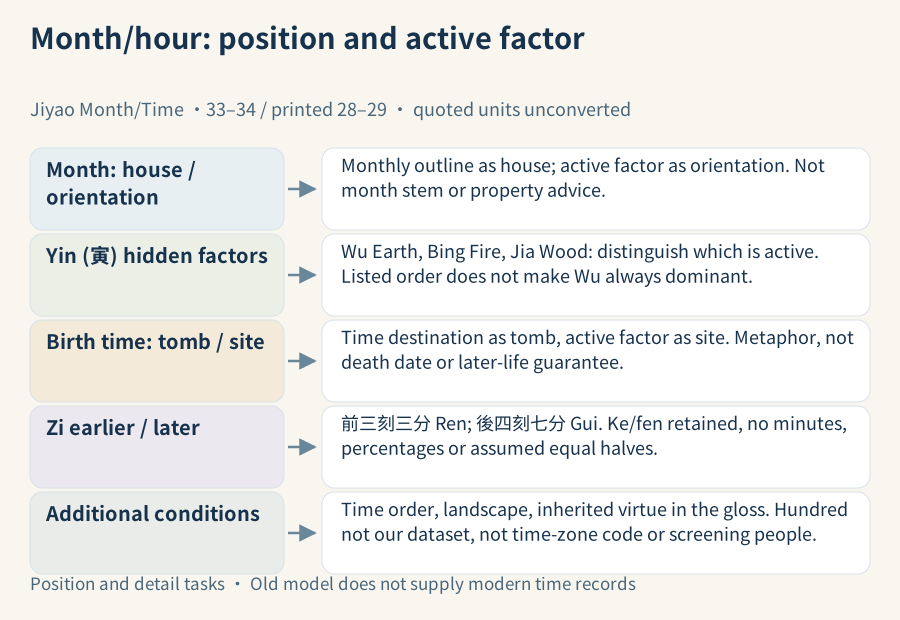
The complete figure is shown below. Select it to enlarge the labels. Open full-size figure · PNG
A hundred responses is not our hundred-person dataset
Scan 34 says that where people share year, month, day and time yet have different responses, one should examine earlier/later time as well as differences of landscape and inherited virtue.[6] The hundred belongs to the recorded author's scenario. We have collected no hundred authenticated births and life histories.
The passage supports a textual finding: the explanation does not regard the hour-branch label as all the information. It does not establish an accuracy rate, controlled experiment or efficacy of the additional conditions. Missing records cannot be replaced by invented stories that then certify the old claim.
Landscape is also not today's historical time-zone database, and inherited virtue is not a measure for judging readers' families or character. We can describe how the old explanation expands its considered conditions without adopting them as standards for evaluating people. Naming a condition and proving it works remain distinct.
Spatial metaphors do not provide time records
House orientation and tomb site give no longitude, UTC offset, day boundary or modern solar-time algorithm by themselves. A spatial word does not imply that this print already contained those computational data. Actual chart calculations require recorded inputs and their own rule evidence.
Destination likewise does not supply a life story. These short texts assign monthly and time-position tasks inside a traditional model. Unlisted birthdays, pillars and outcomes remain unlisted; the graphic does not conceal a completed birth chart.
Read the shared active-factor term in its different positions
Remove the active factor from the monthly line and house loses the orientation task. Remove it from the time line and tomb loses the site task. Reduce the Zi explanation to Zi Water and the Ren/Gui and quoted-unit distinction disappears. Restoring the fields retains the actual explanation.
The collection moves from witnesses and commentary layers through historical concepts, imagery, branches and classifications to monthly/time details. It provides six sourced reading questions, not a complete critical edition or modern predictive model. Continue by asking who speaks, what the object is, which conditions remain, and where the conclusion ends.
Sources and further reading
滴天髓輯要目錄, printed 目录一/目录二, scans 4/5. Source page 1 Source page 2
月令論 短句, printed 二八, scans 33. Source page 1
月令論 解说, printed 二八, scans 33. Source page 1
生時論 短句, printed 二八, scans 33. Source page 1
生時論 子时用事解说, printed 二八, scans 33. Source page 1
生時論 同年月日時解说, printed 二九, scans 34. Source page 1
扉页与刊记, printed 无正文印页/无正文印页, scans 1/64. Source page 1 Source page 2
Punctuation, translation, analysis and diagrams are original. Source facsimiles, modern commercial annotations and private inspection materials are excluded. Return to Text Commentary and Metaphor, or consult the Ten Gods guide.
Evidence and source roles
These roles distinguish ancient text, older commentary, historical scholarship and tool reproduction. The numbered notes in the article retain the precise scan pages and explanations. Library and academic sources do not endorse predictive claims.
- DT1-E04 · Ancient text evidence: 滴天髓輯要目錄
Text layer in the witness: Actual contents entries, not a continuous main-text sentence - DT1-E28 · Ancient text evidence: 月令論 短句
Text layer in the witness: Ancient short text in this Jiyao witness; earliest author not established - DT1-E29 · Ancient text evidence: 月令論 解说
Text layer in the witness: Explanation recorded in Jiyao, not individually labelled by commentator; compilation responsibility alone does not prove each author - DT1-E30 · Ancient text evidence: 生時論 短句
Text layer in the witness: Ancient short text in this Jiyao witness; earliest author not established - DT1-E31 · Ancient text evidence: 生時論 子时用事解说
Text layer in the witness: Explanation recorded in Jiyao, not individually labelled by commentator; compilation responsibility alone does not prove each author - DT1-E32 · Ancient text evidence: 生時論 同年月日時解说
Text layer in the witness: Explanation recorded in Jiyao, not individually labelled by commentator; compilation responsibility alone does not prove each author - DT1-E01 · Ancient text evidence: 扉页与刊记
Text layer in the witness: Printed title/imprint/responsibility fields in separate locations