Image/form and direction/group all discuss configurations, but they are not one classification table. Jiyao's selected image/form statements distinguish two qi forming an image from five qi forming a form. Its direction/group section explicitly separates fang and ju and explains through branch components, disclosed stems and additional relations. The useful question is what each passage classifies, rather than exchanging conclusions whenever Wood, Fire or three branches appear.
We read NLC9444's Image/Form section on printed 14–15, scans 19–20 before Direction/Group, and the latter on printed 15–16, scans 20–21 before Configurations. Only selected two-qi, five-qi and one direction/group example are examined, not every category in the whole image section. Contents and actual 1936 imprint are separately identified.[1,8]
Two qi forming an image retains the objects combined
The short text says two qi combine into an image, which must not be broken. The explanation supplies stems of Wood with branches of Fire and stems of Fire with branches of Wood; if Metal appears, it breaks the image.[2,3] This is not any two stems forming an image. Stems/branches, Wood/Fire and the specified connection remain.
The two arrangements differ in direction but both illustrate this Wood/Fire image. Metal breaks belongs to these examples, not every configuration. The closing imitate the rest does not become our exhaustive phase-pair list, and no complete birth or assigned pillar positions are added.
Must not be broken is normative language in the model. It does not prove that a real fate cannot be disturbed or that every actual loss was caused by a Metal character.
Five qi forming a form describes another whole
The actual line is “五氣聚而成形,形不可害”: five qi gather to form a form, which must not be harmed.[4] Qi and gathering name the relations developed by the following explanation. The explanation takes Wood as its reference: Water generates it, Fire carries it forward, Earth cultivates it and Metal completes it; the five gather into form.[5]
Metal completes here cannot be substituted for Metal breaks in the two-qi Wood/Fire example. Both involve Wood, but the recorded task differs. A single graphic saying Metal always harms Wood would omit the explicit completing role in this second explanation.
Generation, movement, cultivation and completion are not four modern nutrient instructions. They organize a whole through historical phase relationships, supplying neither botanical experiments nor advice to add metal fertilizer. A vivid Wood metaphor does not establish an ecological or natural-science model.
Retain yu instead of silently replacing it
The five-qi explanation ends “或遇或缺則害.”[5] The witness's 遇, encounter, remains; it is not silently replaced by 過, excess. A claim that another reading is original would require another identified witness. An unfamiliar sentence does not authorize restoration from habit.
Our substantive comparison does not depend on interpreting encounter as excess. The secure preceding clauses already distinguish four operations and five-factor gathering. The ending is recorded without manufacturing a percentage threshold beyond which harm occurs. Wording can be preserved while an unresolved interpretation stays unresolved.
Direction/group does not allow arbitrary addition of similar factors
Its short line distinguishes fang from ju and says not to mix a direction with a group.[6] It does not make image, form, direction and group synonyms or rank them by an item count. Its explanation's components need to be read on their own rather than borrowed from the five-qi paragraph.
The selected example has full Yin/Mao/Chen, Jia/Yi disclosed as one primal factor, and additionally Hai's generation and Wei's storehouse. It states decisively no blessing and concludes that fang cannot be mixed with ju.[7] The entire excerpt is on scan 20, printed 15. Every component remains; extracting Hai/Wei alone loses its entrance.
Decisively no blessing is the explanation's strong assessment, not our judgment of a reader's wealth or life. Preserving attribution and scope also means not deleting decisively to make the old text sound more qualified than it is.
| Selected discussion | Object explained | Recorded conditions/operations | Unsupported substitution |
|---|---|---|---|
| Two qi form image | Two Wood/Fire stem-branch arrangements | Metal appearance breaks | Any two stems; Metal always harms |
| Five qi form form | Whole illustrated through Wood | Water generates, Fire advances, Earth cultivates, Metal completes | Any three-branch gathering equals form |
| Five-qi ending | This witness's wording | Actual 遇 and 缺 | Silent replacement by excess or numerical threshold |
| Direction/group example | Full Yin/Mao/Chen plus disclosure/additions | Jia/Yi, Hai generation, Wei storehouse; fang/ju restriction | More similar characters always improve |
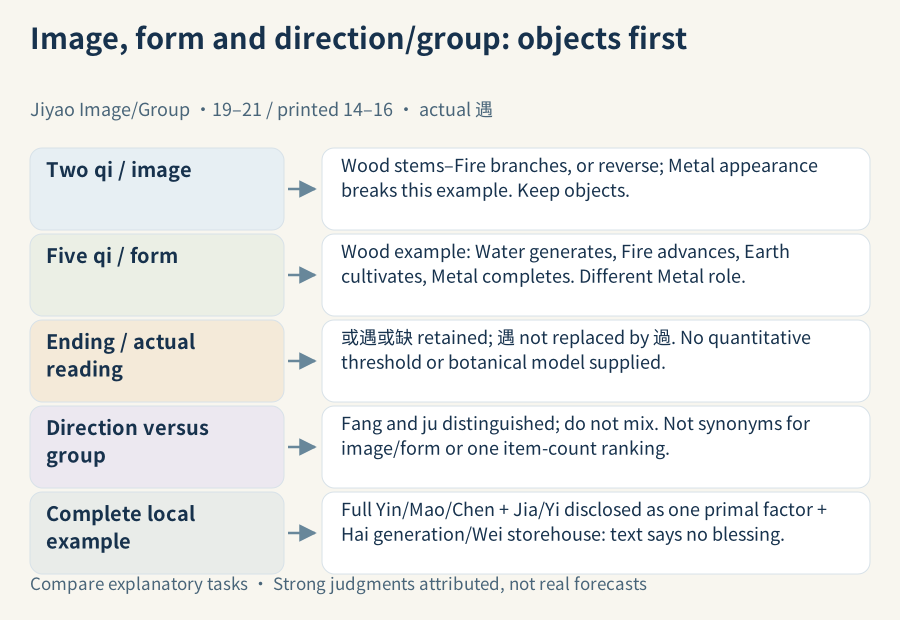
The complete figure is shown below. Select it to enlarge the labels. Open full-size figure · PNG
Analytical fields do not create an original algorithm
We record the selected image/form material as explanation of configuration relationships and the fang/ju example as branch-component, disclosure and addition conditions. These are original reading fields, not a claim that the author designed a modern layered model or executable classifier.
Whether one full configuration meets other image/form or direction/group statements needs further specified information. We provide no complete chart for such testing. The excerpts demonstrate distinct tasks without exhausting every relationship between the categories.
Shared Wood does not make the assessments identical
The two-qi and five-qi examples share Wood, while the direction/group example includes Yin/Mao/Chen and Jia/Yi. Overlapping names do not establish identical scope or function. Metal's breaking/completing contrast and the restrictive addition example show why phase name alone cannot summarize the argument.
Verbs therefore matter in the table. If only five colored phase names remain, combination, gathering, generation, movement, cultivation, completion and disclosure disappear. Filling a color chart cannot replace these operations and qualifications.
Read combination, gathering and mixing back to their pages
Ask which two qi combine, how five qi are presented as a whole, and which components are jointly specified in the fang/ju example. Attach each to its section and page, checking whether a gloss has been moved into another verse. That makes the comparison evidence-based as a textual reading rather than decided by similar headings.
The next question examines Month Command and Birth Time: both use spatial metaphors, but the house/direction and tomb/site perform different tasks. Objects, recorded explanations and unproved inferences continue to need separate fields.
Sources and further reading
滴天髓輯要目錄, printed 目录一/目录二, scans 4/5. Source page 1 Source page 2
形象論 两气短句, printed 一四, scans 19. Source page 1
形象論 两气解说, printed 一四, scans 19. Source page 1
形象論 五气短句, printed 一四, scans 19. Source page 1
形象論 五气解说, printed 一四, scans 19. Source page 1
方局論 短句, printed 一五, scans 20. Source page 1
方局論 解说, printed 一五, scans 20. Source page 1
扉页与刊记, printed 无正文印页/无正文印页, scans 1/64. Source page 1 Source page 2
Punctuation, translation, analysis and diagrams are original. Source facsimiles, modern commercial annotations and private inspection materials are excluded. Return to Text Commentary and Metaphor, or consult the Ten Gods guide.
Evidence and source roles
These roles distinguish ancient text, older commentary, historical scholarship and tool reproduction. The numbered notes in the article retain the precise scan pages and explanations. Library and academic sources do not endorse predictive claims.
- DT1-E04 · Ancient text evidence: 滴天髓輯要目錄
Text layer in the witness: Actual contents entries, not a continuous main-text sentence - DT1-E22 · Ancient text evidence: 形象論 两气短句
Text layer in the witness: Ancient short text in this Jiyao witness; earliest author not established - DT1-E23 · Ancient text evidence: 形象論 两气解说
Text layer in the witness: Explanation recorded in Jiyao, not individually labelled by commentator; compilation responsibility alone does not prove each author - DT1-E24 · Ancient text evidence: 形象論 五气短句
Text layer in the witness: Ancient short text in this Jiyao witness; earliest author not established - DT1-E25 · Ancient text evidence: 形象論 五气解说
Text layer in the witness: Explanation recorded in Jiyao, not individually labelled by commentator; compilation responsibility alone does not prove each author - DT1-E26 · Ancient text evidence: 方局論 短句
Text layer in the witness: Ancient short text in this Jiyao witness; earliest author not established - DT1-E27 · Ancient text evidence: 方局論 解说
Text layer in the witness: Explanation recorded in Jiyao, not individually labelled by commentator; compilation responsibility alone does not prove each author - DT1-E01 · Ancient text evidence: 扉页与刊记
Text layer in the witness: Printed title/imprint/responsibility fields in separate locations