The branch section does more than assign each of twelve branches a material attribute. The selected passages describe polarity, motion/stillness and time, then distinguish growth, storehouse and defeat-ground groups with different combination/clash tasks. Neither coloring every clash unfavorable nor deleting the commentary's strong prohibitions preserves that structure.
We use NLC9444's Branches section from the middle of scan 14, printed 9, to before Stems/Branches on 16, printed 11. Both polarity short texts are on scan 14; the following Yin explanation continues onto 15. Short text and explanation remain separate, with contents and actual July 1, 1936 imprint independently located.[1,6]
Symbolic class and operation are not personal attributes
The lines read “陽支動且強,速達顯災祥” and “陰支靜且專,否泰每經年.”[2,3] Yang/Yin first limits the object; motion/strength versus stillness/concentration supplies description; rapid appearance versus extended years supplies temporal wording. Removing the class broadens the statement, while merging both into all branches rapid deletes the contrast.
These are descriptions within a symbolic model, not a personality or ability table for actual people. Concentrated does not diagnose attention; strong does not assess bodily condition or willpower. Calamity/auspiciousness and adversity/prosperity likewise remain the old text's terms, not our risk or outcome forecasts.
The temporal wording gives no modern measurement scale in the selected passage. Turning extended years into exactly one year for everyone, or motion/strength into a speed coefficient, adds units and validation. Class and wording can remain faithful without invented numbers.
Growth, storehouse and defeat-ground form another classification
The next line says growth places fear movement, storehouses should open, and defeat-ground clash requires close judgment.[4] Three objects receive three tasks. Clash is not assigned one conclusion for all three.
The explanation identifies Yin/Shen/Si/Hai as four growth places, Chen/Xu/Chou/Wei as four storehouses and Zi/Wu/Mao/You as four defeat grounds.[5] These are this paragraph's groups, not every day stem's full stage lookup. Growth and defeat do not mean actual birth or personal failure, while a storehouse is not an actual bank account.
This grouping also differs from the preceding polarity field. One asks what group a clash encounters; the other describes polarity-related motion and time. Several classifications can coexist without becoming a permanent favorable/unfavorable score for each branch.
| Class in this passage | Branches listed | Recorded task | Scope retained |
|---|---|---|---|
| Four growth places | Yin/Shen/Si/Hai | Avoid clash movement | Growth-place object, not all clashes |
| Four storehouses | Chen/Xu/Chou/Wei | Favor opening by clash | Storehouse object, not a financial instruction |
| Four defeat grounds | Zi/Wu/Mao/You | Examine combination/clash closely | Distinction from the first two, not one preset outcome |
Yin in the first row is the branch 寅, distinct from Yin 陰 polarity. Group names are retained as traditional categories rather than diagnoses of a person's stage or condition.
Both absolute language and close judgment retain objects
The explanation gives cases encountering combination but favoring clash, contrasting these with growth places that absolutely must not be clashed. It then gives cases encountering clash but favoring combination, contrasting them with storehouses that absolutely must not be closed, before requiring detailed judgment.[5] The strong prohibitions are the commentary's actual language, not silently softened to usually inadvisable.
Recording that strength does not establish real efficacy. Two fields distinguish the commentary's class-limited assertions from modern outcome evidence not supplied. This neither improves the old claim cosmetically nor presents it as our guarantee to readers.
Keeping only close judgment makes the paragraph seem to remove all strong constraints. Keeping only must not omits the defeat-ground judgment task. Both are necessary to explain the actual coexistence of prohibition and further comparison.
Combination and clash need more than one color
The two cases show why an operation name alone does not finish assessment within the stated scope. Combination is not automatic improvement and clash not automatic damage. Group qualifications still constrain them; this does not imply unrestricted reinterpretation of every configuration.
The selected paragraph gives no complete four-pillar example for those clauses. We do not import a case from another book, supply event years or calculate an accuracy rate. The table records this witness's actual groups and statements without completing scenarios it does not provide.
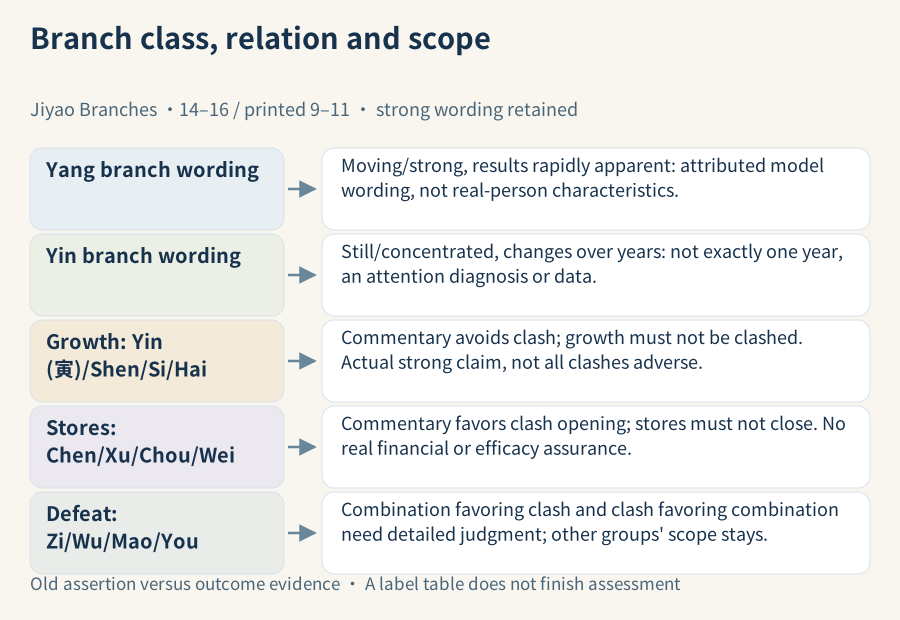
The complete figure is shown below. Select it to enlarge the labels. Open full-size figure · PNG
A label table does not supply the interpretive algorithm
A reference list can identify characters without implementing the passage's judgments. Class, operation, strength of wording and context still need recording. Correct symbolic labels and evidence that a traditional prediction works are different tasks.
Nor do stillness or extended adversity/prosperity supply modern personality indicators. Applying those terms to work ability, household risk or health would require real evidence not furnished by the verse and groups. Symbolic polarity is not a basis for screening people.
The explanation does not individually name its commentator
The classification and clash clauses are explanations recorded in Jiyao. Its Chen compilation responsibility does not make each paragraph Chen's personally authored words. Short text, recorded explanation and our three-row table remain separate layers.
This reading also does not force other books' growth/storehouse or clash vocabulary into one rule. A similar word elsewhere requires its own object and section. One shared label cannot answer every book's distinct question.
Test an abstract through object and qualifier
Removing growth places enlarges avoid clash. Removing storehouses can make opening apply to any branch. Removing detailed judgment erases the comparison task, while softening must not changes the commentary's own strength.
A sound abstract states that the paragraph gives different groups different tasks, retaining both class-limited strong assertions and another group's judgment requirement as historical model language. The next question separates form/image from direction/group by asking what is classified and which components support it.
Sources and further reading
滴天髓輯要目錄, printed 目录一/目录二, scans 4/5. Source page 1 Source page 2
地支論 阳支短句, printed 九, scans 14. Source page 1
地支論 阴支短句, printed 九, scans 14. Source page 1
地支論 生方/库/败地短句, printed 一〇, scans 15. Source page 1
地支論 冲合解说, printed 一〇, scans 15. Source page 1
扉页与刊记, printed 无正文印页/无正文印页, scans 1/64. Source page 1 Source page 2
Punctuation, translation, analysis and diagrams are original. Source facsimiles, modern commercial annotations and private inspection materials are excluded. Return to Text Commentary and Metaphor, or consult the Ten Gods guide.
Evidence and source roles
These roles distinguish ancient text, older commentary, historical scholarship and tool reproduction. The numbered notes in the article retain the precise scan pages and explanations. Library and academic sources do not endorse predictive claims.
- DT1-E04 · Ancient text evidence: 滴天髓輯要目錄
Text layer in the witness: Actual contents entries, not a continuous main-text sentence - DT1-E18 · Ancient text evidence: 地支論 阳支短句
Text layer in the witness: Ancient short text in this Jiyao witness; earliest author not established - DT1-E19 · Ancient text evidence: 地支論 阴支短句
Text layer in the witness: Ancient short text in this Jiyao witness; earliest author not established - DT1-E20 · Ancient text evidence: 地支論 生方/库/败地短句
Text layer in the witness: Ancient short text in this Jiyao witness; earliest author not established - DT1-E21 · Ancient text evidence: 地支論 冲合解说
Text layer in the witness: Explanation recorded in Jiyao, not individually labelled by commentator; compilation responsibility alone does not prove each author - DT1-E01 · Ancient text evidence: 扉页与刊记
Text layer in the witness: Printed title/imprint/responsibility fields in separate locations