The relationship between Di tian sui Jiyao and Chanwei cannot be settled by their shared title alone. A corresponding opening may differ in wording, while commentary is collected and labelled differently. This question compares limited pages from two independent old prints, separating short text, compilation, recorded explanation, original-gloss labels, expansion and correction. Printed responsibilities are evidence about a witness, not a completed identification of the earliest author.
Our principal witness is NLC9444, Jiyao, with 65 scans and an actual July 1, 1936 first-edition imprint on scan 64. The separate SSID11335994 Chanwei has 516 scans and an April 1947 first-edition imprint on scan 3. We inspect only its opening Heaven's Way paragraph under volume one's Tongshen lun, plus responsibility fields, rather than claiming a full comparison of either book.[1,5]
Dates and responsibilities need their own objects
Jiyao's title page names Chen Su'an as compiler. Its imprint separately identifies Chen for compilation/revision, Lewu for correction/printing and Qianqian Book Society for distribution.[1] These duties differ. Correction/printing does not establish that every explanatory paragraph is that person's commentary, while compilation cannot identify the first author of an anonymous old verse.
The 1947 text names Ren Tieqiao for expanded commentary and Li Yutian for correction. Its imprint identifies Li's correction/distribution and Shanghai Dadong Book Company as sales outlet; the prefixed Beginner's Shortcut separately labels Li as its supplementer.[5] First edition dates this particular print, not the first creation of Ren's commentary. The supplement is another layer and its contents are not quoted as ancient verse here.
Likewise, publication in 1936 does not mean every sentence was composed in that year. An old prefatory date does not replace the physical imprint either. Dates remain attached to what they actually establish rather than dating the earliest author through a later edition.
The attribution claim in a preface remains a voice
Jiyao's preface says the work was made by a person versed in fate interpretation and attributed to Liu Ji.[2] Reporting that preface's claim differs from announcing that Liu Ji has been established as the earliest author. The preface does not itself complete modern historical investigation or resolve every other authorship tradition.
It also states that the narrator revised the section arrangement and made some adjustments to wording.[3] Differences between witnesses therefore deserve recording rather than a prior assumption that every text and table of contents must be identical. But the statement supplies no character-by-character revision list. It cannot determine that a specific variant was Chen's alteration or a printing error.
A reading card records the witness for a verse, the prefatory voice for an attribution statement, and the degree of evidence for an authorship conclusion. Keeping these fields separate identifies what was seen and what remains unresolved.
Use the actual contents of the Jiyao witness
The two contents pages, scans 4–5, contain 42 entries. They begin with the heaven, stems, branches and stem/branch sections, followed by form/image and directional/group discussions; Month Command and Birth Time appear later.[4] Contents locates text, but does not mean that every body paragraph of all 42 sections has been closely read. This collection selects limited passages from seven relevant sections.
The compared Chanwei opening instead has Tongshen lun and Heaven's Way as its headings.[5,6] One corresponding paragraph does not establish a complete section-for-section mapping between the books. A circulating Chanwei chapter scheme is not substituted for Jiyao's inspected contents.
Wanwu and wanfa belong to different openings
Jiyao's opening reads “欲識三元萬物宗,” while the inspected Chanwei opening reads “欲識三元萬法宗”; both continue with the line about heavenly ordering and numinous operation.[10,6] The different characters, things and methods, each have a checked location. Familiarity with one does not authorize silently replacing the other.
Recording the variant determines neither the earliest reading nor a change in the whole theory. It establishes why a quotation needs an identified witness. A further genealogy or judgment of original authenticity would require additional witnesses and evidence.
| Layer inspected | 1936 Jiyao | 1947 Chanwei opening inspected |
|---|---|---|
| Print and responsibilities | Chen compilation, Lewu correction/printing, Qianqian distribution | Ren expansion, Li correction/distribution, Dadong sales |
| Selected short text | Three origins and wanwu | Three origins and wanfa |
| Explanatory labelling | Recorded explanations without each commentator named | Original gloss and Ren says separately labelled |
| Additional layer | Preface claims arrangement/wording adjustment | Beginner's Shortcut separately attributed to Li's supplementation |
| Not established | Earliest author and each explanation's composer | Original-gloss composer and a complete mapping to other editions |
Original gloss and Ren says are not one speaker
The 1947 paragraph labels an original gloss after the short text, then separately labels Ren says. The first links Heaven's Yin/Yang with seasonal Wood, Fire, Metal, Water and Earth; the second defines the three origins as stems, branches and what branches contain.[7,8] These are separately labelled explanations rather than one continuous speech by the verse's first author.
Original gloss names a layer within that witness; it does not establish Liu Ji or another person as its composer. Ren says offers a more explicit local attribution, but one labelled paragraph does not classify every item elsewhere in the book. Where Jiyao's explanations lack individual labels, we call them explanations recorded in this Jiyao witness rather than assigning each to Chen personally.
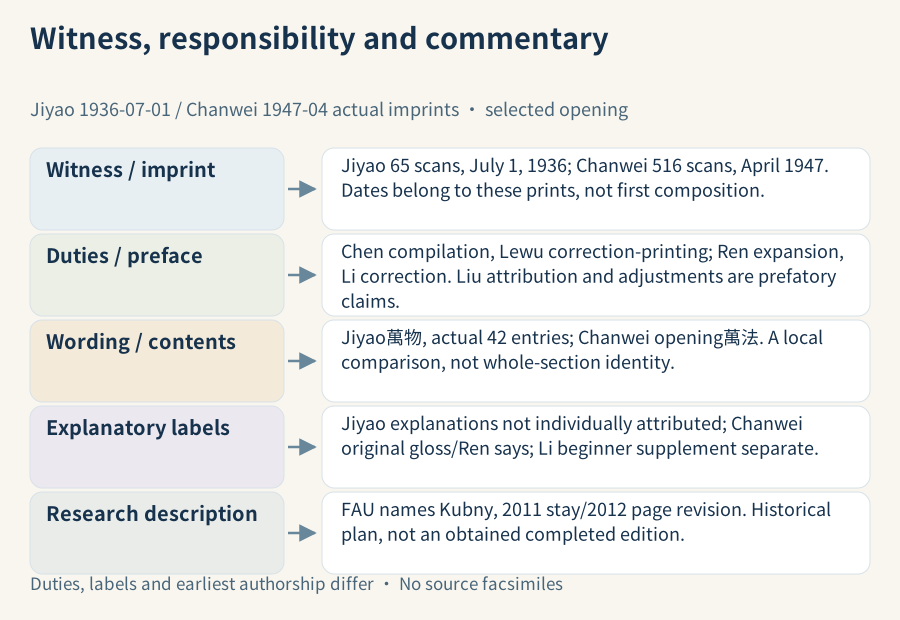
The complete figure is shown below. Select it to enlarge the labels. Open full-size figure · PNG
A university project gives a methodological entrance
FAU's historical IKGF project page names Manfred Kubny, records a January–September 2011 research stay, and bears a February 1, 2012 modification date. It describes translation and structural/content analysis as work at that time.[9] We use this as a methodological entrance without claiming a completed translation was obtained or inferring a current position.
That description does not replace the physical pages compared here or transfer its edition's page numbers to the 1947 witness. Edition and structure are worthwhile research questions; particular readings and responsibilities still return to their own witnesses. No modern translation or commercial annotation is copied.
Five fields keep an excerpt accountable
A card can record witness/date scope, actual location, textual layer, printed responsibility and what remains unproved. A Ren-labelled paragraph can have clear local attribution while the earliest verse author remains unresolved. Jiyao can have a precise 1936 imprint without individually naming every explanation's writer.
The next question follows Jiyao's heaven section into li, qi and following/opposition, first separating short text from explanation, then tracing conditions. This preserves complexity without asking a commentator's name, old attribution or publication date to stand in for the argument.
Sources and further reading
扉页与刊记, printed 无正文印页/无正文印页, scans 1/64. Source page 1 Source page 2
滴天髓輯要自序, printed 序一, scans 2. Source page 1
滴天髓輯要自序, printed 序一, scans 2. Source page 1
滴天髓輯要目錄, printed 目录一/目录二, scans 4/5. Source page 1 Source page 2
刊记、通神論正文题署及初學捷徑题署, printed 无正文印页/初學捷徑一/正文卷一 一, scans 3/12/51. Source page 1 Source page 2 Source page 3
卷一 通神論 天道, printed 一, scans 51. Source page 1
卷一 通神論 天道, printed 一, scans 51. Source page 1
卷一 通神論 天道, printed 一, scans 51. Source page 1
官方项目简介, official historical research-project description. Project page
通天論, printed 一, scans 6. Source page 1
Punctuation, translation, analysis and diagrams are original. Source facsimiles, modern commercial annotations and private inspection materials are excluded. Return to Text Commentary and Metaphor, or consult the Ten Gods guide.
Evidence and source roles
These roles distinguish ancient text, older commentary, historical scholarship and tool reproduction. The numbered notes in the article retain the precise scan pages and explanations. Library and academic sources do not endorse predictive claims.
- DT1-E01 · Ancient text evidence: 扉页与刊记
Text layer in the witness: Printed title/imprint/responsibility fields in separate locations - DT1-E02 · Ancient text evidence: 滴天髓輯要自序
Text layer in the witness: Old prefatory voice, separately attributed - DT1-E03 · Ancient text evidence: 滴天髓輯要自序
Text layer in the witness: Old prefatory voice, separately attributed - DT1-E04 · Ancient text evidence: 滴天髓輯要目錄
Text layer in the witness: Actual contents entries, not a continuous main-text sentence - DT1-E05 · Ancient text evidence: 刊记、通神論正文题署及初學捷徑题署
Text layer in the witness: Printed title/imprint/responsibility fields in separate locations - DT1-E06 · Ancient text evidence: 卷一 通神論 天道
Text layer in the witness: Short text in the independent Chanwei witness; earliest author not established - DT1-E07 · Ancient text evidence: 卷一 通神論 天道
Text layer in the witness: Explicit original-gloss label in Chanwei; composer not independently established - DT1-E08 · Ancient text evidence: 卷一 通神論 天道
Text layer in the witness: Explicit Ren says label in Chanwei, separate from short text and original gloss - DT1-E09 · University research project: Critical Edition and Translation of The Leaking Essence of Heaven
Text layer in the project description: Official historical research-project description, not a source-image or classical-commentary layer - DT1-E10 · Ancient text evidence: 通天論
Text layer in the witness: Ancient short text in this Jiyao witness; earliest author not established