The heaven section uses concise lines about three origins, heavenly ordering and numinous operation, then asks readers to understand accordance/opposition and advance/retreat. Replacing qi in advance with modern energy and li with scientific law would import meanings before reading the argument. A more grounded approach asks what each line requires and which objects and months the recorded explanation uses to make its vocabulary conditional.
We read Jiyao's first contents entry, Tongtian lun, on printed pages 1–3, scans 6–8 before the stem section. NLC9444 has an actual July 1, 1936 imprint and 42 contents entries. Short text and subsequent explanation are separate; the explanations do not individually name a commentator. The selected wording retains 理行承氣 rather than a familiar reordered line.[1,7]
First observe is a reading instruction
The opening asks to understand the three origins and wanwu, then first observe heavenly ordering and numinous operation.[3] The verbs state a goal and order of reading. The accompanying nouns locate that goal in historical cosmological vocabulary. No instruments, measurement units or experimental results are supplied, so observe cannot be promoted into an already specified physical test.
Three origins likewise is not evidence of three modern spatial axes. Different commentary layers can explain its reference, and those explanations require their own labels. The preceding question identified a Ren-tagged explanation in Chanwei; it cannot be inserted anonymously here as the original short text's complete definition.
Wanwu is the reading in this Jiyao witness, not silently replaced by the other witness's wanfa. Retaining it keeps quotation accurate. It does not establish that the book encompasses every natural science: the broad claim remains part of the old expression.
Accordance and opposition need a relational object
Another line asks to open human incomprehension and understand the turning point of accordance/opposition.[4] The historical deafness imagery is not our description of a reader's hearing or mental state. The operative reading demand is to understand the turning point, rather than assign unconditional value to a favorable-sounding word.
Accordance/opposition can name relationships within the model without becoming advice to obey authority or a judgment of someone's moral character. We record their argumentative setting, then examine the objects supplied by the explanation. No unstated full configuration, person or event is added.
The strength of an instructional sentence also differs from predictive evidence. Requiring understanding does not establish every real result; describing numinous operation does not mean this site has validated a supernatural mechanism.
Preserve the li/qi wording without inventing its theory
The selected seven characters on scan 7 are “理行承氣豈有常.” Li, qi and the question of constancy occur together.[5] The witness's word order is retained without rearranging it into a circulating line or deriving a complete philosophical system from that order alone.
Some following advance/retreat connecting glyphs remain outside the secure excerpt, so no missing full line is supplied. The intact explanation still shows Jia-Wood month examples. Those checked conditions offer a firmer basis than constructing a grand modern analogy around unsettled characters.
Li is not an experimentally established law here, and qi is not a measured gas or energy field. Their function in a historical account of change can be examined without translation conferring units or validation that the passage does not provide.
Jia Wood has different third- and ninth-month conditions
The recorded explanation says movement begins and advances; at the extreme of advance lies the opportunity for retreat, illustrated by Jia Wood in the third month. It then gives movement's fullness and retreat, with advance possible at retreat's extreme, illustrated by Jia Wood in the ninth month.[6] Direction, extreme, transition, object and month are retained on both sides.
The third-month example belongs to advance turning toward retreat; the ninth to retreat turning toward advance. Their months cannot be exchanged. Nor is this a person's March success and September failure. Third and ninth month are not automatically modern civil-calendar March and September.
We have no rule here for converting the passage into dates, temperature curves or events in a real birth. Advance/retreat is also a state direction rather than active production of something. Diagram arrows can show the stated transitions without claiming empirical causation or fixed quantitative cycles.
| Selected language | Reading task | Conditions and scope retained |
|---|---|---|
| Understand; first observe | Goal and order of reading | Historical three-origin and heavenly-operation vocabulary |
| Understand accordance/opposition's turning point | Examine a relational transition | Not moral categories for actual people |
| Actual li/qi word order and constancy question | Preserve witness before interpretation | No supplied unsettled continuation or physical law |
| Third-month/ninth-month Jia Wood | Compare one object under different conditions | Month, direction and extreme stay together |
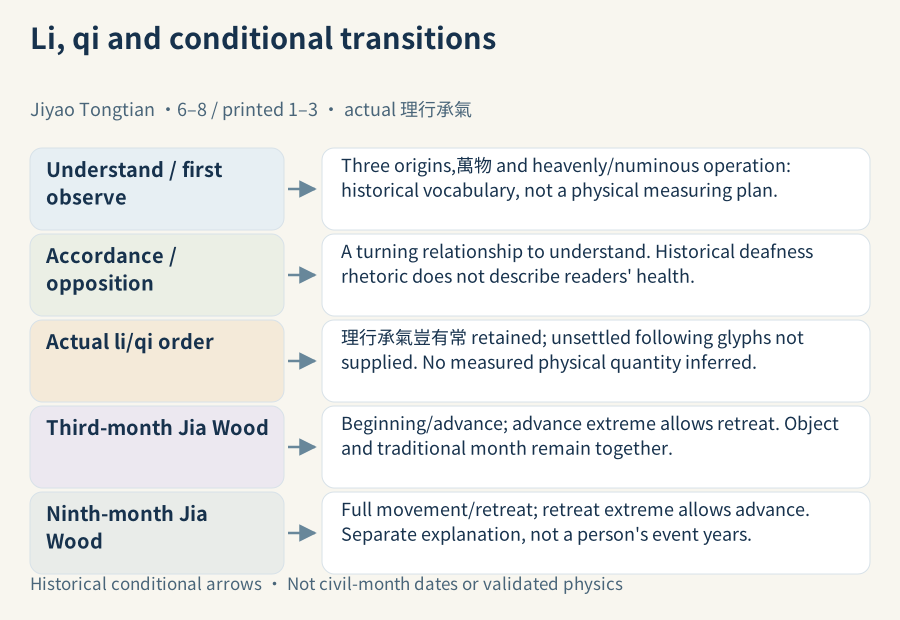
The complete figure is shown below. Select it to enlarge the labels. Open full-size figure · PNG
Commentary adds conditions but not an author identity
The month examples belong to the explanation recorded in Jiyao. They are not joined to the seven-character line as one continuous original verse. Compression and explanation have different jobs: the former is concise, while the latter supplies objects and sequence. Separate excerpt fields show where the information enters.
Chen's compilation/revision responsibility does not individually assign every explanation to Chen. The prefatory wording-adjustment statement reinforces the need for witness boundaries. We neither use another Ren-tagged paragraph to fill this explanation anonymously nor copy modern translated commentary.
A modern analogy would need additional evidence
Calling advance/retreat feedback or energy conversion would add a comparative model needing defined variables, conditions and evidence. The old paragraph supplies Jia-Wood months and transition vocabulary, not proof of that conversion. An analogy can be a research question; familiar modern terminology must not increase certainty by itself.
The historical FAU project page offers a structural/content-analysis and translation entrance, with a 2011 stay and 2012 page modification.[2] It is not a finding that this passage predicts effectively or that a completed critical edition has been obtained. Textual analysis and outcome evidence remain different tasks.
Three fields keep the context inspectable
A note can record wording/location, the explanation's object and conditions, and evidence absent for a proposed modern conclusion. Third-month Jia Wood has an intact transition statement, not a dataset of people's spring experiences. The li/qi line has a witnessed order, not modern physical units.
This does not empty the traditional text of meaning. It identifies how it argues. The next question follows Jia/Yi imagery through roots and branches, season and specified configurations, asking how an image supports explanation without becoming a personality label.
Sources and further reading
滴天髓輯要目錄, printed 目录一/目录二, scans 4/5. Source page 1 Source page 2
官方项目简介, official historical research-project description. Project page
通天論, printed 一, scans 6. Source page 1
通天論, printed 二, scans 7. Source page 1
通天論, printed 二, scans 7. Source page 1
通天論, printed 二, scans 7. Source page 1
扉页与刊记, printed 无正文印页/无正文印页, scans 1/64. Source page 1 Source page 2
Punctuation, translation, analysis and diagrams are original. Source facsimiles, modern commercial annotations and private inspection materials are excluded. Return to Text Commentary and Metaphor, or consult the Ten Gods guide.
Evidence and source roles
These roles distinguish ancient text, older commentary, historical scholarship and tool reproduction. The numbered notes in the article retain the precise scan pages and explanations. Library and academic sources do not endorse predictive claims.
- DT1-E04 · Ancient text evidence: 滴天髓輯要目錄
Text layer in the witness: Actual contents entries, not a continuous main-text sentence - DT1-E09 · University research project: Critical Edition and Translation of The Leaking Essence of Heaven
Text layer in the project description: Official historical research-project description, not a source-image or classical-commentary layer - DT1-E10 · Ancient text evidence: 通天論
Text layer in the witness: Ancient short text in this Jiyao witness; earliest author not established - DT1-E11 · Ancient text evidence: 通天論
Text layer in the witness: Ancient short text in this Jiyao witness; earliest author not established - DT1-E12 · Ancient text evidence: 通天論
Text layer in the witness: Ancient short text in this Jiyao witness; earliest author not established - DT1-E13 · Ancient text evidence: 通天論
Text layer in the witness: Explanation recorded in Jiyao, not individually labelled by commentator; compilation responsibility alone does not prove each author - DT1-E01 · Ancient text evidence: 扉页与刊记
Text layer in the witness: Printed title/imprint/responsibility fields in separate locations