“More Water” and “less Water” leave out much of the selected Ren/Gui argument. The passages name a month, a degree of flourishing or weakness, relations that supply or restrain, and conditions under which another factor can act. Their shared Water label does not tell us whether Ren, Xin, Wu, Bing or Companion/Rob Wealth factors are being discussed.
The comparison uses four finite clauses from the identified Waseda witness, keeping its physical 網 title distinct from the catalogue's 綱 and leaving the printing year unresolved.[5,6] Ren's selected months are the fourth and eleventh; Gui's are the fifth and eleventh. The summer months are therefore not identical. These are textual comparisons, without a complete birth chart, water measurement or verified life outcome.
Fourth-month Ren gives three different supporting roles
Scan 84 left, 四月壬水, reads 四月壬水,丙火司權,水弱極矣。耑取壬水為比為助,次取辛金發源,且暗合丙火,庚金為佐.[1] An original translation is: “Fourth-month Ren Water: Bing Fire holds authority and Water is extremely weak. Specifically take Ren Water as a companion and aid; next take Xin Metal to provide a source and also covertly combine with Bing Fire; Geng Metal serves as an assistant.”
The first sentence supplies a degree judgment and a named seasonal factor. “Extremely weak” is not a measured volume of water. The next sentence then distinguishes Ren as companion/aid, Xin as source with a combining relation, and Geng as assistant.
These are three roles rather than three interchangeable quantities. 辛金 is the preceding named object that supplies the subject for 且暗合丙火; Geng's later 為佐 is a different clause. Grouping Geng and Xin as “more Metal” would erase that distinction, just as grouping the first Ren with all Water would erase 為比為助.
耑取 and 次取 are retained in their actual wording. The excerpt ends at Geng's assistance; later disclosures, quantities, absences and other branches are not supplied. It is a local explanation of how support is named, not a completed rule for every fourth-month Ren configuration.
Eleventh-month Ren changes the local state and order
Scan 88 left, 十一月壬水, says 十一月壬水,陽刃幫身,較前更旺。先取戊土,次用丙火.[2] An original translation is: “Eleventh-month Ren Water: the Yang Blade helps the subject, making it more flourishing than before. First take Wu Earth, next use Bing Fire.”
The reference of 較前 is the preceding tenth-month Ren section, not this article's selected summer passage. A comparison table must not rewrite it as “more flourishing than summer.” That would turn a printed local backward reference into a new cross-season result.
陽刃幫身 also gives a relation, while 更旺 gives a comparative degree. Neither is a simple inventory of Water characters. The following Wu/Bing order differs from fourth-month Ren's companion/source/assistant structure, but this does not mean that the present short paragraph contains every condition for either month.
In particular, later two-disclosure, absence and branch-formation discussions are omitted. Keeping the opening's order alongside that limit is more faithful than reducing it to a promise that adding Earth always solves strong Water.
Fifth-month Gui tests the capacity of its proposed source
Scan 92 left, 五月癸水, contains a continuous chain: 五月癸水,至弱無根,必須庚辛為生身之本。但丁火司權,金難敵火,安能滋養癸水?宜見比劫,方得庚辛之用.[3]
An original translation is: “Fifth-month Gui Water is extremely weak and without roots; Geng and Xin must form the basis of generating the subject. But Ding Fire holds authority, and Metal has difficulty withstanding Fire: how can it nourish Gui Water? Companion/Rob Wealth factors should be present; only then can Geng and Xin provide their use.”
The argument does not stop when Geng and Xin have been named. 但 introduces an obstacle to their capacity, and the rhetorical question asks how their proposed nourishing action can take effect under that obstacle. The final 宜見/方得 clause then supplies an additional qualification.
Deleting the middle and final parts would make a conditional chain look like an unconditional Metal-to-Water instruction. Conversely, keeping only “Metal cannot withstand Fire” would lose the factor that the passage introduces afterward. The words belong together as an argument, rather than separate slogans competing for universal priority.
宜 is preserved as “should,” rather than changed into the earlier 必須. 方得 retains its conditional force. 比劫 are traditional relation terms within this paragraph, not a recommendation to seek actual rivals or companions. No arrangement, number or position of those factors is fabricated as a complete birth chart.
Eleventh-month Gui does not remove Metal when it introduces Fire
Scan 95 left, 十一月癸水, reads 十一月癸水,值冰凍之時,金水無交歡之象。耑用丙火解凍,庶不致成冰,又要辛金滋扶.[4] An original translation is: “Eleventh-month Gui Water, at a time of freezing: Metal and Water have no image of mutual accord. Specifically use Bing Fire to thaw, in the hope of not becoming ice; Xin Metal is also needed to nourish and support.”
The opening describes a seasonal state and a relationship image, not just Water's quantity. The response names Bing for thawing and then also Xin for support. A note saying “cold Water needs Fire instead of Metal” would delete 又要辛金 and turn an addition into an exclusion.
庶 also keeps the stated hope from becoming a guarantee. The translation does not replace it with “will certainly prevent ice.” These old freezing and nourishment images are not measured temperature laws, health advice or authenticated predictions about an individual.
The current selection stops at 滋扶. Subsequent presence/absence, disclosure and other branches remain unselected. Reading a secure opening accurately does not remove the need to return to them before attempting a fuller account of the section.
The same eleventh month has Bing in both the Ren and Gui entries, but Ren prints it as next, while Gui specifies its use and also names Xin. A shared name does not make their use grammar identical.
Record a relation chain rather than a quantity label
| Selected entry | State and named action | Qualification easily lost |
|---|---|---|
| Fourth-month Ren | Extremely weak; Ren companion/aid, Xin source/combine, Geng assistant | Different objects and roles; next names Xin specifically |
| Eleventh-month Ren | Yang Blade helps; more flourishing than the preceding tenth-month entry | Local backward reference; Wu first, Bing next |
| Fifth-month Gui | Extreme weakness/no roots; Geng/Xin basis, Ding obstacle, Companion/Rob Wealth condition | Keep 但, rhetorical question and 宜見/方得 together |
| Eleventh-month Gui | Freezing/no mutual accord; Bing thawing and Xin support | Hope in 庶; also in 又要, not exclusion of Metal |
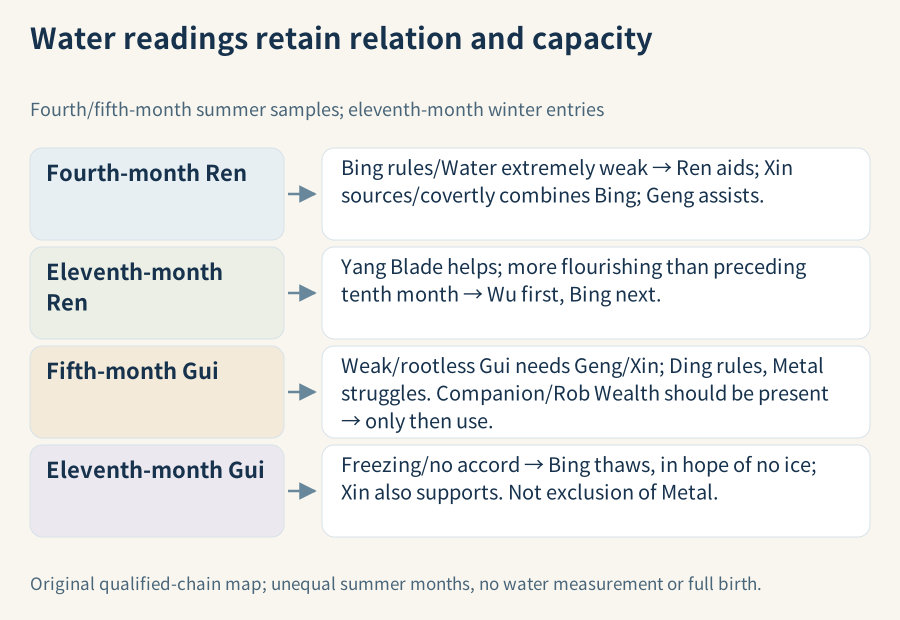
The complete figure is shown below. Select it to enlarge the labels. Open full-size figure · PNG
The figure is a map of the selected argument, not a procedure that adds up Water or ranks actual lives. Its compact rows still need the article's distinction between fourth and fifth months, and its explanation of what “before” refers to.
From the second-collection directory, compare the other stem pairs; use the Ten Gods guide for relation names. A dependable Water note keeps the subject, month, degree, named relation, action and restricting word in separate fields. Those fields explain why a simple more/less label cannot preserve what these clauses actually say.
Sources and further reading
四月壬水, scan 84, left half, printed folio unresolved. Waseda University Library classical-text database
十一月壬水, scan 88, left half, printed folio unresolved. Waseda University Library classical-text database
五月癸水, scan 92, left half, printed folio unresolved. Waseda University Library classical-text database
十一月癸水, scan 95, left half, printed folio unresolved. Waseda University Library classical-text database
Separately located cover, volume titles and printed responsibilities, scan 8, printed 一. Waseda University Library classical-text database Separate positions: 1, 2, 4, 49
Waseda classical-text catalogue, Bunko19 F0111, historical-witness catalogue; ancient scan/printed page inapplicable. Waseda University Library historical-witness catalogue
Punctuation, translation, analysis and diagrams are original. General seasonal discussion, named stem/month clauses, specified relations and limited exceptions retain their separate layers. Physical Wang and catalogued Gang stay distinct; printing year unestablished. Institutional images and modern commercial commentary are excluded. Finite readings, not full original-text collation or empirical life prediction.
Evidence and source roles
These roles distinguish ancient text, older commentary, historical scholarship and tool reproduction. The numbered notes in the article retain the precise scan pages and explanations. Library and academic sources do not endorse predictive claims.
- QT2-E05-01 · Ancient text evidence: 四月壬水
Text layer in the witness: Printed general discussion, seasonal introduction or named stem/month clause as separately specified; punctuation, translation and analysis are editorial. Handwritten margins/uncertain preceding side-character wording excluded. - QT2-E05-02 · Ancient text evidence: 十一月壬水
Text layer in the witness: Printed general discussion, seasonal introduction or named stem/month clause as separately specified; punctuation, translation and analysis are editorial. Handwritten margins/uncertain preceding side-character wording excluded. - QT2-E05-03 · Ancient text evidence: 五月癸水
Text layer in the witness: Printed general discussion, seasonal introduction or named stem/month clause as separately specified; punctuation, translation and analysis are editorial. Handwritten margins/uncertain preceding side-character wording excluded. - QT2-E05-04 · Ancient text evidence: 十一月癸水
Text layer in the witness: Printed general discussion, seasonal introduction or named stem/month clause as separately specified; punctuation, translation and analysis are editorial. Handwritten margins/uncertain preceding side-character wording excluded. - QT2-E00-IDENTITY · Ancient text evidence: Separately located cover, volume titles and printed responsibilities
Text layer in the witness: Physical title and separately located printed responsibility fields; not one continuous quotation or an autograph/authorship judgment - QT2-E00-CATALOGUE · Historical-witness library catalogue: Waseda classical-text catalogue, Bunko19 F0111
Text layer in the catalogue: Modern institutional catalogue of a historical witness; not an original title page, printing date or commentary text