The old print groups fifth- and sixth-month Jia Wood under one heading, yet gives different priorities: Gui before Ding in the fifth month, Ding before Geng in the sixth. Their shared heading and description of parched Wood establish a comparison. They do not make every premise identical. To explain the difference, read the branches, absences and additional qualifications before deciding which summary can be traced back to the paragraph.
This article uses the identified Waseda University Library Bunko19 F0111 witness. Its physical title prints Wang, 網; the catalogue records Gang, 綱. Printing year remains unresolved. The excerpts are finite, and punctuation and analysis are editorial.[4,5] Earlier collections examined month labels, states and selected stem comparisons. Here those details become a record of conditions that a reader can check.
A shared premise can contain further branches
Scan 12, left half, under the fifth/sixth-month Jia entry, contains one continuous passage: “Fifth- and sixth-month Jia Wood are considered through a common principle; Wood's nature is parched. In the fifth month, Gui comes first, Ding afterward, and Geng Metal next. In the sixth month, cold arises in the sanfu period and Ding Fire's qi recedes: Ding first, Geng afterward; even without Gui it may form.”[1] The printed number on this half is unresolved. The translation keeps the two months, Ding's receding qi and absence of Gui distinct. The continuous quote stops at the sixth-month absence permission. The following fifth-month fallback is cited separately, with its luck-region glyph unresolved.
The common-principle phrase and parched-Wood description establish a shared background. Separate month clauses follow; the sixth month adds its own state description. Thus “the same condition” can mean only part of the background here. If an abstract claims that all premises are identical, then asks why the conclusions conflict, its own compression has created the conflict.
A useful sequence of questions is: what is shared, where does the month branch begin, what state is added, and which absence introduces a further qualification? The shared background remains relevant. It is not a sufficient description of every branch.
First, afterward and next express local priorities
The fifth-month clause explicitly places Gui before Ding and then names Geng as next. The sixth-month clause gives Ding before Geng after its state description. These are printed ordering words, so they can support a comparison. Mere order of appearance cannot: Gui occurs again as an absence condition, not as a newly supplied third-place preference for the sixth month.
Nor do the words supply numerical weights. There are no percentages for Gui or Ding, doses, units or timed intervention instructions. “First” distinguishes a priority in the paragraph's selection discussion. It does not tell a modern reader to buy Water objects before Fire objects, or describe successive events in someone's early and later life.
A reading card may therefore separate first consideration, subsequent consideration and additional restrictions. Turning that card into a numerical score would require thresholds, combination rules and validation evidence. The selected paragraph does not provide them.
The two Gui-absence clauses cannot be merged
For the sixth month the text says that even without Gui the arrangement may form. The previous Ding-before-Geng route remains in place, while Gui's absence is allowed in this local statement. That does not declare Gui useless in every context, or permit deletion of all remaining conditions. Formation is the book's structural assessment, not a verified promise of income, employment or health.
For the fifth month it says that when Gui is lacking, Ding is also usable, then adds a luck-region qualification whose region glyph remains unresolved. No particular Phase is supplied.[3] Stopping at the permission yields a shortened permission. Treating that luck-cycle condition as Gui already present in the original arrangement collapses two layers the paragraph distinguishes.
Both clauses concern absence of Gui, but they belong to different months and have different continuations. “Without Water, use Fire” drops the named Gui, the month distinction, Geng's order and the fifth-month luck condition. Even the same missing factor does not make the two arguments identical.
Test three summaries against the whole passage
| Proposed summary | What the passage would lose | More accurate record |
|---|---|---|
| Both months put Water before Fire | Sixth-month Ding before Geng and receding Ding qi | Branch the shared background by month |
| Ding always fully replaces missing Gui | Fifth-month luck qualification; sixth-month Geng | Keep absence, permission and added condition together |
| No Gui is needed in month six, so Water is useless | A local absence permission is not a verdict on all Water | Record permitted absence here, then check remaining factors |
These claims can be compared directly with these secure finite clauses and editorial punctuation. No invented birth chart is needed. The test concerns preservation of textual conditions; an imagined case would not validate the historical prediction.
Likewise, retaining the strong Gui-before-Ding wording does not require endorsing it as a scientifically verified prescription. Textual fidelity and empirical validation ask different questions. The former checks words, positions and syntax; the latter requires data, methods and tests.
Another Ding-first clause carries abundant Geng
Later on the same page, a separately selected four-character clause says abundant Geng, Ding first.[2] One preceding character is unresolved, so the article does not reconstruct a familiar full maxim around it. The secure words nevertheless show that this priority carries a relational state, Geng's abundance, rather than merely a month name.
Beside the sixth-month clause, two entries become distinguishable: month and receding Ding qi introduce one priority, while abundant Geng qualifies another Ding-first statement later in the text. The same Ding does not necessarily perform the same job everywhere. Nor can a month label absorb every relational qualification.
This does not create two numerical ranks for Ding or turn abundant Geng into a measured threshold. It adds a retrieval question: does this ordering statement respond to a seasonal state or an explicitly stated relational degree? Without evidence, no common weight is supplied.
A note containing only Ding preferred cannot distinguish these routes. Preserve sixth month/receding Ding and abundant Geng separately, then return to each branch's surrounding words. An unresolved neighboring character does not justify deleting all qualifications.
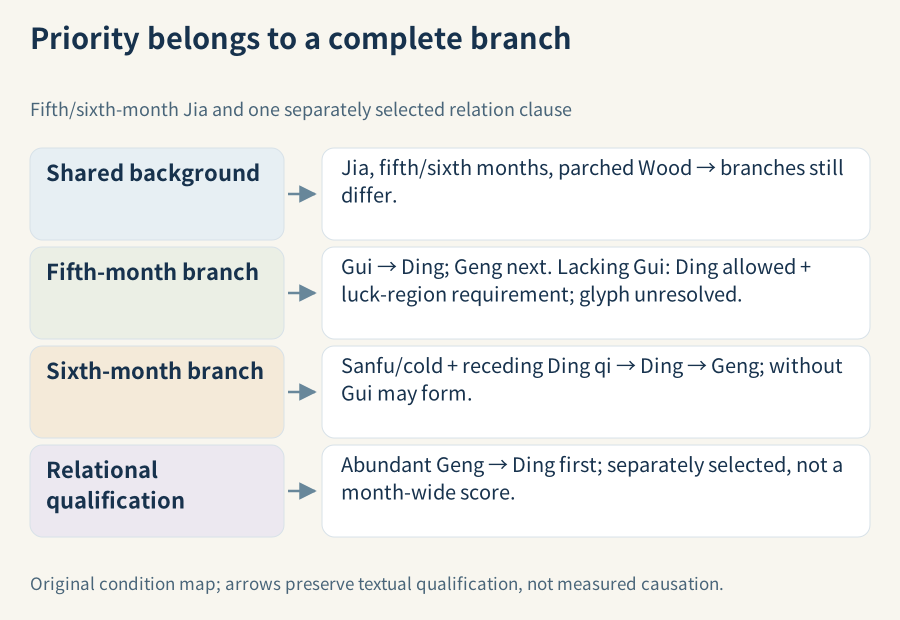
The complete figure is shown below. Select it to enlarge the labels. Open full-size figure · PNG
Build a record that can be checked backward
Record at least five fields: named stem and scope, stated condition, named factors and actual ordering words, absence or relation-change branches, and omitted text. Distinguish the main route, exception and luck-cycle layer rather than silently moving information between them.
Then ask backward questions. Does removing the month leave the same assessment supported? Which branch permits Gui's absence? Where is the extra qualification attached to Ding's use? An inability to answer often shows that the abstract is more absolute than the paragraph. This check exposes omissions; it does not claim knowledge of every possible combination.
The next article examines what must be checked when a formation appears. Whether an order survives a changed relation depends on actual wording, rather than an unstated assumption of permanence. Return to the second collection for the stem comparisons, or the Ten Gods guide for relationship names.
Sources and further reading
五六月甲木, scan 12, left half, numbered printed page unresolved or inapplicable. Waseda University Library classical-text page
五六月甲木续段, scan 12, left half, numbered printed page unresolved or inapplicable. Waseda University Library classical-text page
五六月甲木:五月乏癸接续, scan 12, left half, numbered printed page unresolved or inapplicable. Waseda University Library classical-text page
Printed titles and responsibilities, separately located, scan 8, printed 一. Waseda University Library classical-text page Separate positions: 1, 2, 4, 49
Historical-witness catalogue, historical-witness catalogue; scan/old printed page inapplicable. Historical-witness catalogue
Punctuation, translation, analysis and diagrams are original. Physical Wang/catalogued Gang, actual 1926/1936/1937 witnesses and commentary layers remain distinct; scan 12 region glyph unresolved. Institutional scans, complete modern commentary chapters and research materials excluded. Finite interpretation, not whole-book collation or validated life prediction.
Evidence and source roles
These roles distinguish ancient text, older commentary, historical scholarship and tool reproduction. The numbered notes in the article retain the precise scan pages and explanations. Library and academic sources do not endorse predictive claims.
- QT3-E01-CORE42 · Ancient text evidence: 五六月甲木
Text layer in the witness: Historical printed text in the identified Waseda witness; punctuation is editorial; handwritten margins and modern explanation excluded. - QT3-E01-ROLE4 · Ancient text evidence: 五六月甲木续段
Text layer in the witness: Historical printed text in the identified Waseda witness; punctuation is editorial; handwritten margins and modern explanation excluded. - QT3-E01-FALLBACK · Ancient text evidence: 五六月甲木:五月乏癸接续
Text layer in the witness: Contiguous printed fallback with one unresolved position marked by an editorial bracket; not a settled Water/Fire/direction glyph. - QT3-E00-WASEDA · Ancient text evidence: Printed titles and responsibilities, separately located
Text layer in the witness: Physical title and separately located duties; not one continuous quote or modern commentary. - QT3-E00-CATALOGUE · Historical-witness library catalogue: Historical-witness catalogue
Text layer in the catalogue: Modern catalogue of a historical witness; not its original title, date-bearing imprint or commentary body.