Earth's general placement, a month's description and a named response occupy different levels in the selected passages. Wu in the fifth month gives Ren priority; Ji's summer paragraph gives Gui importance. Winter Wu names Jia before Bing; winter Ji favors Bing while retaining an early-winter Ren/Wu exception. These differences are visible in the words, before any complete birth chart is supplied.
The title's “seasonal placement” is a reading question. It does not claim that the selected old paragraph defines a technical term called 寄位. The discussion below uses the identified Waseda witness, whose printing year remains unresolved, and separates its general Earth discussion from four selected stem/month or stem/season clauses.[6,7] Traditional imagery is read as historical textual reasoning, without measuring soil, climate or an individual's prospects.
Locate the general Earth discussion first
Scan 49, left half, 論土, says 五行之土,散在四維,故金木水火依而成象.[1] An original translation is: “Earth among the Five Phases is dispersed through the four corners; thus Metal, Wood, Water and Fire depend on it to take form.” The subject here is Earth at the general Five-Phase level, rather than Wu or Ji in one named month.
散在 supplies a distribution image, and 依而 connects that image with the other phases taking form. Neither phrase alone establishes which named stem is to be selected in a later monthly paragraph. A note should therefore retain the heading, general subject and distribution statement before moving to a different section.
Within this finite selection, 寄位 is not a quoted term or an independently printed definition. Using it in the question to ask how Earth is situated does not license adding a missing quotation, assigning every month to a stem, or treating this general paragraph as a complete seasonal allocation table. The selected sentence also is not evidence for a scientific theory of material composition.
Fifth-month Wu retains both order and degree
The left half of scan 53, 五月戊土, reads 五月戊土,仲夏火炎,先看壬水,次取甲木。丙火酌用,用癸力微.[2] An original translation is: “Fifth-month Wu Earth: midsummer Fire is blazing. First consider Ren Water, next take Jia Wood. Bing Fire is used with discretion; using Gui has slight force.”
The month, Wu subject and blazing-Fire premise travel together. The order words name Ren and Jia; they do not merely ask for an unspecified amount of Water and Wood. The final clause then distinguishes Bing's discretionary use from Gui's slight force.
酌用 is not the same verb as 必用. Likewise, 力微 limits the stated force; it does not print a categorical prohibition against Gui. Replacing both with a favorable/unfavorable list would flatten two different judgments. It would also conceal the fact that the selected paragraph names Ren and Gui differently even though both belong to Water.
The excerpt stops at 力微. Later disclosures, absences, relations and examples are not supplied here, so this finite order is not a complete fifth-month decision procedure. Its value for comparison is that it preserves the actual qualifiers rather than a reconstructed universal formula.
Tenth-month Wu addresses a different premise
Under 十月戊土, scan 56 left, the selected continuous clause begins 先用甲木,次取丙火。非甲土不靈,非丙土不暖,安能發生萬物?[3] An original translation is: “First use Jia Wood, next take Bing Fire. Without Jia, Earth is not responsive; without Bing, Earth is not warm. How could it bring forth the myriad things?”
The heading supplies the month and Wu subject; it is not silently inserted inside the quotation. Within the sentence, the two negative constructions give Jia and Bing different stated functions. The rhetorical question continues the book's generative Earth imagery, without supplying observations of an actual crop or person.
Compared with the fifth-month excerpt, Jia has changed position and Bing has a different role: discretionary use there, a named warmth condition here. The comparison concerns textual priority and function. It does not prove that summer and winter exhaust all Wu conditions or that Jia is first throughout every winter paragraph.
Ji's summer imagery names Gui rather than Ren
Scan 60 right, 三夏己土, says 三夏己土,禾稼在田,最喜甘沛。取癸為要,次用丙火.[4] An original translation is: “Ji Earth in the three summer months: crops stand in the fields and most favor sweet rain. Taking Gui is important; Bing Fire is used next.” 甘沛 retains this witness's printed wording; the translation interprets the rain image rather than replacing the characters with a familiar alternative.
This is a season-wide paragraph, while the Wu summer example was a fifth-month clause. Their scopes should remain visible beside the comparison. They also start with different descriptions: blazing Fire for the selected Wu month, crops in the fields for Ji's summer paragraph.
The text does not allow Gui to be replaced by Ren merely because both are Water. Gui is important here, while the fifth-month Wu excerpt describes using Gui as having slight force. Keeping both local subjects resolves the apparent clash without forcing either sentence to govern all Earth.
Winter Ji carries its own exception and limitation
Scan 62 right, 三冬己土, gives a longer continuous selection: 三冬己土,濕泥寒凍,非丙暖不生。取丙為尊,戊土癸水不用,甲木參酌。惟初冬壬旺,取戊制之,餘皆用丙丁。但丁不能解凍除寒,不能大濟.[5]
An original translation is: “Ji Earth in the three winter months is damp, cold and frozen mud; without Bing's warmth it does not bring forth. Taking Bing is foremost; Wu Earth and Gui Water are not used, while Jia Wood is considered with discretion. Only in early winter, with Ren flourishing, is Wu taken to restrain it; in the remaining cases Bing and Ding are used. But Ding cannot thaw and remove cold, and cannot provide great help.”
The apparently simple prohibition is immediately qualified. 惟 attaches the Wu branch to both early winter and flourishing Ren. Reading only 戊土癸水不用 would erase that exception; reading only 取戊制之 would make the exception appear general. The antecedent of 之 is the named Ren in that branch.
The final 但 also matters. Ding can appear in the remaining-use clause while still being denied the thawing function and degree of help stated afterward. Appearing on a list is not equivalent to sharing every other listed stem's role. Nor does this restriction turn the passage into a modern heating instruction or a prediction about an individual.
Compare levels before comparing answers
| Selected level and subject | Actual premise and response | Qualification to retain |
|---|---|---|
| General Earth, 論土 | Dispersed through four corners; other phases take form | General distribution image, not a Wu/Ji month rule |
| Fifth-month Wu | Blazing Fire; Ren first, Jia next | Bing discretionary; Gui slight in force |
| Tenth-month Wu | Jia first, Bing next | Separate negative clauses for responsiveness and warmth |
| Summer Ji | Crops/rain image; Gui important, Bing next | Seasonal scope differs from the selected Wu month |
| Winter Ji | Bing foremost; early-winter flourishing Ren permits Wu restraint | Keep 惟 and the subsequent Ding limitation |
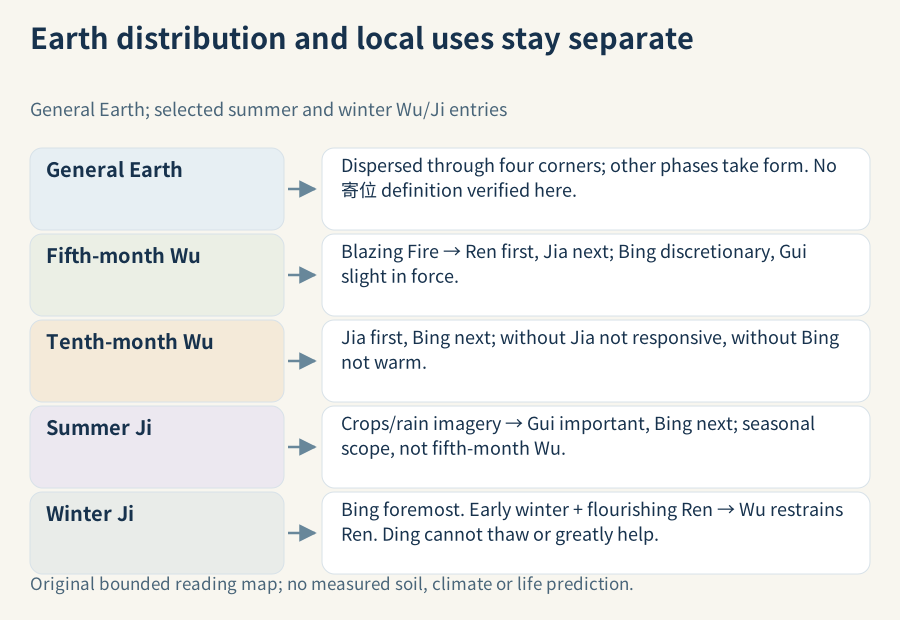
The complete figure is shown below. Select it to enlarge the labels. Open full-size figure · PNG
The diagram keeps the long winter-Ji branch attached to its premise. It should not turn the general Earth row into a cause that automatically generates the other rows' answers. Each later row still needs its own stem, scope and wording.
Return to the second-collection directory and the Ten Gods guide when relation names need clarification. A useful Earth note records the distribution layer, local seasonal description, named object, degree or order, and exception separately. That record allows comparison while leaving the unselected branches open.
Sources and further reading
論土, scan 49, left half, printed folio unresolved. Waseda University Library classical-text database
五月戊土, scan 53, left half, printed folio unresolved. Waseda University Library classical-text database
十月戊土, scan 56, left half, printed folio unresolved. Waseda University Library classical-text database
三夏己土, scan 60, right half, printed folio unresolved. Waseda University Library classical-text database
三冬己土, scan 62, right half, printed folio unresolved. Waseda University Library classical-text database
Separately located cover, volume titles and printed responsibilities, scan 8, printed 一. Waseda University Library classical-text database Separate positions: 1, 2, 4, 49
Waseda classical-text catalogue, Bunko19 F0111, historical-witness catalogue; ancient scan/printed page inapplicable. Waseda University Library historical-witness catalogue
Punctuation, translation, analysis and diagrams are original. General seasonal discussion, named stem/month clauses, specified relations and limited exceptions retain their separate layers. Physical Wang and catalogued Gang stay distinct; printing year unestablished. Institutional images and modern commercial commentary are excluded. Finite readings, not full original-text collation or empirical life prediction.
Evidence and source roles
These roles distinguish ancient text, older commentary, historical scholarship and tool reproduction. The numbered notes in the article retain the precise scan pages and explanations. Library and academic sources do not endorse predictive claims.
- QT2-E03-01 · Ancient text evidence: 論土
Text layer in the witness: Printed general discussion, seasonal introduction or named stem/month clause as separately specified; punctuation, translation and analysis are editorial. Handwritten margins/uncertain preceding side-character wording excluded. - QT2-E03-02 · Ancient text evidence: 五月戊土
Text layer in the witness: Printed general discussion, seasonal introduction or named stem/month clause as separately specified; punctuation, translation and analysis are editorial. Handwritten margins/uncertain preceding side-character wording excluded. - QT2-E03-03 · Ancient text evidence: 十月戊土
Text layer in the witness: Printed general discussion, seasonal introduction or named stem/month clause as separately specified; punctuation, translation and analysis are editorial. Handwritten margins/uncertain preceding side-character wording excluded. - QT2-E03-04 · Ancient text evidence: 三夏己土
Text layer in the witness: Printed general discussion, seasonal introduction or named stem/month clause as separately specified; punctuation, translation and analysis are editorial. Handwritten margins/uncertain preceding side-character wording excluded. - QT2-E03-05 · Ancient text evidence: 三冬己土
Text layer in the witness: Printed general discussion, seasonal introduction or named stem/month clause as separately specified; punctuation, translation and analysis are editorial. Handwritten margins/uncertain preceding side-character wording excluded. - QT2-E00-IDENTITY · Ancient text evidence: Separately located cover, volume titles and printed responsibilities
Text layer in the witness: Physical title and separately located printed responsibility fields; not one continuous quotation or an autograph/authorship judgment - QT2-E00-CATALOGUE · Historical-witness library catalogue: Waseda classical-text catalogue, Bunko19 F0111
Text layer in the catalogue: Modern institutional catalogue of a historical witness; not an original title page, printing date or commentary text