The selected Fire passages do not answer cold and warmth with a single instruction. Summer Bing names Ren Water; fourth-month Ding connects Jia to Geng; winter Bing again places Ren foremost with Wu assisting; winter Ding discusses Geng and Jia. The subjects, seasonal scopes and verbs explain why a shared Fire label cannot settle the comparison.
These are finite selections from the identified Waseda witness.[6,7] A seasonal introduction, a particular month and a later short clause within that month are different units. The article keeps those units visible instead of turning them into four identical cells or a physical law about actual fire.
Summer Bing names a particular Water object
The 三夏丙火 opening, scan 34 left half, reads 三夏丙火,陽威性烈,專用壬水.[1] An original translation is: “Bing Fire in the three summer months: yang's force is fierce in nature; specifically use Ren Water.” The text names summer, Bing and Ren, alongside its forceful description and 專用.
Retaining the strong wording does not make this a completed account of every summer branch. The selection stops at Ren Water. The subsequent source distinguishes further locations and accompanying factors, which this excerpt does not enumerate. A local opening is useful evidence without being the whole argument.
It also does not give a thermometer reading or demonstrate a modern cooling mechanism. The article records how the traditional paragraph relates its stated condition to its named response. Substituting “all Fire needs any Water in summer” would broaden both the subject and the object beyond the obtained words.
Winter Bing has a temporal premise and a separately selected use clause
The eleventh-month Bing section, scan 39 left half, has 十一月丙火,冬至一陽生: “Eleventh-month Bing Fire: at winter solstice one yang comes into being.”[2] This is the author's seasonal/qi language. It does not supply a Gregorian instant, a modern time standard or an observed person's state.
Later within that section, a separately selected clause reads 壬水為最,戊土佐之: “Ren Water is foremost; Wu Earth assists it.”[3] The phrases are not adjacent. Intervening words have not been included in the safe quotation, and they must not disappear through a fabricated continuous sentence.
We can compare two statements located in one month section while retaining that gap. What we cannot claim is that the first short sentence alone supplies every qualification for the second. The subsequent disclosure, absence and other-factor branches also remain outside the selection.
The two verbs in the later clause matter. 為最 gives Ren a principal place; 佐之 gives Wu an assisting role. They are not the printed 先 and 次 of an ordered recipe. Changing them to “first Ren, next Wu” would introduce a different grammatical claim, even if the same names remained.
The occurrence of Ren in both selected Bing seasons is therefore worth recording, but it does not prove that their complete instructions are identical. Summer's forceful opening and the particular eleventh-month context differ, and only the latter selected clause expressly includes Wu's assistance.
Fourth-month Ding adds a named cutting relation
Under 四月丁火, scan 43 right half, the safe continuous selection reads 必用庚劈甲。甲多,又取庚為先.[4] An original translation is: “Geng must be used to split Jia. If Jia is abundant, Geng is again taken first.” The heading supplies the fourth-month Ding subject; the excerpt starts at 必用, without joining an uncertain preceding main-line/side-character reading into a purported continuous quotation.
必 retains a stated requirement, while the following 甲多 qualifies the priority expressed by 為先. Removing that abundance condition would make a particular branch appear to govern every fourth-month configuration. Conversely, abundance should not be inserted into the earlier requirement as though both sentences had identical scope.
The selected action also has a specific object: Geng splits Jia. A description based only on “more warmth” would lose that relation. The old working/fuel imagery can be analyzed as imagery without claiming that it establishes an actual person's capacities or prospects. A shorter secure excerpt can preserve this argument while leaving the unselected preceding wording open.
Winter Ding retains both its actual state word and its question
Under 三冬丁火, scan 47 right half, the selection reads 三冬丁火,微寒,當用庚甲。甲乃庚之良友。凡用甲木,庚不可少;無庚劈甲,何能引丁?[5] An original translation is: “Ding Fire in the three winter months is slightly cold; Geng and Jia should be used. Jia is Geng's good companion. Whenever Jia Wood is used, Geng cannot be lacking; without Geng splitting Jia, how can Ding be drawn forth?”
The witnessed word is 微寒, slightly cold. It is not silently replaced with “slightly weak.” The distinction matters in an article comparing seasonal description: a weakness judgment and a coldness word are not automatically interchangeable.
The companion image also remains a statement in this paragraph. It is not a diagnosis of actual friends or proof that these stems behave identically in every season. In the following sentence, 凡 has a stated scope: using Jia Wood. The negation and rhetorical question then keep Geng's relation to Jia attached to drawing forth Ding.
A summary saying only “Ding needs Wood in winter” would delete named Geng and the source's question about how Jia is worked. Conversely, “Geng is always necessary for every Ding situation” would extend 凡 beyond the condition it actually introduces.
Preserve the different kinds of comparison
The Bing entries pair a summer-wide paragraph with one eleventh-month clause; the Ding entries pair a fourth-month clause with a winter-wide paragraph. A side-by-side table preserves these unequal scopes. It compares how the selected wording connects to named objects, rather than counting four outcomes under identical monthly conditions.
| Selected entrance | Actual wording or relation | Distinction to retain |
|---|---|---|
| Summer Bing seasonal opening | Fierce yang force; 專用壬水 | Specific Ren, not any Water or a complete summer argument |
| Eleventh-month Bing opening | 冬至一陽生 | Temporal/qi premise, not a computed modern instant |
| Eleventh-month Bing, later clause | Ren foremost, Wu assisting | Separately located; principal/assistant, not invented first/next |
| Fourth-month Ding | Geng must split Jia | 必 and the Jia-abundance priority branch |
| Winter Ding seasonal paragraph | 微寒; Geng/Jia; no Geng, how draw Ding? | Actual cold word and the scope of using Jia |
These entries show why seasonal description cannot be detached from relations. Their different times do not translate into one hot/cold slider, and their differing objects do not become an unconditional preference list. The useful comparison is between what each selected passage actually says and what a proposed summary would remove.
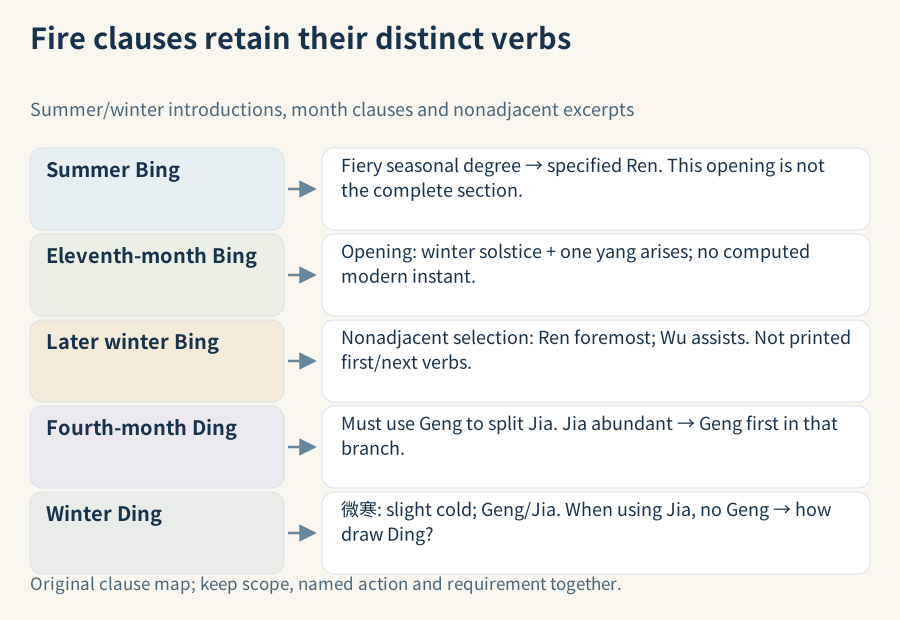
The complete figure is shown below. Select it to enlarge the labels. Open full-size figure · PNG
Check the reading without inventing an outcome
Three checks can be made directly on the words. Keep 微寒 rather than replacing it with a familiar weakness description. Keep 佐之 rather than turning it into an unprinted next-step verb. Keep 甲多 before the Geng-priority branch. Each preserves a different part of the argument.
The resulting account is faithful to a limited old text, not a test of predictive validity. No complete birth, climate measurement or outcome series is introduced. If a later reading uses the omitted branches, it must obtain and locate them rather than borrow the current short selections' confidence.
Continue through the second-collection directory. The first collection separates month labels from modern calendar inputs, while Ten Gods basics introduces relation terms. For the next stem pairs, keep asking which subject, time, action, object and qualification each particular passage supplies.
Sources and further reading
三夏丙火, scan 34, left half, printed folio unresolved. Waseda University Library classical-text database
十一月丙火, scan 39, left half, printed folio unresolved. Waseda University Library classical-text database
十一月丙火(后接取用句), scan 39, left half, printed folio unresolved. Waseda University Library classical-text database
四月丁火, scan 43, right half, printed folio unresolved. Waseda University Library classical-text database
三冬丁火, scan 47, right half, printed folio unresolved. Waseda University Library classical-text database
Separately located cover, volume titles and printed responsibilities, scan 8, printed 一. Waseda University Library classical-text database Separate positions: 1, 2, 4, 49
Waseda classical-text catalogue, Bunko19 F0111, historical-witness catalogue; ancient scan/printed page inapplicable. Waseda University Library historical-witness catalogue
Punctuation, translation, analysis and diagrams are original. General seasonal discussion, named stem/month clauses, specified relations and limited exceptions retain their separate layers. Physical Wang and catalogued Gang stay distinct; printing year unestablished. Institutional images and modern commercial commentary are excluded. Finite readings, not full original-text collation or empirical life prediction.
Evidence and source roles
These roles distinguish ancient text, older commentary, historical scholarship and tool reproduction. The numbered notes in the article retain the precise scan pages and explanations. Library and academic sources do not endorse predictive claims.
- QT2-E02-01 · Ancient text evidence: 三夏丙火
Text layer in the witness: Printed general discussion, seasonal introduction or named stem/month clause as separately specified; punctuation, translation and analysis are editorial. Handwritten margins/uncertain preceding side-character wording excluded. - QT2-E02-02 · Ancient text evidence: 十一月丙火
Text layer in the witness: Printed general discussion, seasonal introduction or named stem/month clause as separately specified; punctuation, translation and analysis are editorial. Handwritten margins/uncertain preceding side-character wording excluded. - QT2-E02-03 · Ancient text evidence: 十一月丙火(后接取用句)
Text layer in the witness: Printed general discussion, seasonal introduction or named stem/month clause as separately specified; punctuation, translation and analysis are editorial. Handwritten margins/uncertain preceding side-character wording excluded. - QT2-E02-04 · Ancient text evidence: 四月丁火
Text layer in the witness: Printed general discussion, seasonal introduction or named stem/month clause as separately specified; punctuation, translation and analysis are editorial. Handwritten margins/uncertain preceding side-character wording excluded. - QT2-E02-05 · Ancient text evidence: 三冬丁火
Text layer in the witness: Printed general discussion, seasonal introduction or named stem/month clause as separately specified; punctuation, translation and analysis are editorial. Handwritten margins/uncertain preceding side-character wording excluded. - QT2-E00-IDENTITY · Ancient text evidence: Separately located cover, volume titles and printed responsibilities
Text layer in the witness: Physical title and separately located printed responsibility fields; not one continuous quotation or an autograph/authorship judgment - QT2-E00-CATALOGUE · Historical-witness library catalogue: Waseda classical-text catalogue, Bunko19 F0111
Text layer in the catalogue: Modern institutional catalogue of a historical witness; not an original title page, printing date or commentary text