Sharing the Wood category does not give Jia and Yi identical instructions. In the selected spring passages, Jia's early-spring clause names Fire generally, while Yi's first-month clause expressly requires Bing. In the selected winter passages, Jia has an ordered Geng-to-Ding route, while Yi favors Bing for thawing and restricts Gui. The comparison works only while the actual subjects and seasonal premises remain attached.
The examples come from the Waseda witness identified in the first collection.[6,7] They compare finite spring and winter selections. The winter months are deliberately unequal: twelfth-month Jia and eleventh-month Yi. This is a comparison of stated conditions, not a matched-month experiment or a complete set of birth charts.
Begin with the early-spring Jia clause at its own scope
The seasonal paragraph 三春甲木論, scan 8 left half, printed folio 1, describes spring Wood as gradually showing growth and says that early spring still has residual cold, so Fire should provide warmth.[1] Its subject is fixed by the Jia heading. “Early spring” narrows the seasonal introduction before the response is given.
The selected clause names 火, Fire. It does not replace that word with Bing or Ding. Its 當以 expresses what should be used under the stated residual-cold premise. Keeping the generic object here is as important as retaining a specific stem where another clause prints one.
The first collection examined other branches of this spring-Jia paragraph, including repeated flourishing and late-spring thirst. This selection stops before those branches. It therefore cannot turn the early-spring warmth clause into a rule governing every point in the season. The larger paragraph supplies distinctions that the short selection has not removed.
The winter-Jia selection adds an ordered operation
In 十二月甲木, scan 19 left half, the safe continuous selection reads: 木性極寒,無發生之象。先用庚劈甲,方引丁火,始得木火有通明之象.[2] An original translation is: “Wood's nature is extremely cold, without an image of emergence. First use Geng to split Jia; only then draw in Ding Fire, beginning to obtain an image of Wood and Fire's shared clarity.”
The force of the passage lies in its sequence. 先 names the first operation, 方 connects Ding to that operation, and 始 qualifies the resulting image. A summary containing only “cold Wood needs Fire” would lose Geng, Jia as the object being worked, named Ding and the ordered connection between them.
The text's image of clarity remains an image in an old argument. It is not independently observed plant physiology or a verified life outcome. Nor does the selected sequence tell us that Geng and Ding have already appeared in a particular person's complete chart. The excerpt provides a conditional route within this month/stem section.
The preceding weather phrase is outside this article's selected quotation. That choice keeps the argument on the clearly obtained continuous words beginning 木性極寒, rather than making a wider transcription claim about the whole opening.
The spring-Yi seasonal image and first-month rule are distinct layers
Scan 20 left half first gives 三春乙木,為芝蘭蒿草之物,丙癸不可離也.[3] The paragraph compares spring Yi with the plant imagery named zhi, lan and hao, then states that Bing and Gui cannot be separated from this discussion. We retain the old image's names rather than treating it as an authenticated modern botanical classification.
This is a spring-Yi seasonal statement, not an unrestricted property of every Yi-Wood month. The following first-month section is another level of organization. Its selected words are 正月乙木,必須用丙。因天氣尤有餘寒,非丙不暖.[4] An original translation is: “First-month Yi Wood must use Bing. Because the weather still has residual cold, without Bing it does not become warm.”
Here the named Bing and the double negative 非丙不暖 are actually printed. They should not be weakened into “any Fire is equally appropriate,” but they also should not be moved into the early-spring Jia quotation as if Jia's selected clause had named Bing. Each statement keeps its own scope and precision.
The seasonal image and the numbered-month opening can be read together without being made into a single continuous quotation. Their headers tell us why both concern Yi while still differing in organizational level. The omitted following qualifications are not supplied by the image alone.
Winter Yi restricts a factor present in the spring image
The eleventh-month Yi section, scan 28 right half, reads: 十一月乙木,花木寒凍,一陽來復,喜用丙火解凍,則花木有向陽之意。不宜用癸,以凍花木.[5] An original translation is: “Eleventh-month Yi Wood: flowers and Wood are frozen, and one yang returns. It favors Bing Fire to thaw; then flowers and Wood have an inclination toward the sun. Gui should not be used, as it would freeze the flowers and Wood.”
The local context contains cold/frozen plant imagery, 一陽來復 and the named Bing response. It then restricts Gui. Copying the spring-Yi 丙癸不可離 clause into this winter position would make that local restriction disappear. “Same stem” does not justify making every seasonal statement identical.
The phrase 有向陽之意 is also qualified image language: an inclination or tendency in the author's picture. It does not report a measured effect or guarantee an event. The remaining eleventh-month discussion contains further factor and disclosure/concealment qualifications; this selected opening does not exhaust them.
Compare the entries with their differences left visible
| Selected entrance | Stated premise | Named response that remains local |
|---|---|---|
| Early-spring Jia within 三春甲木論 | Residual cold | Fire should provide warmth; no Bing/Ding supplied in this clause |
| Twelfth-month Jia | Extreme cold, no image of emergence | Geng first, only then Ding, then the stated Wood/Fire image |
| Spring-Yi seasonal paragraph | Zhi/lan/hao plant imagery | Bing and Gui cannot be separated in this local statement |
| First-month Yi | Residual cold | Must use Bing; without Bing not warm |
| Eleventh-month Yi | Frozen flowers/Wood and one yang returning | Favors Bing thawing; Gui unsuitable in this branch |
The entries are not five equivalent experimental treatments. Two are seasonal introductions, three are numbered-month clauses, and the winter months differ. These limits do not make comparison impossible; they specify what the comparison can establish. We can compare the source's subjects, premises and responses, while leaving unselected months and outcomes unresolved.
Find the missing term in a simplified explanation
Three editing tests expose different losses. Replacing Jia's selected 火 with Bing borrows a named object from another clause. Reducing twelfth-month Jia to “add Fire” deletes its first operation and named Ding. Making spring Yi's Bing/Gui pair permanent ignores the eleventh-month restriction on Gui.
Each error is identifiable from the obtained wording. No invented complete birth or numerical strength score is needed. The exercise tests the fidelity of a reading note, not whether the old judgments predict people's lives. Traditional confidence and an accurate translation remain distinct from external verification.
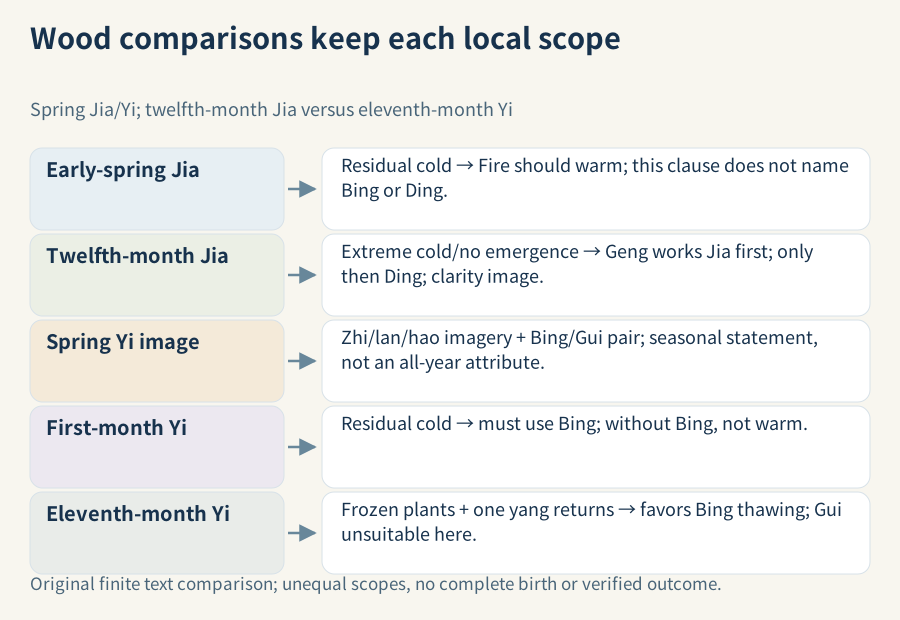
The complete figure is shown below. Select it to enlarge the labels. Open full-size figure · PNG
Carry the method into the other stem pairs
The following questions apply this comparison method to Fire, Earth, Metal and Water. They do not assume that every stem pair has the same metaphor, identical seasonal headers or a uniform set of monthly cells. The actual selected paragraph must determine the comparison's columns.
Return to the second-collection directory, or review the first collection's edition and season-reading foundations. Ten Gods basics supplies relation terminology. The resulting note should make the actual stem, selected time, textual level, named operation, qualification and omitted scope available for inspection together.
Sources and further reading
三春甲木論, scan 8, left half, printed 一. Waseda University Library classical-text database
十二月甲木, scan 19, left half, printed folio unresolved. Waseda University Library classical-text database
三春乙木, scan 20, left half, printed folio unresolved. Waseda University Library classical-text database
正月乙木, scan 20, left half, printed folio unresolved. Waseda University Library classical-text database
十一月乙木, scan 28, right half, printed folio unresolved. Waseda University Library classical-text database
Separately located cover, volume titles and printed responsibilities, scan 8, printed 一. Waseda University Library classical-text database Separate positions: 1, 2, 4, 49
Waseda classical-text catalogue, Bunko19 F0111, historical-witness catalogue; ancient scan/printed page inapplicable. Waseda University Library historical-witness catalogue
Punctuation, translation, analysis and diagrams are original. General seasonal discussion, named stem/month clauses, specified relations and limited exceptions retain their separate layers. Physical Wang and catalogued Gang stay distinct; printing year unestablished. Institutional images and modern commercial commentary are excluded. Finite readings, not full original-text collation or empirical life prediction.
Evidence and source roles
These roles distinguish ancient text, older commentary, historical scholarship and tool reproduction. The numbered notes in the article retain the precise scan pages and explanations. Library and academic sources do not endorse predictive claims.
- QT2-E01-01 · Ancient text evidence: 三春甲木論
Text layer in the witness: Printed general discussion, seasonal introduction or named stem/month clause as separately specified; punctuation, translation and analysis are editorial. Handwritten margins/uncertain preceding side-character wording excluded. - QT2-E01-02 · Ancient text evidence: 十二月甲木
Text layer in the witness: Printed general discussion, seasonal introduction or named stem/month clause as separately specified; punctuation, translation and analysis are editorial. Handwritten margins/uncertain preceding side-character wording excluded. - QT2-E01-03 · Ancient text evidence: 三春乙木
Text layer in the witness: Printed general discussion, seasonal introduction or named stem/month clause as separately specified; punctuation, translation and analysis are editorial. Handwritten margins/uncertain preceding side-character wording excluded. - QT2-E01-04 · Ancient text evidence: 正月乙木
Text layer in the witness: Printed general discussion, seasonal introduction or named stem/month clause as separately specified; punctuation, translation and analysis are editorial. Handwritten margins/uncertain preceding side-character wording excluded. - QT2-E01-05 · Ancient text evidence: 十一月乙木
Text layer in the witness: Printed general discussion, seasonal introduction or named stem/month clause as separately specified; punctuation, translation and analysis are editorial. Handwritten margins/uncertain preceding side-character wording excluded. - QT2-E00-IDENTITY · Ancient text evidence: Separately located cover, volume titles and printed responsibilities
Text layer in the witness: Physical title and separately located printed responsibility fields; not one continuous quotation or an autograph/authorship judgment - QT2-E00-CATALOGUE · Historical-witness library catalogue: Waseda classical-text catalogue, Bunko19 F0111
Text layer in the catalogue: Modern institutional catalogue of a historical witness; not an original title page, printing date or commentary text